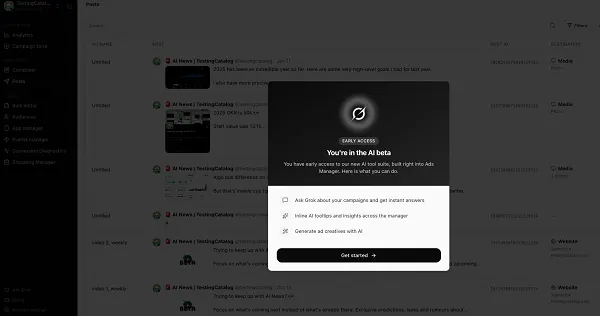

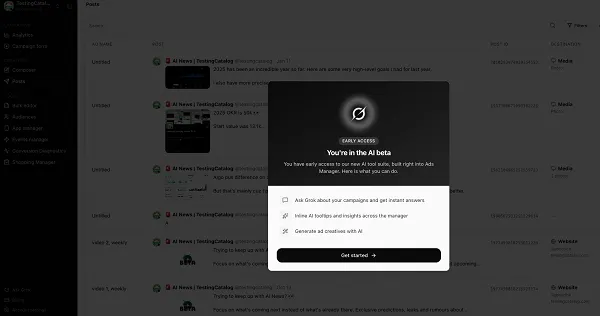
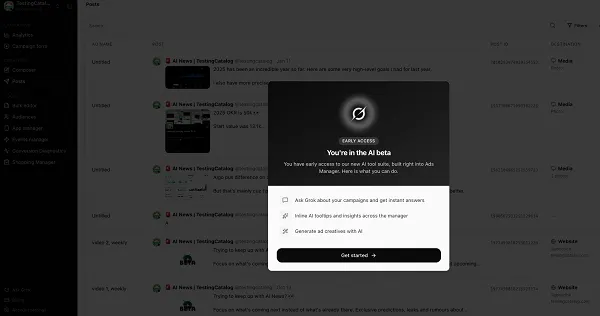
X has officially commenced beta testing for its proprietary artificial intelligence assistant, Grok, within the X Ads Manager interface, marking a significant milestone in the company’s roadmap toward an AI-centric advertising ecosystem. This integration, developed in partnership with Elon Musk’s xAI startup, aims to provide advertisers with a sophisticated, conversational interface to optimize campaign performance, generate creative assets, and refine audience targeting. The move represents a fundamental shift from traditional, manual ad configuration toward what industry experts describe as "agentic" advertising, where artificial intelligence assumes the role of both strategist and executor.
The beta rollout was first identified by digital researchers and advertisers who received notifications within their dashboard interfaces. According to early reports and screenshots shared by the testing community, the integration allows users to engage with Grok directly within the campaign creation workflow. This "always-on" assistant is designed to provide real-time guidance, answering complex questions about bid strategies, audience demographics, and creative optimization. Furthermore, the update introduces enhanced tooltips and generative AI features that suggest ad copy and visual concepts based on the specific goals of the promotion.
The Evolution of X’s Advertising Infrastructure
To understand the significance of the Grok integration, it is necessary to examine the trajectory of X’s advertising technology over the past eighteen months. Since the acquisition of the platform formerly known as Twitter, Elon Musk has prioritized a complete overhaul of the company’s legacy systems. In April 2024, X launched a rebuilt Ad Manager platform, which the company characterized as the most significant technological update in its history. This foundation was designed to move away from the rigid, keyword-based targeting of the past toward a more fluid, interest-based system powered by machine learning.
The April update focused on improving the platform’s ability to understand user intent in real-time. By analyzing the hundreds of millions of posts shared daily, X’s revamped algorithms began to better identify emerging trends and align them with advertiser needs. The company claimed that these improvements led to a measurable increase in ad relevance and delivery efficiency. The current integration of Grok serves as the secondary phase of this transformation, layering a generative and conversational interface over the existing machine learning backbone.
Strategic Vision: Toward Full Automation
The long-term objective of this integration is nothing less than the total automation of the advertising process. In statements made regarding the future of the platform, Elon Musk has outlined a vision where human intervention in ad placement becomes optional. By August 2025, Musk anticipates that Grok will be capable of managing the entire lifecycle of an advertisement—from the initial conceptualization and creative design to the final execution, budget management, and safety auditing.
This concept of agentic ad generation relies on the AI’s ability to function as an autonomous agent. Instead of an advertiser manually selecting age brackets, geographical locations, or specific interests, they might simply provide a high-level objective, such as "increase sales of sustainable footwear among urban professionals." The AI would then leverage its deep understanding of the platform’s 550 million active users to build a multi-faceted campaign, identifying the exact "personas" most likely to convert based on their historical behavior, real-time engagement, and sentiment analysis.
Data Processing and Persona Matching at Scale
The efficacy of Grok’s integration is fundamentally tied to the volume of data it can process. With over 550 million users generating billions of data points through likes, reposts, and replies, X possesses a unique dataset that captures the "global consciousness" in real-time. The xAI infrastructure, which powers Grok, utilizes these signals to perform high-fidelity persona matching.
For example, if a brand’s existing customer base exhibits a specific pattern of behavior—such as following certain financial news outlets while frequently interacting with automotive content—the AI can scan the broader X user base to find "lookalike" profiles that share these subtle, often non-obvious traits. Unlike traditional lookalike modeling, which often relies on static demographic data, Grok’s integration allows for dynamic adjustments based on how users are interacting with the platform at any given second. This capacity for real-time pivot is what X believes will give it a competitive edge over established giants like Meta and Google.
Addressing Brand Safety and Content Matching
One of the most persistent challenges for X has been the issue of brand safety—ensuring that advertisements do not appear alongside controversial or harmful content. The Grok integration is specifically designed to address this concern through automated content matching and safety checks. By utilizing natural language processing (NLP), Grok can analyze the context of the posts surrounding an ad slot with far greater nuance than previous automated filters.

The vision for Grok includes a proactive safety layer that evaluates the "vibe" or sentiment of a conversation before placing an ad. If a trending topic becomes toxic or highly polarized, the AI agent can theoretically withhold ad delivery in those specific threads in real-time, protecting the brand’s reputation without requiring manual oversight from the advertiser. This level of automated sensitivity is a core component of Musk’s pitch to bring back major advertisers who may have been wary of the platform’s content moderation policies.
Industry Implications and Competitive Context
The push toward AI-driven advertising is not unique to X, but the platform’s approach is notably aggressive. Meta has seen success with its Advantage+ suite, and Google has integrated Gemini into its Ads ecosystem to assist with creative generation. However, X is positioning Grok not just as a tool, but as a central "operating system" for the entire business.
Market analysts suggest that if X can successfully demonstrate that Grok-driven campaigns yield a higher Return on Ad Spend (ROAS) than manual campaigns, it could significantly alter the digital marketing landscape. Smaller businesses, in particular, stand to benefit from a system that eliminates the need for expensive dedicated social media managers. If a small business owner can "talk" to Grok to set up a professional-grade campaign in minutes, X could capture a larger share of the lucrative SME (Small and Medium Enterprise) market.
Chronology of X’s AI Integration
The path to the current beta test can be traced through several key milestones:
- July 2023: Formation of xAI, Musk’s artificial intelligence company, with the goal of understanding the "true nature of the universe" and supporting the X platform.
- November 2023: Initial launch of Grok for X Premium+ subscribers, establishing the chatbot as a core feature for power users.
- April 2024: Complete reconstruction of the X Ad Manager, introducing improved machine learning models for ad delivery.
- Early 2025: Internal testing of Grok-based ad tools, focusing on creative copy generation.
- Present: Launch of the beta integration in Ads Manager, allowing selected advertisers to use Grok as a strategic consultant.
Potential Challenges and the Road Ahead
Despite the technological promise, the integration of Grok into Ads Manager faces several hurdles. The first is the "hallucination" problem common to all Large Language Models (LLMs). If Grok provides inaccurate advice regarding budget allocation or misinterpreted audience data, it could lead to financial losses for advertisers. Ensuring the reliability of Grok’s data-driven insights is paramount for gaining the trust of institutional marketing firms.
Furthermore, there are ongoing questions regarding data privacy and the ethical use of user data to train the very AI that then targets those users with ads. While X maintains that its practices are compliant with relevant regulations, the deep integration of xAI’s models will likely remain a point of scrutiny for privacy advocates.
As the beta test expands, X is expected to gather feedback from its early adopters to refine Grok’s conversational capabilities. The ultimate goal remains a platform where the barrier between a business idea and a live, optimized global campaign is nothing more than a conversation with an AI. For X, this is more than just a feature update; it is a bid for survival and growth in an era where the effectiveness of digital advertising is increasingly defined by the sophistication of the underlying artificial intelligence.