
In an era defined by rapid technological evolution and shifting consumer habits, social media has firmly cemented its place as a primary pipeline for global information. A comprehensive report published by Pew Research on October 23 underscores a profound transformation in how the American public consumes current events: more than half of all adults in the United States now rely on social media platforms as a core component of their daily news diet. This data reflects a monumental shift in the media ecosystem, raising critical questions about the intersection of digital communication, democratic participation, corporate governance, and societal polarization.
The Evolution of Digital Consumption
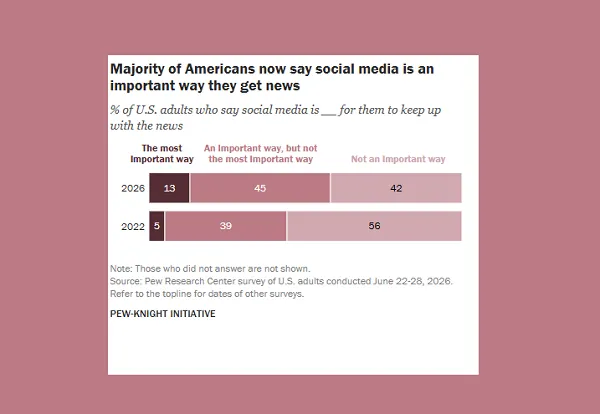
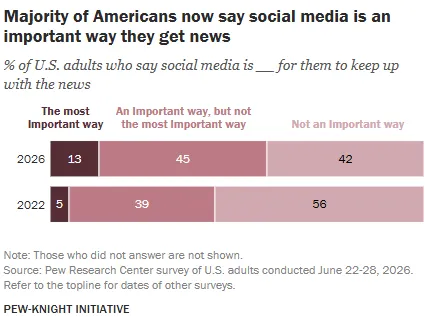
Based on a rigorous nationwide survey of more than 3,500 U.S. adults conducted in June, the Pew Research findings reveal that 58% of Americans consider social networks and digital applications to be important connectors to current events. Among that demographic, 13% view social apps as their single most vital source of information.
When mapped against the total U.S. adult population—estimated by the Annie E. Casey Foundation to be approximately 270 million—these percentages translate to roughly 35 million Americans who depend primarily on social media to keep them informed. This represents a substantial upward trajectory compared to previous years. When Pew Research administered a similar study in 2002—referring to the broader baseline tracking up to the 2022 dataset—only 43% of U.S. adults identified social media as an important news vehicle, with a mere 5% designating it as their primary news resource.
This steady migration away from traditional print, broadcast, and even standard digital news sites toward app-based ecosystems highlights a fundamental restructuring of information dissemination. Social media algorithms, built to maximize user retention and engagement, now act as the primary gatekeepers of public knowledge for tens of millions of citizens.
The Chronology of Content Governance and Ideological Clashes
The immense power wielded by social networks over public narratives has not gone unnoticed by political leaders, corporate executives, or the public. For years, the mechanisms governing content moderation have been a focal point of intense legal, political, and cultural conflict.
The debate intensified significantly in October 2022, when billionaire entrepreneur Elon Musk completed his high-profile acquisition of Twitter (subsequently rebranded as X). Musk’s stated motivation for the multi-billion-dollar purchase was rooted in deep concerns that the platform’s previous management team had exerted undue influence on democratic processes by manipulating algorithmic visibility and suppressing specific viewpoints.
As public scrutiny mounted over how digital platforms curate speech, critics began conceptualizing a phenomenon they dubbed the “censorship-industrial complex.” This term describes a loose alliance of government entities, non-governmental organizations, academic institutions, and activist groups allegedly working in concert to police online discourse, pressure tech executives, and marginalize non-mainstream opinions.
The political friction surrounding this issue reached a high-profile milestone in December, when U.S. Secretary of State Marco Rubio formally announced sweeping federal actions. The State Department revealed targeted measures aimed at combating what the administration explicitly termed the “censorship-industrial complex.” In his announcement, Rubio accused organized networks of individuals and groups of coercing American technology platforms into censoring, demonetizing, and suppressing viewpoints that ran counter to prevailing institutional narratives.
The Policy Pendulum: Meta and the Pivot Away From Fact-Checking
As governments grapple with the external pressures of content regulation, social media companies themselves have frequently altered their internal policies regarding speech and safety. No entity exemplifies this policy volatility quite as clearly as Meta, the parent company of Facebook, Instagram, and Threads.
The ideological pendulum within Meta has swung dramatically over the past several years. In 2021, Meta founder and CEO Mark Zuckerberg outlined the immense challenges platforms face when balancing open expression against the amplification of sensationalism. In a public note published that year, Zuckerberg warned about the inherent psychological drivers of human engagement, noting that users naturally gravitate toward provocative, divisive content when left to their own devices.
Zuckerberg wrote at the time: “One of the biggest issues social networks face is that, when left unchecked, people will engage disproportionately with more sensationalist and provocative content. This is not a new phenomenon. It is widespread on cable news today and has been a staple of tabloids for more than a century. At scale it can undermine the quality of public discourse and lead to polarization.”
To combat this perceived threat to societal cohesion, Meta spent years investing heavily in third-party fact-checking partnerships, community standards enforcement teams, and algorithmic down-ranking of borderline content. These measures were designed to curb the viral spread of misinformation concerning elections, public health, and social issues.
However, in January 2025, Zuckerberg executed a sharp strategic reversal. In an official corporate announcement regarding Meta’s transition away from traditional fact-checking mechanisms—titled “Meta: More Speech, Fewer Mistakes”—Zuckerberg articulated a renewed philosophical commitment to maximum expression. He argued that the company held a fundamental obligation to facilitate broader public discussion, even on deeply controversial or contentious topics.
Consequently, Meta relaxed a series of strict content moderation rules that had previously restricted discussions surrounding polarizing subjects such as immigration, gender identity, and socio-political disputes.
Implications for Public Discourse and Democratic Integrity
This sudden pivot by one of the world’s most influential technology leaders has triggered profound debate among sociologists, political scientists, and industry analysts. Critics point out an inherent contradiction: by Zuckerberg’s own previous logic, relaxing content restrictions and empowering algorithms that reward engagement will inevitably accelerate societal polarization and amplify misinformation.
The core dilemma facing modern democracies lies in balancing two competing imperatives. On one hand, maintaining an open, unrestricted digital public square is essential for protecting free speech, preventing corporate overreach, and ensuring diverse perspectives can be heard without institutional interference. On the other hand, the unfettered amplification of unverified claims, sensationalized narratives, and coordinated disinformation campaigns poses a direct threat to factual consensus and institutional trust.
As social media continues to entrench itself as the primary news source for more than half of the American public, the rules governing these digital spaces carry monumental weight. Without robust consensus on content governance—and with major tech platforms oscillating between heavy moderation and hands-off laissez-faire policies—the responsibility increasingly falls upon individual consumers to navigate an increasingly complex, fragmented, and polarized information landscape.