
The professional networking landscape has undergone a significant transformation in 2026, as new data from social media management platform Buffer reveals a major shift in how users interact with LinkedIn content. Following an extensive analysis of 4.8 million posts, the study, led by resident data scientist Julian Winternheimer, indicates that the traditional "working hours" dominance of the platform is fading. For the first time in recent years, the highest levels of engagement are now occurring in the late afternoon and evening, suggesting that professionals are increasingly consuming industry news and networking content after their primary workday has concluded.
The 2026 Engagement Shift: From Desk to After-Hours
In 2025, LinkedIn engagement was largely defined by a strict adherence to the 9-to-5 corporate schedule. Content shared during standard business hours saw peak activity, while engagement metrics plummeted sharply after 5:00 p.m. However, the 2026 data illustrates a behavioral migration that mirrors trends previously seen on entertainment-heavy platforms like Instagram and TikTok.
The current data shows that peak engagement windows have shifted toward the late afternoon and evening, specifically between 3:00 p.m. and 8:00 p.m. on weekdays. This trend indicates that while the platform remains the primary hub for professional content, the "professional" is no longer strictly tethered to their desk while consuming it. Whether during commutes, evening relaxation, or "second-screen" browsing, the LinkedIn audience has become an after-hours community.
Chronology of Platform Behavior: 2024 to 2026
To understand the 2026 results, it is necessary to look at the evolution of the platform over the last three years. In 2024, LinkedIn was still stabilizing after the global shift toward hybrid work. During that period, mid-morning windows (10:00 a.m. to 11:00 a.m.) were considered the "golden hours" for reach.
By 2025, the data showed a slight widening of these windows, with lunch breaks and early afternoons becoming high-traffic zones. However, the professional-personal boundary remained relatively intact; users rarely checked LinkedIn once the workday ended.
The 2026 findings represent a total pivot. The "workday dip" has become more pronounced, with mornings (6:00 a.m. to 11:00 a.m.) showing significantly lower engagement than in previous years. The rise of mobile-first consumption and the integration of professional development into personal time have essentially extended the platform’s "prime time" into the night.
Detailed Data Analysis: The Best Times to Post by Day
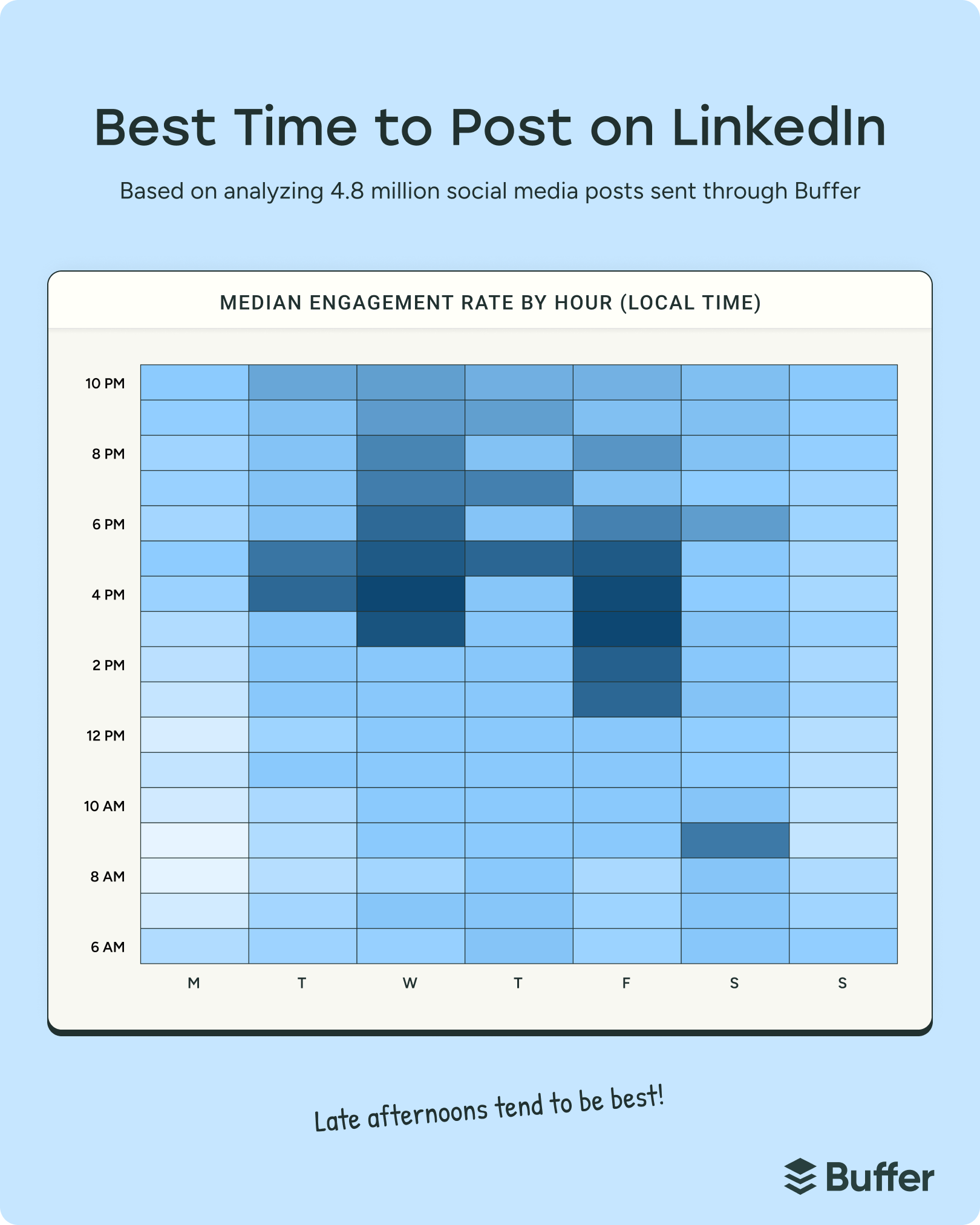
The Buffer study provides a granular breakdown of the 2026 engagement heatmap. To ensure accuracy across global markets, the data was normalized by local time zones, meaning a recommendation of 4:00 p.m. applies to the specific time zone of the target audience.
Mid-Week Dominance: Wednesday and Thursday
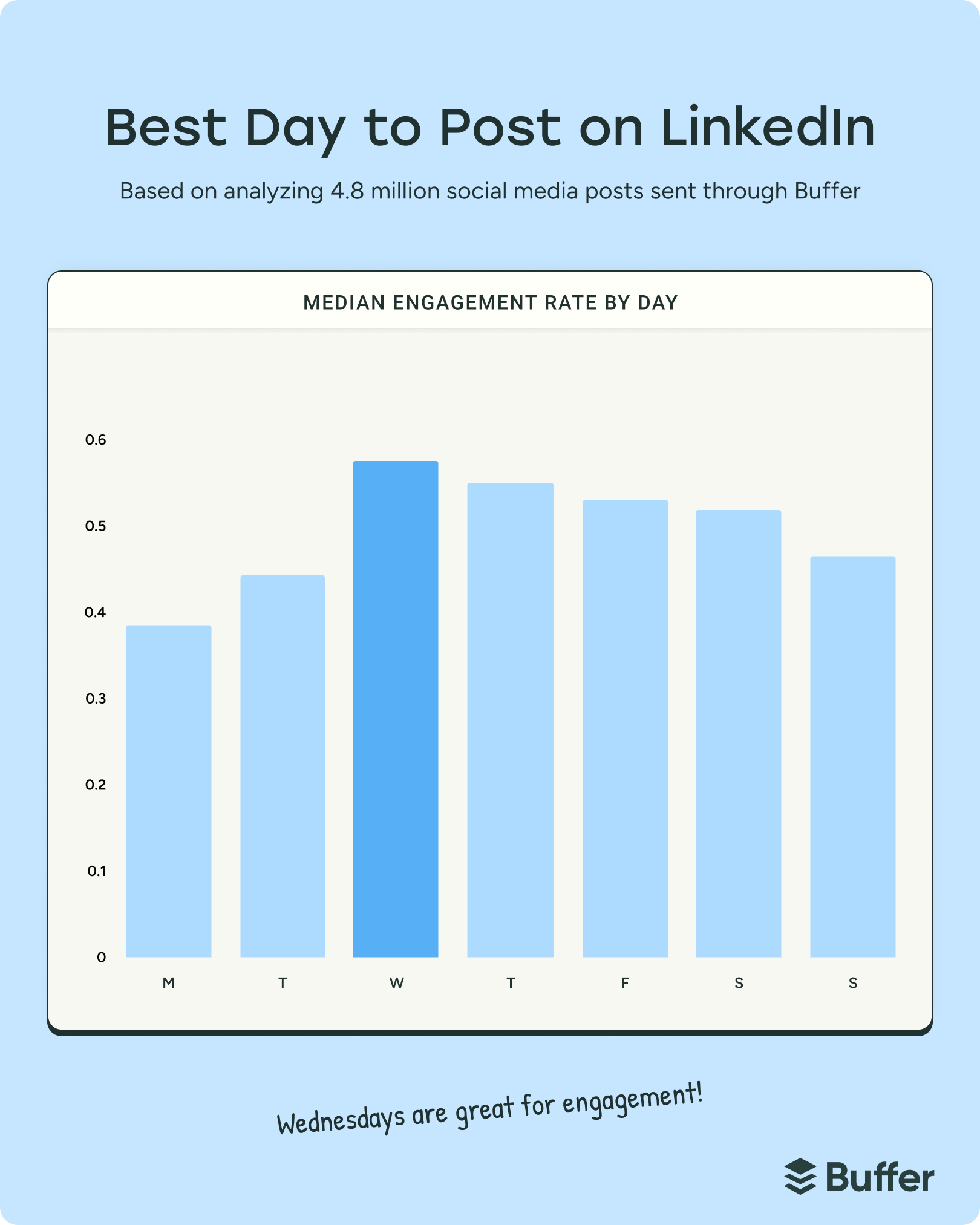
Wednesday has emerged as the strongest day for engagement on LinkedIn in 2026. The peak window occurs at 4:00 p.m., with high activity sustained between 3:00 p.m. and 5:00 p.m. Thursday follows closely, with 5:00 p.m. being the optimal time, though engagement remains robust as late as 9:00 p.m.
The Early Week Lag
Monday and Tuesday continue to show the lowest engagement rates of the workweek. On Monday, the highest engagement does not occur until 10:00 p.m., as professionals likely spend their daylight hours managing emails and attending meetings, only turning to social networking once their primary tasks are cleared. Tuesday follows a similar pattern, with a peak at 4:00 p.m., but overall volume remains lower than the mid-week surge.
The Friday Wind-Down
Friday presents a unique opportunity for creators. Engagement peaks early in the afternoon at 3:00 p.m., as the workforce begins to wind down for the weekend. High engagement continues through 5:00 p.m., making it one of the most consistent days for content distribution.
Weekend Anomalies
While weekends generally see lower traffic, they are not devoid of opportunity. Saturday sees a small spike at 9:00 a.m., catering to the "early riser" professional demographic. Sunday engagement is almost entirely concentrated in the late evening, specifically at 10:00 p.m., as users prepare for the upcoming workweek—a phenomenon often referred to by sociologists as the "Sunday Scaries" leading to proactive professional browsing.
Supporting Data: Frequency and Format Metrics
Timing is only one variable in the 2026 LinkedIn algorithm. The Buffer report also cross-referenced engagement times with content formats and posting frequency to provide a comprehensive view of what drives reach.
The Power of Document Posts
According to the research, format choice significantly outweighs timing in certain scenarios. Carousel posts (uploaded as PDFs or documents) generate up to 596% more engagement than text-only posts. When these high-value formats are paired with the new 4:00 p.m. to 6:00 p.m. peak windows, the resulting reach is maximized.
Optimal Posting Frequency
The study analyzed over 2 million posts to determine the "sweet spot" for frequency. The findings suggest:
- 2 to 5 posts per week: This is the baseline for growth, yielding approximately 1,182 more impressions per post than those who post once weekly.
- 11+ posts per week: For brands and power users, this high-frequency strategy results in a dramatic lift of nearly 17,000 more impressions per post.
The LinkedIn Algorithm: Why Engagement Dictates Reach
The shift toward evening posting is largely a response to how the LinkedIn algorithm prioritizes content. LinkedIn uses "signals"—reactions, comments, and reposts—to determine the value of a post. When a post receives immediate engagement, the algorithm identifies it as relevant and surfaces it to a wider audience.
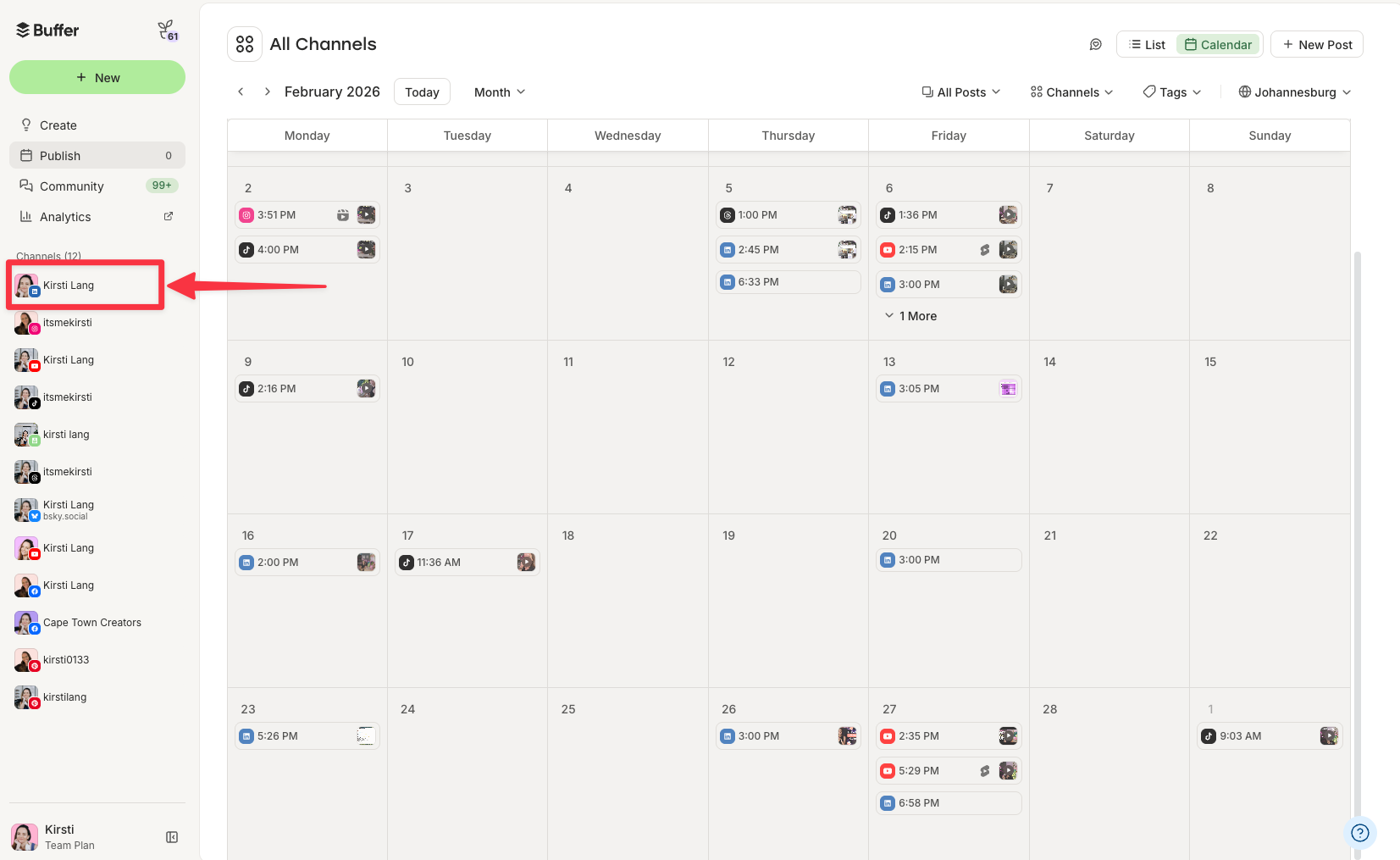
By posting during the newly identified late-afternoon and evening windows, creators are hitting the platform at the exact moment the largest volume of users is active and ready to interact. This creates a "snowball effect": high initial engagement leads to greater algorithmic distribution, which in turn leads to even higher engagement numbers.
Industry Reactions and Expert Analysis
Digital marketing analysts suggest that this shift in timing is indicative of a broader cultural change in how professional identities are maintained. "We are seeing the ‘socialization’ of LinkedIn," says one industry observer. "It is no longer just a place to look for a job or post a press release. It has become a feed for professional storytelling, and storytelling is something people consume when they have the mental space—usually after their core work tasks are finished."
Furthermore, the "Normalization of Time Zones" mentioned in the Buffer data suggests that global remote work has forced social media managers to become more localized in their strategies. Brands can no longer rely on a single global "blast" time; they must schedule content to hit the 4:00 p.m. to 7:00 p.m. window in each specific region they serve.
Strategic Implications for Brands and Personal Brands
For social media managers and individual creators, the 2026 data necessitates a revision of existing content calendars. The "safe" bet of posting at 9:00 a.m. on a Tuesday is no longer supported by the numbers.
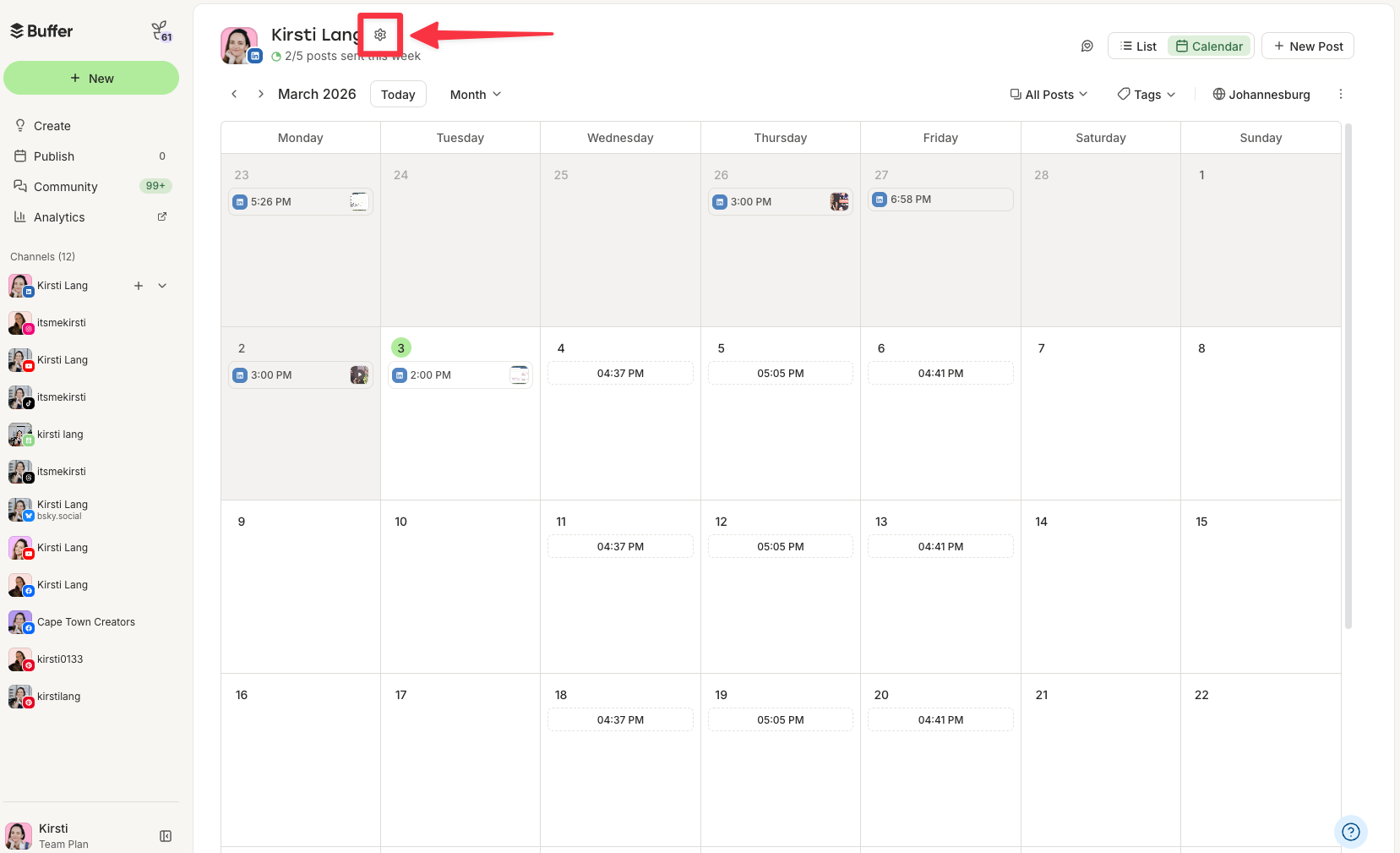
Recommendations for Strategy Adjustment:
- Pivot to the Afternoon: Move high-priority announcements and thought-leadership pieces to the 3:00 p.m.–5:00 p.m. window, particularly on Wednesdays and Fridays.
- Experiment with Late-Night Content: For audiences in the tech or creative sectors, testing 9:00 p.m. or 10:00 p.m. slots on Mondays and Thursdays could capture an underserved, highly active segment of "night owl" professionals.
- Prioritize Interaction over Reach: Since engagement is the primary driver of the algorithm, creators should post at times when they themselves can be online to respond to comments, further boosting the post’s visibility.
Conclusion: The Future of Professional Networking
As we progress through 2026, the data confirms that LinkedIn has successfully transitioned from a utility-based job board to a high-engagement social network. The shift in peak times to the evening hours suggests a more integrated approach to professional life, where learning and networking are part of a user’s daily digital routine rather than a task performed strictly during office hours.
While these findings provide a robust benchmark based on millions of data points, experts remind users that individual audience behavior may vary. The 2026 report serves as a foundational guide, but the most successful users will be those who combine these data-driven insights with their own analytics to find the precise moment their specific community is ready to engage.