Tag: trends

  • The Evolution of TikTok Soundscapes: Analyzing the Viral Trends and Algorithmic Drivers of April 2026.

    The Evolution of TikTok Soundscapes: Analyzing the Viral Trends and Algorithmic Drivers of April 2026.

    As digital consumption patterns continue to be dictated by short-form video dynamics, the role of auditory cues has transitioned from a mere background element to a primary driver of content discoverability. In April 2026, the TikTok ecosystem has seen a significant shift toward ambient, nostalgic, and cinematically dramatic audio tracks, reflecting a broader consumer preference for atmospheric storytelling over traditional high-energy choreography. This shift is not merely a matter of aesthetic preference but is deeply rooted in the platform’s 2026 algorithmic updates, which prioritize "audio-visual cohesion" and "re-watchability metrics" above simple view counts. For brands and creators, understanding the specific mechanics of these trending sounds is essential for navigating the increasingly competitive "For You Page" (FYP) landscape.

    The Algorithmic Significance of Audio in 2026

    The TikTok algorithm in 2026 operates on a sophisticated "familiarity-repeatability" index. When a user interacts with a specific sound—either by lingering on a video or engaging with the audio’s source page—the algorithm categorizes the user’s current "mood state." If a user watches a video featuring an ambient track like "Snowfall (Slowed)" to completion, the system is programmed to serve similar auditory experiences within the next three to five content slots. This creates a "trend cluster," where being an early adopter of a rising sound can result in a 35 to 50 percent increase in organic reach compared to using stagnant or non-trending audio.

    Furthermore, the platform has integrated advanced audio-matching technology that identifies the "vibe" of a video. In 2026, the algorithm can distinguish between a "humorous" use of classical music and a "sincere" use of the same track, rewarding creators who align their visual pacing with the rhythmic and emotional beats of the audio. This technical evolution has made the selection of trending sounds a strategic necessity for any entity seeking to maintain digital relevance.

    Chronology of the April 2026 Soundscape

    The current month’s trends are defined by three distinct movements: the "Classical Irony" revival, the "Ambient Wave" spearheaded by electronic producers, and the "20-Year Nostalgia Cycle."

    13 Trending Songs on TikTok in April 2026 (+ How to Use Them)

    Early in the month, classical compositions began reappearing in humorous contexts, creating a juxtaposition between high-culture audio and low-brow or "chaotic" visual content. By mid-April, the trend shifted toward introspective, atmospheric tracks as users responded to a global "digital detox" movement, preferring quieter, more reflective content. Simultaneously, the 20th anniversary of mid-2000s pop culture icons triggered a massive resurgence in nostalgic soundtracks, specifically those tied to millennial and early Gen Z childhood milestones.

    Analysis of the Top 13 Trending Sounds

    The following tracks have been identified by TikTok’s Creative Center as the most influential sounds of April 2026, categorized by their functional use and audience impact.

    1. Classic Classical Gymnopedie Solo Piano (1034554)

    Erik Satie’s "Gymnopédie No. 1" has seen a 200 percent increase in usage this month. While traditionally associated with tranquility, its 2026 iteration is primarily used for the "Exhale and Scream" challenge. This trend involves creators performing mundane tasks in a calm, aesthetic manner, only to break the silence with a silent or muffled scream, highlighting the contrast between perceived social media perfection and internal stress.

    2. Gucci by MAF Teeski

    Despite its aggressive rhythmic structure, this track has been repurposed for "Wholesome Bait-and-Switch" narratives. The "I wanna be a mommy/baby when I grow up" trend utilizes childhood photography followed by a quick transition to modern-day relationship milestones. Analysts suggest this trend resonates because it humanizes hip-hop tracks by placing them in domestic, relatable contexts.

    3. Snowfall (Slowed) by dunsky

    This track represents the pinnacle of the "Ambient Wave." With over 900 million streams on external platforms like Spotify, its presence on TikTok in April 2026 is almost ubiquitous. It is used as a low-decibel backdrop for "Real Talk" videos and "Morning Routine" vlogs. Its success is attributed to its "non-intrusive" nature, allowing the creator’s voiceover to remain the focal point while providing a professional-grade emotional texture.

    13 Trending Songs on TikTok in April 2026 (+ How to Use Them)

    4. A Dream by Flatsound

    Used primarily in "Photo Dump" carousels, this track taps into the "Late Night Journal" aesthetic. Data indicates that videos using this sound have a higher "Save" rate, as users often revisit the content for its meditative quality.

    5. Voices by Øneheart

    A collaboration involving the co-creator of "Snowfall," this track has become the anthem for "What Could Have Been" travel montages. It is frequently used by tourism boards and travel influencers to evoke a sense of longing and "Saudade."

    6. Monkeyshine NO PERC-JP by Lt FitzGibbons Men

    This serves as the month’s primary "Uh-Oh" audio. Its whimsical, slightly discordant melody signals impending social or physical failure. It is a staple in the "Jestermaxxing" subculture, where creators document intentional or accidental absurdity.

    7. Kitchen Flowers by Them & I

    An intimate, guitar-heavy track, "Kitchen Flowers" is the leading choice for "Grief and Processing" content. The track has sparked a trend where users share personal stories of loss or recovery, emphasizing the platform’s role as a space for community support in 2026.

    8. Realization by Futureville

    This track is utilized for profound "Epiphany" content. Whether discussing relationship breakthroughs or philosophical realizations, the intense choral build-up provides a cinematic gravity that encourages viewers to stop scrolling and engage with the text-heavy overlays.

    13 Trending Songs on TikTok in April 2026 (+ How to Use Them)

    9. The Best of Both Worlds (Hannah Montana)

    The "20-Year Nostalgia Cycle" is currently centered on the 2006 debut of Hannah Montana. Following a 2026 reunion special featuring Miley Cyrus, this track has seen a massive spike in usage among creators aged 25–35, who are recreating 2000s-era fashion and lifestyle trends.

    10. Birthday Girl by Hunxho

    In the commercial sector, this track is the dominant sound for "Product Launches" and "Celebratory Reveals." Its high-energy beat and literal lyrics make it an ideal choice for high-production-value "unboxing" videos and event recaps.

    11. I’m Not Them by Them & I

    Similar to "Kitchen Flowers," this track focuses on individual identity. It is frequently paired with "Unpopular Opinion" text overlays, where creators distinguish their lifestyle choices from societal expectations.

    12. 500 Miles by Peter, Paul & Mary

    This 1960s classic has been revitalized by the "Digital Nomad" community. The lyric "Lord, I’m 500 miles from my home" is used to showcase the distance between creators and their birthplaces, often highlighting the isolation or freedom of global travel.

    13. The End by LLow

    Functioning as a "Cinematic Punchline," this track is used for minor inconveniences portrayed as apocalyptic events. The dramatic choral opening followed by a sudden beat drop provides a perfect structure for comedic timing.

    13 Trending Songs on TikTok in April 2026 (+ How to Use Them)

    Commercial Implications and Compliance

    For business entities operating in 2026, the distinction between the "General Music Library" and the "Commercial Music Library" (CML) remains a critical legal boundary. TikTok’s official stance, reiterated in their Q1 2026 policy update, warns that branded content using non-commercial tracks is subject to immediate demonetization and muting.

    Marketing analysts suggest that brands should focus on "Ambient" and "Classical" tracks, such as "Snowfall" or "Gymnopédie," which are frequently cleared for business use. These tracks allow for "soft-sell" marketing, where the product is integrated into an aesthetic lifestyle rather than being the subject of a traditional advertisement.

    Broader Impact and Future Outlook

    The trends of April 2026 suggest a maturing audience that values emotional resonance over viral "challenges." The dominance of ambient and introspective audio indicates that TikTok is increasingly being used as a tool for "mood regulation" rather than just entertainment.

    As we move into the second half of 2026, industry experts predict that the "Audio-First" strategy will evolve further with the integration of AI-generated custom soundtracks that adapt in real-time to a user’s scrolling speed. For now, the 13 sounds identified this month provide the most reliable roadmap for creators looking to capture the attention of an increasingly sophisticated global audience. Staying aligned with these auditory shifts is no longer optional; it is the fundamental language of digital influence in the mid-2020s.

  • The State of Marketing Automation in 2024 and Beyond Industry Growth Adoption Trends and Strategic Impact

    The State of Marketing Automation in 2024 and Beyond Industry Growth Adoption Trends and Strategic Impact

    The marketing technology landscape is undergoing a profound transformation as businesses increasingly pivot toward automated solutions to manage the complexity of the modern digital ecosystem. Marketing automation, once a specialized tool for enterprise-level corporations, has evolved into a foundational component of the marketing tech stack for organizations of all sizes. By leveraging software to automate repetitive tasks—ranging from email sequencing and social media scheduling to complex lead scoring and multi-channel campaign management—companies are realizing significant gains in operational efficiency and customer engagement. As of 2024, the industry is positioned at a critical juncture where artificial intelligence and machine learning are merging with traditional automation frameworks to redefine how brands interact with their audiences.

    Market Revenue and Industry Growth Projections

    The economic footprint of the marketing automation industry reflects its growing necessity within the global business framework. Market analysts and industry data indicate a consistent upward trajectory in worldwide revenue, signaling that investment in these technologies is not merely a trend but a long-term strategic shift. In 2021, the global marketing automation market was valued at approximately $4.79 billion. By 2022, this figure grew to $5.19 billion, followed by a jump to $5.86 billion in 2023.

    15 Key Marketing Automation Statistics

    Current projections for 2024 estimate the market size at $6.62 billion, representing a robust year-over-year growth rate. This momentum is expected to accelerate as businesses seek to integrate disparate data sources into unified platforms. By 2026, spending is anticipated to reach $8.44 billion, eventually crossing the $10 billion threshold by 2028. Long-term forecasts are even more aggressive, with the market expected to hit $17.2 billion by 2031 and reach a staggering $21.7 billion by 2032. This nearly five-fold increase from 2021 levels underscores the total digital transformation of the marketing sector, driven by the need for hyper-personalization at scale.

    Evolution of Marketing Automation: A Brief Chronology

    The journey to the current $6.6 billion market has been marked by several distinct eras of technological advancement. Understanding this timeline provides essential context for the current statistics:

    • The Early Era (1990s – Early 2000s): The inception of the industry was characterized by basic email marketing tools and the birth of CRM (Customer Relationship Management) systems. These tools were primarily reactive and required significant manual oversight.
    • The Integration Era (2010 – 2018): Platforms like HubSpot, Marketo, and Pardot began to consolidate features, allowing marketers to link social media, landing pages, and email into a single workflow. This era saw the rise of inbound marketing as a dominant strategy.
    • The Intelligence Era (2019 – Present): The current phase is defined by the integration of Artificial Intelligence (AI). Modern platforms no longer just follow "if-then" rules; they use predictive analytics to determine the best time to send a message, the most effective subject lines, and the likelihood of a lead to convert.

    Shifting Budgets and Marketer Sentiment

    The financial commitment of marketing departments serves as a primary indicator of the technology’s perceived value. Data regarding budget allocations for 2024 reveals a strong consensus: marketing automation is a high-priority investment. Approximately 68% of marketers report that they are increasing their automation budgets. Specifically, 14% of respondents plan to increase spending significantly, while 54% anticipate moderate increases.

    15 Key Marketing Automation Statistics

    Conversely, only 11% of marketers expect to decrease their spending, with a mere 2% planning significant cuts. About 21% intend to keep their budgets stable. This widespread willingness to allocate more capital toward automation suggests that the Return on Investment (ROI) of these platforms has been proven across various sectors, even in a fluctuating global economy. Industry experts suggest that as labor costs rise, companies are looking to automation to maintain output without proportionally increasing their headcount.

    Current Adoption Rates and Channel Usage

    While the term "marketing automation" covers a broad spectrum of activities, adoption is not uniform across all channels. Email marketing remains the most dominant application, with 58% of marketers utilizing automation for their email campaigns. This is followed closely by social media management at 49%, where tools are used to schedule posts and monitor engagement across multiple platforms simultaneously.

    Other significant areas of adoption include:

    15 Key Marketing Automation Statistics
    • Content Management: 33%
    • Paid Advertisements: 32%
    • SMS Marketing: 30%
    • Campaign Tracking: 28%
    • Landing Pages: 27%

    Interestingly, there is a gap between current usage and planned adoption. For instance, while only 32% currently automate their paid ads, 29% of marketers plan to implement automation in this area in the near future. Similarly, social media management is a top priority for upcoming automation projects (29%). These figures indicate that while email is the "mature" segment of the market, the next wave of growth will come from paid media and mobile-first channels like SMS and push notifications.

    Strategic Goals and the Quest for Data Quality

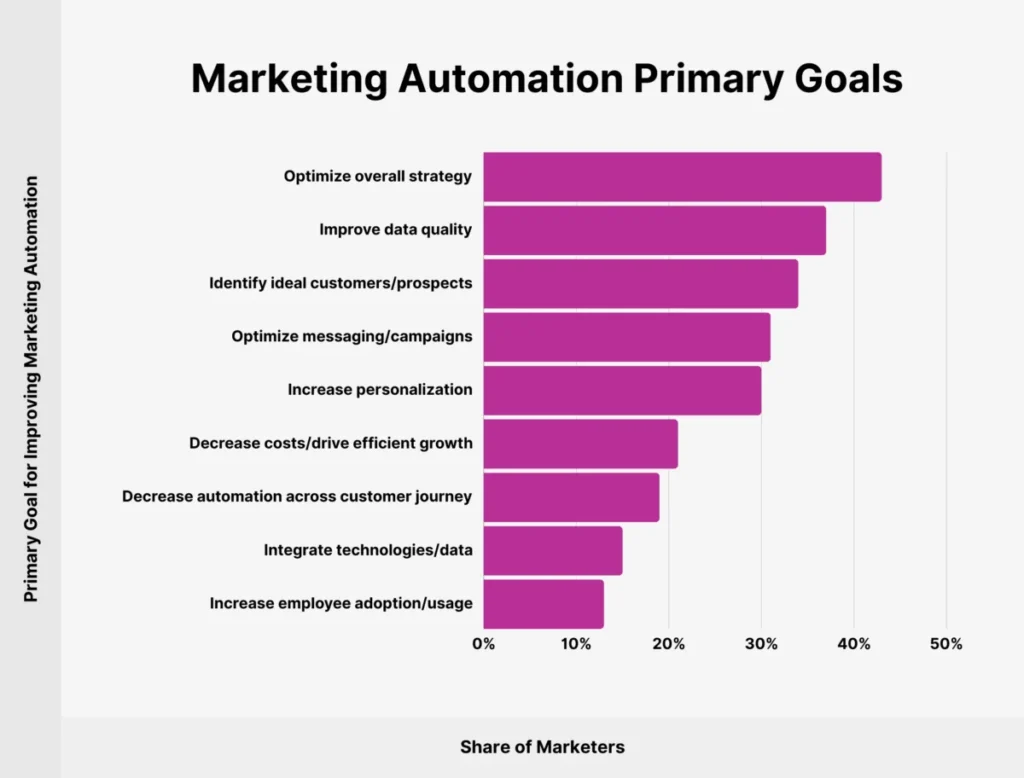
    The primary motivation for implementing marketing automation has shifted from simple "time-saving" to more complex strategic objectives. According to recent surveys, the top goal for improving marketing automation is to optimize the overall marketing strategy, cited by 43% of professionals. This suggests that marketers are no longer looking for siloed tools but for platforms that can inform their broader business decisions.

    The second most common goal is improving data quality (37%). In an era of strict privacy regulations like GDPR and CCPA, and the phasing out of third-party cookies, having high-quality, first-party data is essential. Automation platforms serve as the "source of truth" for customer interactions, helping to clean and organize data that would otherwise be fragmented. Other key goals include:

    15 Key Marketing Automation Statistics
    • Identifying Ideal Customers/Prospects: 34%
    • Optimizing Messaging/Campaigns: 31%
    • Increasing Personalization: 30%
    • Driving Efficient Growth/Decreasing Costs: 21%

    The Customer Journey and Automation Depth

    A critical metric for the success of these platforms is how effectively they manage the customer journey. However, the data reveals that "full automation" is still a rarity. Only 9% of marketers describe their customer journey as "fully automated." The vast majority (59%) report being "partially automated," while 32% are "mostly automated."

    Despite the lack of total automation, there is high satisfaction with the capabilities of modern platforms. 89% of marketers agree (30% strongly, 59% somewhat) that their marketing automation platform makes it easy to build effective customer journeys. The bottleneck appears not to be the software itself, but rather the complexity of designing multi-channel strategies that feel seamless to the end user. Only 5% of organizations have fully automated their multi-channel marketing strategies, while 22% have not automated them at all, highlighting a significant opportunity for growth in the mid-market and enterprise segments.

    Procurement Drivers: What Influences the Purchase Decision?

    When organizations enter the market for a new automation solution, their priorities are clear and pragmatic. Price remains the leading factor, influencing 58% of purchase decisions. However, "Ease of Use" is a very close second at 54%. This reflects a common pain point in the industry: sophisticated software is useless if the marketing team cannot navigate it without constant help from IT.

    15 Key Marketing Automation Statistics

    Other influential factors include:

    • Customer Service: 27%
    • Customization Options: 24%
    • Integration Capabilities: 22%
    • Breadth and Depth of Features: 21% and 19% respectively
    • Data Visualization and Analytics: 13%

    The emphasis on ease of use and customer service suggests that "human" factors remain vital in the software-as-a-service (SaaS) industry. Companies are looking for partners, not just vendors, to help them navigate the complexities of implementation and onboarding.

    Quantifiable Benefits and Business Impact

    The benefits of marketing automation extend beyond the marketing department and impact the entire organization’s bottom line. The most cited advantage is the improvement of the customer experience (43%). By delivering the right message at the right time, automation reduces friction in the buying process and fosters brand loyalty.

    15 Key Marketing Automation Statistics

    Efficiency gains are also a major driver, with 38% of marketers stating that automation enables better use of staff time. By removing manual data entry and repetitive tasks, employees can focus on high-level creative and strategic work. Furthermore, 35% of respondents noted that automation leads to better data and decision-making, while 34% saw improvements in lead generation and nurturing. From a fiscal perspective, 33% of marketers believe automation allows for better use of the overall marketing budget by identifying and doubling down on the most effective channels.

    Broader Implications and Future Outlook

    The data presented paints a picture of an industry that is both maturing and expanding. As marketing automation moves toward the $21 billion mark over the next decade, several key implications emerge. First, the divide between "automated" and "manual" businesses will likely widen, with the former enjoying a significant competitive advantage in terms of speed-to-market and personalization.

    Second, the role of the marketer is evolving. The demand for "MarTech" specialists who can bridge the gap between creative strategy and technical execution is at an all-time high. Finally, the integration of AI will likely solve the current "partial automation" dilemma, allowing for more dynamic, self-optimizing customer journeys that require less manual configuration.

    15 Key Marketing Automation Statistics

    In conclusion, marketing automation has moved past the early adoption phase and is now a critical engine for business growth. With nearly 70% of marketers increasing their budgets and a clear roadmap toward multi-billion dollar revenues, the industry is set to remain a cornerstone of the global digital economy. Organizations that successfully navigate the challenges of data quality and ease of use will be best positioned to capitalize on these technological advancements, ultimately delivering a superior experience to their customers.

Grafex Media
Privacy Overview

This website uses cookies so that we can provide you with the best user experience possible. Cookie information is stored in your browser and performs functions such as recognising you when you return to our website and helping our team to understand which sections of the website you find most interesting and useful.