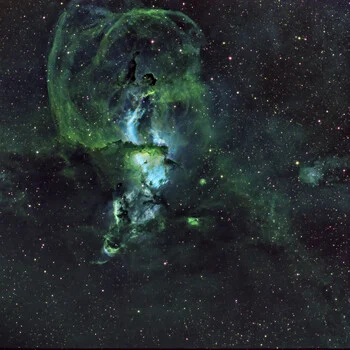

The selection of a photograph for NASA’s Astronomy Picture of the Day (APOD) remains one of the highest honors in the global imaging community, and on July 20, 2026, that distinction was awarded to astrophotographer Logan Carpenter for his striking depiction of NGC 3576. Known colloquially as the Statue of Liberty Nebula, this luminous emission complex is situated approximately 9,000 light-years from Earth within the constellation Carina. The image, which has since been circulated to a global audience of millions, serves as both a masterpiece of technical execution and a profound scientific document, illustrating the chaotic yet creative forces at work in a massive stellar nursery.
The subject of the feature, NGC 3576, is far more than a visual curiosity; it is a region of intense star formation located in the Sagittarius arm of the Milky Way galaxy. NASA’s APOD curators noted that the nebula’s intricate structures—composed of glowing gas and dark, obscuring dust—reside within a larger complex known as RCW 57. While the "Statue of Liberty" moniker is the most widely recognized, the nebula’s complex morphology often leads viewers to see various figures, ranging from a soaring superhero to a mournful celestial angel. This latest image utilizes a remapped color palette to emphasize the fine details of the nebula’s internal environment, showcasing the dramatic interplay between the radiation of newborn stars and the cold, dense material from which they emerge.
The Scientific Profile of NGC 3576: A Cradle of Stars and Life
While the aesthetic appeal of the Statue of Liberty Nebula is undeniable, its scientific importance is rooted in the complex chemistry and physics occurring within its borders. According to NASA’s analysis, NGC 3576—which is also cataloged under the designations NGC 3582 and NGC 3584—is a hotbed of stellar activity. Detailed spectroscopic studies have identified at least 33 massive stars in the final stages of their formation. These stars are massive, energetic, and short-lived, emitting intense ultraviolet radiation that ionizes the surrounding hydrogen gas, causing it to glow with the characteristic red hue often seen in emission nebulae.
Perhaps the most significant scientific discovery within NGC 3576 is the confirmed presence of polycyclic aromatic hydrocarbons (PAHs). These are complex, carbon-based molecules that researchers believe form in the cooling gas of stellar nurseries. The detection of PAHs is of paramount interest to astrobiologists and cosmologists alike. It is theorized that similar molecules were present in the nebula that birthed our own Sun approximately five billion years ago. The existence of these organic compounds in regions like NGC 3576 suggests that the precursors for life are a standard byproduct of the star-formation process throughout the universe. Consequently, looking at Carpenter’s image is not merely an exercise in observing a distant object; it is a look back into the chemical origins of our own solar system.
A Chronology of Discovery and Nomenclature
The history of NGC 3576 spans nearly two centuries of astronomical progress. The nebula was first recorded by the pioneering British astronomer John Frederick William Herschel on March 16, 1834. Observing from the Cape of Good Hope in South Africa, Herschel utilized a 18.3-inch metallic mirror telescope to map the southern skies. At the time, the resolution of telescopes was insufficient to reveal the "torch" or the "statue" shape, and the object was documented primarily as a bright patch of nebulosity.
The modern nickname, the "Statue of Liberty Nebula," is a relatively recent addition to the astronomical lexicon. It was first proposed by Dr. Steve Mazlin of the Star Shadows Remote Observatory (SSRO). The SSRO, a group dedicated to high-quality remote imaging, sought to provide more relatable names for deep-sky objects to foster public interest in astronomy. The name specifically refers to a torch-like pillar of gas near the center of the nebula that bears a striking resemblance to the monument in New York Harbor.
Over the decades, as imaging technology transitioned from photographic plates to digital CCD and CMOS sensors, the "sculpted" nature of the nebula became clearer. The dark, sinuous shapes visible in the image are known as Bok globules. These are dense, opaque clouds of gas and dust that are undergoing gravitational collapse. As nearby massive stars emit powerful stellar winds and radiation, they erode the edges of these globules, creating the dramatic, frayed structures seen in Carpenter’s photograph.
The Technical Artistry of Logan Carpenter
The path to an APOD feature is rarely a matter of luck; it is the result of meticulous planning and advanced post-processing. Logan Carpenter, an established name in the astrophotography community, has long been recognized for his ability to capture faint deep-sky objects with exceptional clarity. In a 2023 interview with ZWO, a leading manufacturer of astronomy cameras, Carpenter detailed the "gear-and-processing grind" required to produce images of this caliber.
Because NGC 3576 is a southern-hemisphere object, it presents a unique set of challenges for photographers. It is best captured using narrowband filters, a technique that isolates specific wavelengths of light emitted by ionized gases. Carpenter’s featured image utilizes a "re-assigned color" or "false color" scheme, often referred to in the community as the Hubble Palette. In this process:
- Hydrogen-alpha (H-alpha): Typically red, is mapped to the green channel.
- Oxygen III (OIII): Typically blue-green, is mapped to the blue channel.
- Sulfur II (SII): Typically deep red, is mapped to the red channel.
This method is not a "filter gimmick" but a vital scientific tool. By remapping these colors, astrophotographers can reveal the distribution of different elements within the nebula that would otherwise be invisible to the human eye. This technique highlights the "sweeping arcs" of material mentioned by NASA—material that has been cast off by aging stars or pushed aside by the pressure of new ones. Carpenter’s workflow involves combining this narrowband data with LRGB (Luminance, Red, Green, Blue) data to maintain natural star colors while maximizing the contrast and detail of the gaseous structures. Tools such as PixInsight, a dedicated astronomical image processing platform, and Adobe Photoshop are used to manage the noise and enhance the subtle gradients of the interstellar medium.
The Narrowing Gap: Amateur vs. Professional Data
One of the most compelling narratives surrounding this APOD feature is the continued democratization of space science. Carpenter’s success reflects a broader trend where the gap between amateur "backyard" imagers and professional observatories is rapidly closing. In his 2023 interview, Carpenter remarked that he was "pleasantly surprised by the results," noting that modern cameras and telescopes available to consumers are now capable of rivaling data from professional institutions of the previous decade.
Several factors have contributed to this shift:
- Cooled CMOS Cameras: High-sensitivity sensors that can be cooled to -20°C or lower drastically reduce thermal noise, allowing for the long exposures (often totaling 20 to 50 hours per image) necessary to capture faint nebulae.
- Remote Observatories: Many amateurs now utilize remote telescope hosting services in locations with pristine skies, such as the Chilean Andes or the Australian Outback. This allows photographers in the northern hemisphere to capture southern targets like NGC 3576 with professional-grade stability.
- Sophisticated Software: Algorithms for "deconvolution" and "star removal" allow imagers to sharpen details and process the nebula and stars separately, leading to the "clean" and high-impact look seen in NASA’s July 20 feature.
Implications and Broader Impact
The publication of this image on the NASA APOD platform has implications that extend beyond the hobby of astrophotography. For NASA, the APOD project serves as a bridge between complex astrophysical research and public engagement. By featuring the Statue of Liberty Nebula, the agency highlights the ongoing mission to understand the lifecycle of stars and the chemical evolution of the universe.
Furthermore, the feature reinforces the importance of the Carina region as a primary laboratory for stellar physics. Located in the same general area of the sky as the famous Carina Nebula (NGC 3372), NGC 3576 provides a slightly different perspective on how massive stars interact with their environment. The presence of 33 proto-stars in one small pocket of the galaxy suggests that star formation is an incredibly efficient process under the right conditions.
For the astrophotography community, Carpenter’s achievement is a testament to the level of technical execution now expected for a "world-class" image. Getting selected for APOD means an image has been vetted by professional astronomers—usually Dr. Robert Nemiroff and Dr. Jerry Bonnell—who judge the work based on its framing, technical accuracy, and educational value.
As we look toward the future of space exploration, images like the one provided by Logan Carpenter remind us that the universe is not a static void, but a dynamic, evolving landscape. The Statue of Liberty Nebula stands as a 100-light-year-wide monument to the birth of stars, a celestial foundry where the building blocks of future worlds—and perhaps future life—are currently being forged. Through the lens of modern technology and the dedication of individual observers, these distant wonders are brought into focus, offering a clearer view of our place in the cosmos.