
A subtle yet pervasive design flaw often lurks within complex software systems, manifesting as baffling user experiences, increased support burdens, and silent data inconsistencies. This issue, dubbed "The Missing Row," centers on the critical question of responsibility: should users manually create prerequisite records, or should the system intelligently auto-provision derived data? The answer, as highlighted by recent analyses in software engineering, overwhelmingly points to system automation, provided it is implemented with robust mechanisms to prevent common pitfalls like race conditions and data normalization mismatches.
The Silent System Failure: Understanding the Core Problem
The challenge typically surfaces when a user encounters an empty dashboard or a missing entry despite having performed seemingly correct actions. Consider a scenario in a hypothetical collaboration tool, "Loop," where administrators can invite members to specific plans. The system is designed such that "Teams" are a logical grouping of members under a plan, displayed on an admin dashboard. However, in the initial design, creating a "Member" was a distinct action from creating a "Team." If an admin invited members without first manually creating the corresponding team, the dashboard would display an empty list, even though the member records clearly existed in the database.
From the user’s perspective, they followed the intended workflow: "I added a member, but no team shows up." The system, however, was behaving precisely as programmed, returning an empty set because the underlying "Team" record, which the dashboard queried, had simply never been created. This disconnect between user expectation and system behavior underscores a fundamental design flaw: assuming human intervention for data that is intrinsically derivable from other system actions.
The problem extends beyond mere inconvenience. When a record’s existence is implied by another—such as a Team being implied by the first Member invited to a plan—forcing manual creation introduces a cascade of issues:
- User Confusion and Frustration: Users perceive a broken system, leading to a degraded experience.
- Increased Support Tickets: Support teams are inundated with "is this a bug?" inquiries, diverting resources from more critical issues.
- Data Inconsistency: In complex systems, missing derived records can lead to erroneous reports, analytics, and downstream processes.
- Developer Burden: Engineers spend valuable time debugging seemingly inexplicable data discrepancies rather than building new features.
The fundamental fix lies in shifting the responsibility for creating these derived records from the user to the system itself, ensuring that such records are provisioned automatically at the precise moment they become necessary—typically upon the first relevant write operation.
The Pervasive Impact on Modern Systems
This "missing row" phenomenon is not isolated to niche applications; it’s a common challenge across various software domains, particularly in modern, distributed architectures where data consistency across microservices is paramount. In SaaS platforms, e-commerce, and enterprise applications, the dynamic nature of user interactions often creates scenarios where implicit data structures are required. Neglecting robust auto-provisioning mechanisms can lead to significant operational overhead, eroding user trust and increasing the total cost of ownership for software products.
Software architects and development teams increasingly emphasize the importance of idempotency and robust data integrity. A study by IBM in 2020 highlighted that data quality issues cost U.S. businesses an average of $3.1 trillion annually, with a significant portion attributable to inconsistent or missing data leading to flawed decision-making and operational inefficiencies. While not directly quantifiable to "missing rows," the principle underscores the economic impact of data integrity challenges that this specific problem addresses. Product managers frequently report that user experience directly correlates with the perceived reliability of a system, making these seemingly minor data omissions critical for overall product success and retention.

Chronology of a Solution: From Naiveté to Robustness
Early attempts to solve the "missing row" problem often involved a straightforward, application-level check-then-insert logic. For instance, in a .NET application utilizing Entity Framework Core, a developer might implement a service method AddMemberAsync that first checks if a team exists for a given organization and plan code. If not, it creates one before saving changes.
  public async Task AddMemberAsync(NewMember input, CancellationToken ct)

      var member = Member.Create(input);
      await _members.AddAsync(member, ct);

      // Create the team if this is the first member on this plan.
      var exists = await _teams.AnyAsync(
          t => t.OrganizationId == input.OrganizationId
            && t.PlanCode == input.PlanCode, ct);

      if (!exists)

          var team = new Team(input.OrganizationId, input.PlanCode);
          await _teams.AddAsync(team, ct);


      await _unitOfWork.SaveChangesAsync(ct);
While this approach might function perfectly in a development environment or under low concurrency, it introduces two critical traps in production.
Conquering Concurrency: The Race Condition Trap
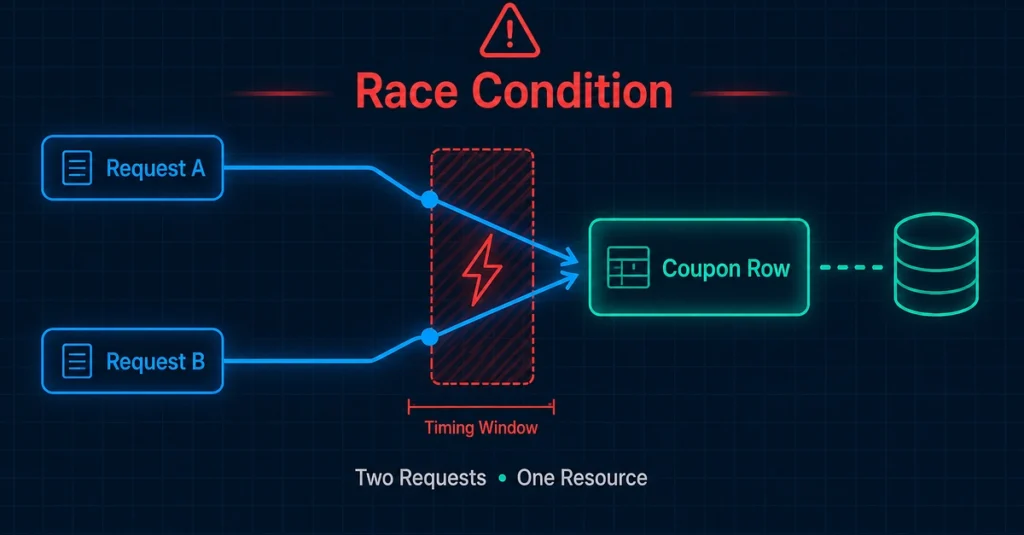
The primary vulnerability of the naive solution is the "check-then-insert" race condition. The AnyAsync(...) call and the subsequent AddAsync(...) operation are not atomic. In a highly concurrent environment, if two or more requests attempt to add the first member to the same new team simultaneously, all requests could concurrently observe exists == false. Consequently, each request would proceed to insert a new team record. This results in duplicate team entries in the database, leading to a fragmented user experience where the dashboard might show multiple identical team cards, and aggregated data (like member counts) would be incorrectly split across these duplicates.
The only reliable defense against this race condition lies not in application-level logic alone, but in leveraging the inherent concurrency control mechanisms of the database itself. A unique constraint on the relevant columns (e.g., OrganizationId and PlanCode for a Team entity) ensures that the database, as the single source of truth for all writes, will reject any subsequent attempts to insert a duplicate record.
  // EF Core model configuration
  modelBuilder.Entity<Team>()
      .HasIndex(t => new  t.OrganizationId, t.PlanCode )
      .IsUnique();
With the unique constraint in place, the application logic can be refined. Instead of merely checking for existence, the system should "try to insert" and gracefully handle a unique constraint violation as an expected success condition. If a violation occurs, it signifies that another concurrent request has already successfully created the desired record, achieving the intended state.
  private async Task EnsureTeamExistsAsync(
      Guid organizationId, string planCode, CancellationToken ct)

      var exists = await _teams.AnyAsync(
          t => t.OrganizationId == organizationId
            && t.PlanCode == planCode, ct);
      if (exists) return; // Optimization: avoid DB roundtrip if already exists

      _teams.Add(new Team(organizationId, planCode));

      try

          await _unitOfWork.SaveChangesAsync(ct);

      catch (DbUpdateException ex) when (IsUniqueViolation(ex))

          // A concurrent request created the same team first.
          // That is the desired end state, so this is a no-op, not an error.
          // (IsUniqueViolation would be a helper method to check specific DB error codes)
This refined approach combines efficiency (the AnyAsync check avoids a failed insert on the common path) with correctness (the unique constraint guarantees data integrity under concurrency).
Ensuring Data Harmony: The Normalization Mismatch
The second trap, often overlooked, pertains to data normalization. If the PlanCode is used as a join key between Team and Member records, any inconsistency in its representation can silently break the relationship. For instance, if one part of the system stores "pro" and another stores "pro " (with a trailing space) or "PRO" (different casing), the database join will fail to match them. This creates a scenario where both team and member records might exist, but the dashboard still shows a count of zero, presenting a bug identical in symptom to the original "missing row" problem.
The solution is to establish a single, authoritative point of normalization for such keys. This means applying any necessary transformations—trimming whitespace, converting to lowercase, or collapsing multiple spaces—at the moment the key is first written and ensuring all subsequent reads and writes adhere to this normalized format.

  public Team(Guid organizationId, string planCode)

      OrganizationId = organizationId;
      // Trim once, here, so the stored key matches how members store it.
      PlanCode = planCode.Trim();
      Id = Guid.NewGuid();
Consistently applying normalization rules across the entire data lifecycle ensures that joins and lookups are reliable, preventing silent data discrepancies. This principle extends beyond simple string manipulation to considerations like character encoding, time zones, and data type conversions.
Addressing the Past: The Critical Role of Backfilling
A frequently forgotten aspect of implementing such a fix is the "retroactive gap." The auto-provisioning logic, once deployed, only addresses new data created after the change. Existing organizations that invited members before the fix will still lack the necessary team rows, and their dashboards will remain broken.
This necessitates a crucial, one-time data migration or "backfill" job. This job systematically identifies all existing member records that should implicitly have a corresponding team but don’t, and then creates those missing team records.
  -- Create the missing team for every distinct (org, plan) that has members
  -- but no team yet. Idempotent: safe to run more than once.
  INSERT INTO teams (id, organization_id, plan_code, created_at_utc)
  SELECT gen_random_uuid(), m.organization_id, TRIM(m.plan_code), now()
  FROM   members m
  LEFT JOIN teams t
    ON t.organization_id = m.organization_id
   AND t.plan_code = TRIM(m.plan_code)
  WHERE  t.id IS NULL
  GROUP BY m.organization_id, TRIM(m.plan_code);
This SQL query is designed to be idempotent, meaning it can be run multiple times without adverse effects, only creating records that are truly missing. The forward fix (auto-provisioning) and the backward fix (backfilling) together constitute a complete and robust solution, ensuring data integrity for both current and historical data. Shipping them concurrently is essential for a seamless transition and immediate resolution of all affected user experiences.
Broader Implications and Best Practices for System Design
The lessons learned from "The Missing Row" extend to several critical areas of software development and system architecture:
- Idempotency: Designing operations to be idempotent—meaning they can be applied multiple times without changing the result beyond the initial application—is fundamental for robust, fault-tolerant systems, especially in distributed environments.
- Database as the Source of Truth: Relying on database constraints (unique, foreign key, check constraints) for data integrity is often more reliable and performant than attempting to enforce all rules at the application layer, particularly under high concurrency.
- Unified Data Models: Ensuring consistent data models and normalization strategies across all services and layers of an application prevents insidious data mismatches.
- Observability: Implementing robust logging and monitoring for unique constraint violations or other data integrity issues can provide early warnings for potential problems.
- User-Centric Design: Prioritizing user experience means anticipating implicit data needs and automating their fulfillment, rather than burdening users with manual prerequisite steps.
- Comprehensive Deployment Strategies: Any change affecting data structure or creation logic must be accompanied by a plan for existing data, including backfills or migration scripts, to ensure a complete and consistent state.
Common mistakes in this area include over-reliance on application-level checks, neglecting edge cases in concurrency, underestimating the complexity of data normalization, and, critically, failing to address historical data through backfills.
Ultimately, an empty response from a system is not always indicative of "no data." Sometimes, it signals "the row you’re reading from was never anyone’s job to create." The most durable and user-friendly solution is to transfer that responsibility from the user to the system. This requires not just implementing a "get-or-create" logic, but surrounding it with the necessary engineering safeguards: unique constraints for correctness, rigorous normalization for reliable joins, and comprehensive backfills for historical accuracy. This holistic approach ensures data integrity, enhances user experience, and reduces long-term maintenance burdens, proving that the interesting engineering often lies in the details surrounding the core functionality.
Credit: This article is based on insights from Odumosu Matthew.
LinkedIn: Matthew Odumosu
Twitter: @iamcymentho
Graphics sourced from Medium.