
YouTube’s financial trajectory shifted notably in the third quarter of 2026, showcasing a mixed landscape of moderating advertising growth balanced by robust gains in subscription services, connected television viewership, and artificial intelligence integration. According to financial data released by parent company Alphabet, YouTube generated $11.2 billion in advertising revenue for the period. While this figure represents a substantial segment of Alphabet’s overall corporate intake, the year-over-year ad revenue growth settled at 9%, marking a deceleration from the 13% growth rate reported during the second quarter of the year.
Despite the slight cooling in traditional ad intake, YouTube’s overarching financial ecosystem remains remarkably resilient. The platform is successfully diversifying its revenue streams, capitalizing on a significant migration of viewing habits toward connected television sets, expanding creator commerce ecosystems, and integrating advanced generative artificial intelligence tools designed to streamline content production and enhance ad targeting.
Subscription Momentum and the Rise of Connected TV
The most pronounced acceleration for YouTube outside of traditional advertising lies in its subscription services. YouTube contributed heavily to an 11% year-over-year increase in Google’s overall subscription, platform, and device revenue during Q3. Combined subscriber counts for YouTube Music and YouTube Premium have now surpassed 150 million globally.
This milestone represents a dramatic expansion from earlier benchmarks. In early 2024, Alphabet announced that YouTube’s subscription services had crossed the 100 million threshold. The addition of 50 million subscribers in roughly two and a half years underscores the platform’s successful conversion of ad-supported viewers into paying customers.
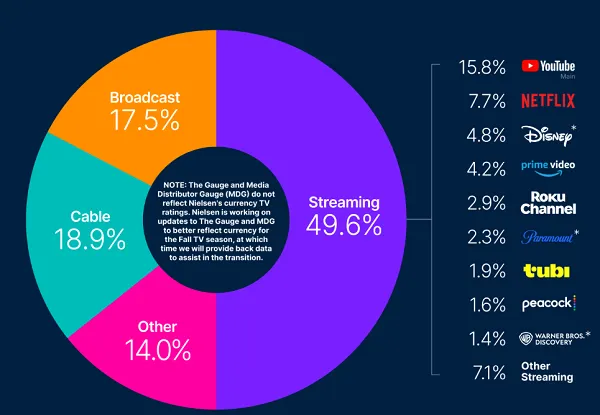
Industry analysts point to connected television (CTV) viewing as a primary catalyst for this subscription growth. During Alphabet’s Q2 earnings call in July, executives noted a significant spike in Premium sign-ups among households utilizing connected TVs. This trend aligns directly with broader media consumption shifts. According to data from Nielsen’s "The Gauge" report published in August 2026, YouTube firmly maintained its position as the top streaming platform in the United States, commanding a dominant share of total television viewing time and frequently outperforming major subscription video-on-demand services and traditional broadcast networks alike.
Alphabet executives elaborated on this phenomenon during the Q3 earnings call. Google Chief Business Officer Philipp Schindler highlighted that Living Room—YouTube’s dedicated connected TV experience—has evolved far beyond a secondary viewing format. Living Room consumption now accounts for more than one-third of YouTube’s total advertising revenue. As audiences increasingly substitute traditional cable packages with YouTube on their living room displays, advertisers are shifting budgets accordingly, and viewers are increasingly willing to pay for ad-free Premium tiers to enhance their household viewing experience.
Expanding E-Commerce and Creator Partnerships
Beyond subscriptions and living room ads, YouTube is aggressively scaling its creator economy infrastructure and e-commerce integrations. The YouTube Partner Program has expanded to include more than three million creators globally, providing a massive network for brand partnerships and targeted advertising.
Simultaneously, the platform is cementing its footprint in social commerce. More than 1.3 million channels are now actively enrolled in YouTube’s shopping program. This momentum was significantly bolstered by a high-profile announcement regarding a new affiliate partnership with Amazon. The integration allows U.S.-based creators to seamlessly tag Amazon products directly within their long-form videos, Shorts, and livestreams. This strategic alignment bridges the gap between content creation and direct consumer purchasing, offering creators robust new revenue avenues while positioning YouTube as a major player in the e-commerce discovery funnel.

Furthermore, Schindler noted that small and medium-sized businesses (SMBs) continue to demonstrate strong adoption rates for Google’s Demand Gen advertising products, indicating that the platform’s advertising tools remain attractive to smaller enterprises even as enterprise-level ad growth normalizes.
Generative AI Integration and Creative Toolsets
Artificial intelligence emerged as a central theme in Alphabet’s Q3 financial communications, with executives emphasizing how machine learning and generative AI are transforming both ad targeting capabilities and creator output.
With more than 20 million videos uploaded to the platform daily, content volume remains staggering. To manage this scale and empower creators, YouTube has systematically rolled out advanced generative AI tools within YouTube Studio, alongside conversational editing assistants embedded in Shorts and the standalone YouTube Create application.
The platform’s push into AI-driven creation tools has a clear historical trajectory over the course of 2026:
- March 2026: YouTube launched an AI-powered "reimagine" feature for Shorts, allowing viewers to generate alternative video variations based on existing creator clips.
- Mid-2026: The platform tested and refined an "Extend with AI" capability, granting creators the ability to seamlessly generate alternative video endings.
- September 2026: YouTube published internal data tracking creator sentiment, revealing that 61% of users who posted videos over the preceding 12 months expressed active interest in utilizing AI features to insert themselves directly into video content.
While industry observers frequently caution platforms regarding the proliferation of low-quality or automated content—often referred to as "AI slop"—the engagement metrics released by Alphabet suggest that YouTube’s targeted, creator-centric AI integrations are resonating well with its core user base. Rather than replacing human creators, these tools are being adopted as workflow enhancers that lower technical barriers to production.
Broader Implications and Market Outlook
The Q3 2026 financial disclosures paint a nuanced picture of a mature digital platform navigating shifting macroeconomic and technological currents. The moderation of YouTube’s ad revenue growth from 13% to 9% suggests that pure display and video ad growth may be reaching a natural equilibrium point, constrained by high penetration rates and digital advertising saturation.
However, the diversification of YouTube’s revenue model mitigates potential risks associated with ad market fluctuations. By cultivating a dual-engine financial structure anchored by steady subscription growth and diversified advertising streams—spanning mobile, desktop, connected living room displays, and e-commerce partnerships—Alphabet has insulated the platform against single-vector market downturns.
As YouTube solidifies its dominance as America’s premier streaming television destination and deepens its integration with generative AI and retail commerce, its strategic focus has shifted toward ecosystem stickiness. By making creation easier, keeping viewers engaged on larger screens, and offering lucrative monetization pathways for creators and merchants alike, YouTube is positioning itself to capture sustainable, long-term value through the remainder of the decade.