
The global advertising and creative industries have reached a pivotal inflection point where the sheer capability of artificial intelligence is no longer a differentiator. As generative AI models become universally accessible, standardizing the creation of text, imagery, and video into a low-cost commodity, creative agencies face a pressing existential question: What constitutes a genuine creative advantage when anyone can generate almost anything with a prompt?
Addressing this modern industry dilemma, First Concepts, a specialized taste-aware AI workspace built explicitly for creative teams, has officially opened its doors to the public. The platform’s commercial debut follows an intensive one-year closed beta period during which the startup collaborated closely with top-tier agencies including Mother, Pablo, 72andSunny, nice&frank, Havas, Stink, and VCCP, alongside more than 40 other prominent creative institutions worldwide.
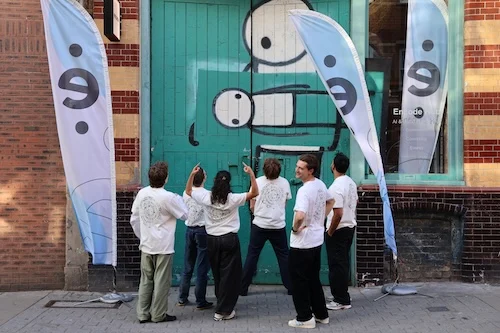
The launch event is being celebrated in high-profile fashion at Mother London through a live, high-pressure competition known as Creative Sprint 3. Here, 40 rising creative talents have gathered to test the limits of collaborative intelligence by taking a single brief—commissioned specifically by Granola—from a completely blank page to a fully realized, pitched concept in a mere 90 minutes. The high-stakes sprint is being evaluated by an elite panel of industry heavyweights: Tom Bender, Executive Creative Director at Mother; Tom Roach, Vice President of Brand Strategy at Jellyfish; and Laura Jordan Bambach, Founder and Chief Creative Officer of Uncharted and former D&AD President. Crucially, the judging criteria deliberately prioritize the human idea and the underlying strategic judgment rather than the technical proficiency of the tools used.
The Genesis and Philosophy of Taste-Aware AI
The foundational thesis behind First Concepts is that while modern AI has successfully democratized the act of making things, it has simultaneously complicated the far more critical task of knowing what is actually worth making. In traditional agency workflows, early-stage ideation frequently suffers from fragmentation. A team’s research, foundational references, strategic territories, raw scripts, mood boards, and initial frames are routinely scattered across disparate applications, cloud folders, and physical notebooks. Every time an idea is migrated from one software tool to another, a subtle layer of context, nuance, and strategic direction is inevitably lost.
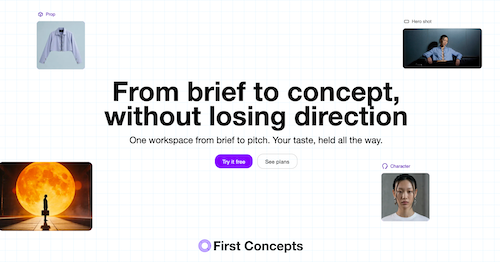
First Concepts positions itself as an integrated digital workspace designed to occupy the critical space before the presentation deck. By centralizing briefs, historical data, references, and frameworks into a single unified ecosystem, the platform ensures that a team’s original creative direction remains intact and traceable from the moment a brief is first read to the final pitch presentation.
At the technological heart of the workspace is a proprietary creative co-director agent. Unlike traditional generative platforms designed to instantly hand back fully realized outputs upon command, this agent is engineered to act as an active, collaborative partner. It interrogates the team’s ideas, challenges assumptions, and dives deeper into conceptual exploration, aligning strictly with the human team’s established artistic taste.
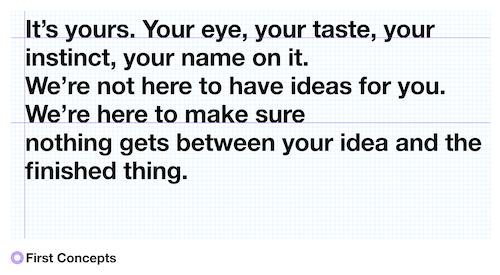
Conor Hoey, founder and chief executive officer of First Concepts, emphasizes that the platform was forged directly in the trenches of agency life. "AI has made making things easy. Knowing what is worth making is still the important part," Hoey stated. "We built First Concepts with working creatives so their judgment survives the process, from the first read of the brief to the finished concept."
Bridging the Gap Between Technology and Human Craft
The rapid evolution of generative AI over recent years has flooded creative departments with infinite options, often leading to a phenomenon known as prompt fatigue. Creative directors frequently spend more time wrestling AI tools into compliance—continually pulling outputs back from generic territory to match a specific aesthetic—than they do refining core concepts.
Felix Richter, global chief creative officer at Mother and an official adviser to First Concepts, highlighted how the platform solves this operational friction. "The output actually reflects your references and taste. You’re not constantly pulling it back to where it should be," Richter observed.
This philosophy is reflected in the platform’s architectural design. According to Polina Sali, co-founder and chief product officer of First Concepts, the goal is nothing short of redesigning how creative minds and systems operate in tandem. "Together with Marin Godechot, our CTO and co-founder, and Ivan Khoridonov, our product design lead, we’re thinking of how to rebuild creative work and mind as a system—its memory, context, references, judgment," Sali explained.
The platform argues that human taste cannot be reduced to a simple settings toggle or a pre-set parameter. Instead, true creative taste is formed through a complex pattern of thousands of micro-decisions made by experienced professionals throughout a campaign’s lifecycle. By embedding these patterns into a system’s memory, First Concepts attempts to preserve the human authorial voice within automated workflows.
Chronology of Development: From Closed Beta to Public Launch
The journey of First Concepts from an experimental concept to a globally available workspace spans a carefully orchestrated timeline tailored to the needs of the advertising sector.
Phase one began in late 2025, when the core founding team initiated quiet partnerships with forward-thinking independent and network agencies. Recognizing that software built for creatives must be tested by creatives, the company embedded itself within workflow environments at agencies such as Mother, Pablo, and 72andSunny. Over the course of twelve months, hundreds of live pitches and client briefs were processed through early iterations of the workspace. This feedback loop allowed the engineering team to refine the balance between automation and human oversight, ensuring the tool addressed real-world bottlenecks rather than theoretical use cases.
Phase two culminated in September 2026 with the official public launch of the platform at firstconcepts.co. By opening access to the wider market, the company aims to scale its user base beyond elite holding companies and progressive independents, offering independent creators, boutique studios, and enterprise brand teams access to the same specialized workspace infrastructure.
Phase three, marked concurrently by Creative Sprint 3 at Mother London, demonstrates the practical application of the software under extreme time constraints. By pitting 40 diverse creatives against a ticking 90-minute clock, the event serves as a stress test for the platform’s core proposition: that advanced AI, when guided by rigorous human taste, can exponentially accelerate the journey from a blank page to a compelling narrative pitch.
The Broader Implications for the Creative Economy
The commercial introduction of taste-aware AI workspaces like First Concepts arrives at a crucial juncture for the creative economy. As corporate clients increasingly pressure agencies to deliver more work at higher speeds and lower costs, the temptation to rely entirely on commoditized AI generation has never been stronger. However, industry veterans have repeatedly warned that unchecked automation risks drowning the marketplace in homogenous, algorithmic mediocrity.
The solution proposed by First Concepts—and validated by its early adoption among major agencies—suggests that the future of agency competitiveness lies not in rejecting AI, but in developing proprietary systems that encode an agency’s unique institutional memory and aesthetic standards. If successful, tools that safeguard human judgment may well define the next generation of creative leadership, separating agencies that merely produce volume from those that maintain distinct, enduring cultural influence.
As First Concepts opens its platform to the wider public, the industry will be watching closely to see how effectively these specialized workspaces can be integrated into day-to-day agency operations. Whether the broader creative sector embraces taste-aware systems as essential infrastructure or treats them as another passing software trend remains to be seen. Nonetheless, events like Creative Sprint 3 make it abundantly clear that the conversation around artificial intelligence in advertising has permanently shifted from what machines can produce to what humans choose to champion.