
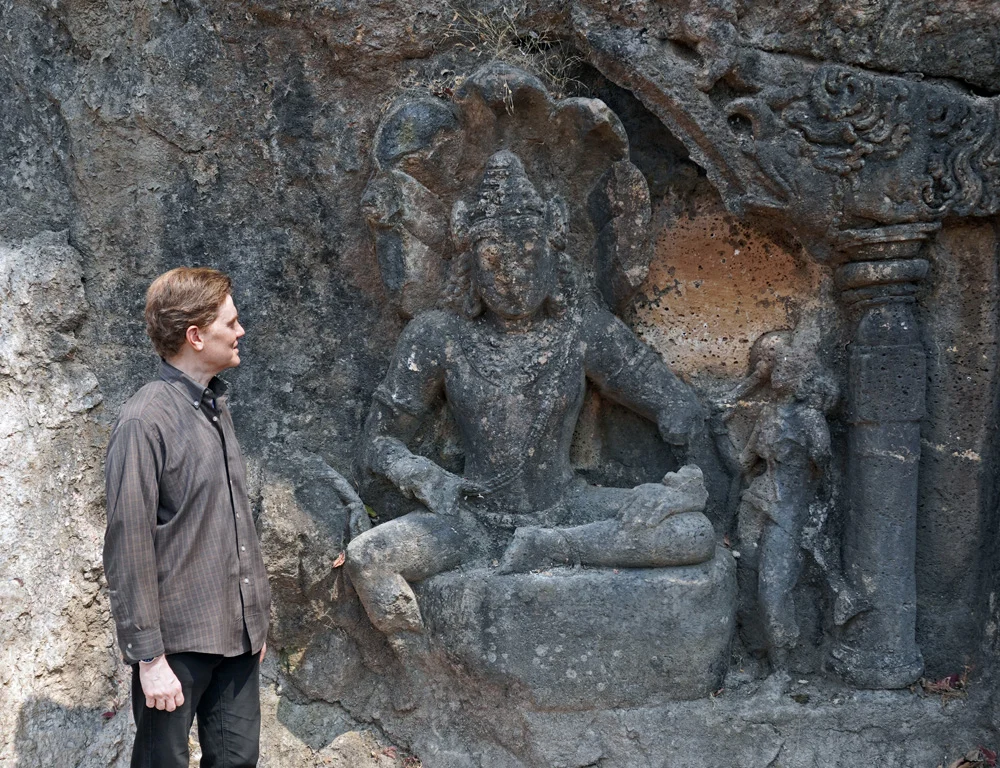

Dr. David S. Efurd, a two-time Fulbright recipient and chair of the art and art history department at Wofford College, has culminated decades of field research into a monumental digital archive documenting the Buddhist rock-cut architecture of western India. Armed with a handheld camera and a meticulous notebook, Efurd has traversed the rugged terrain of the Western Ghats to visit more than 80 cave sites, capturing over 10,000 high-resolution images. This extensive collection, now hosted by Artstor and JSTOR, provides an unprecedented visual record of monasteries, shrines, and residential cells carved directly into the volcanic basalt cliff faces of the Deccan Plateau. Dating from as early as the second century BCE, these sites represent a pinnacle of ancient engineering and religious devotion, offering a window into the evolution of Buddhist practice and the socio-economic landscape of early India.

The significance of Efurd’s work lies not only in the volume of data but in his methodological approach, which he describes as "slow looking." In an era of rapid digital consumption and "drive-by" tourism, Efurd spends days within a single cave system, observing the subtle shifts in light, the precision of architectural measurements, and the weathered details of ancient sculptures. This deliberate attention has allowed him to uncover the sophisticated intent behind these spaces, revealing them to be far more than mere ruins. They are instead complex environments where geometry, light, and religious philosophy converge to create an immersive spiritual experience.

Geological Foundations and the Symbiosis of Trade
The choice of western India for these massive excavations was dictated by a unique combination of geology and geography. The region is defined by the Deccan Traps, one of the largest volcanic provinces in the world, consisting of thick layers of solidified basalt. This stone is remarkably durable and possesses a uniform consistency, making it ideal for large-scale rock-cut architecture. Unlike structural buildings that require the transport of materials and are prone to collapse over centuries, these monasteries were sculpted out of the "living rock," ensuring their survival for over two millennia.

However, the placement of these caves was not purely a matter of finding suitable stone. Contrary to the popular image of the isolated, mountain-dwelling hermit, these monastic complexes were strategically located near major ancient trade routes. These routes connected the inland cities of the Deccan to the thriving ports of the Arabian Sea. The relationship between the Buddhist Sangha (the monastic community) and the broader society was one of mutual dependence. While the monks sought a quiet environment for meditation and study, they remained within walking distance of villages and urban centers to receive alms and support from the laity.

This economic symbiosis is evidenced by the "vassa," or the rainy season retreat. During the three months of the heavy Indian monsoon, Buddhist monks were prohibited from traveling to avoid inadvertently harming insects or plants. The rock-cut monasteries provided essential shelter during this period. In return for the physical sustenance provided by merchants and local villagers, the monks offered spiritual guidance and the opportunity for donors to earn "merit," a central concept in Buddhist theology that influences one’s future karma and rebirth.

A Chronology of Devotion: From Symbols to Icons
The evolution of Buddhist art is etched into the walls of the caves Efurd has documented. The earliest sites, such as those at Pitalkhora and the early phases of Ajanta, date to the second and first centuries BCE. During this "Aniconic" phase, the Buddha was not represented in human form. Instead, his presence was signaled through symbols: the Bodhi tree, his footprints (Buddhapada), or the "Triratna" (the triple gem representing the Buddha, the Dharma, or teachings, and the Sangha).

The central focus of these early shrines was the "stupa," a hemispherical relic mound. In rock-cut architecture, these are known as "chaitya" halls. These halls feature high vaulted ceilings—often carved with stone ribs that mimic wooden rafters—leading to a stupa at the far end of the nave. By the fourth and fifth centuries CE, a significant shift occurred. Influenced by the rise of Mahayana Buddhism, the Buddha began to be depicted in human form. At sites like Ajanta and later Ellora, colossal statues of the Buddha were carved directly into the front of stupas or housed in central sanctums, flanked by Bodhisattvas—enlightened beings who delay their own nirvana to help others.

Efurd’s documentation also highlights the presence of "mithuna" (amorous couples) and "yakshas" (nature spirits) in the sculptural programs. While the inclusion of lovers and fertility figures might seem incongruous in a monastic setting, they were viewed as auspicious symbols of abundance and protection. Their presence indicates that the caves were intended to reflect a cosmic order where all beings, from the mundane to the divine, were subordinated to the Buddha’s Dharma.

The Science of Sacred Light and Proportional Design
One of the most remarkable discoveries reinforced by Efurd’s photography is the ancient builders’ sophisticated understanding of astronomy and optics. Following the pioneering research of the late Walter Spink, Efurd has observed how specific caves at Ajanta and Ellora were designed to interact with the sun. At Ajanta, certain chaitya windows—massive horseshoe-shaped apertures—are aligned so that during the winter solstice, the light of the setting sun penetrates the dark interior to illuminate the Buddha image deep within the cave.

At Ellora, a similar phenomenon occurs during the "Kirnotsav," or the festival of the sun’s rays. Twice a year, a narrow beam of sunlight filters through a small opening to strike the face of the Buddha. These were not accidental occurrences but were the result of precise mathematical calculations and engineering. Efurd’s current research focuses on the Chaitya Hall at Karle, where he has found that the system of proportions and the placement of architectural features follow strict mathematical relationships. By moving away from Western architectural biases, Efurd’s "slow looking" approach reveals that the ancient craftsmen utilized a rigorous indigenous geometry to create spaces that felt both harmonious and divinely inspired.

From Buddhist Sanctuaries to Hindu Shrines: A Changing Legacy
As Buddhism began to decline in India toward the end of the first millennium CE, the role of these monasteries shifted. Many sites were abandoned as the royal patronage and trade networks that supported them withered. However, the caves did not always fall into disuse. In many instances, Hindu communities appropriated the sites, rededicating Buddhist halls to Brahmanical deities.

At Karle, for example, a temple dedicated to the goddess Ekvira was established right at the entrance to the great Buddhist chaitya hall. In other locations, Buddhist images were reinterpreted as forms of Vishnu or Shiva. This transition reflects the fluid nature of Indian religious identity, where sacred spaces are often layered with multiple traditions over centuries. Efurd’s archive captures this "living" history, showing modern Hindu pilgrims worshipping alongside ancient Buddhist carvings, demonstrating how these sites continue to function as centers of spiritual life long after their original inhabitants departed.

Conservation, Discovery, and the Role of the ASI
Today, the majority of these sites are under the protection of the Archaeological Survey of India (ASI). Managing these locations requires a delicate balance between preserving the integrity of the ancient stone and allowing for contemporary religious expression. Efurd’s work as a Fulbright scholar involved navigating the rigorous protocols of the ASI to gain permission for detailed photography and measurement—tasks that are often restricted for the average tourist.

The archive serves as a critical baseline for conservation. Basalt, while durable, is susceptible to water seepage and mineral deposits, particularly during the monsoon. By documenting the current state of over 80 sites, Efurd has provided a tool for scholars and conservationists to monitor the deterioration of sculptures and paintings. Furthermore, the potential for new discoveries remains high. As recently as a few years ago, the clearing of debris at the Ghatotkacha caves revealed a magnificent "nagaraja" (serpent king) sculpture that had been buried for half a millennium. Efurd suggests that many more "lower stories" and isolated cells remain hidden beneath centuries of silt and vegetation.

Implications for Digital Humanities and Global Scholarship
The digitization of Efurd’s 10,000-image archive marks a significant contribution to the digital humanities. By making these images available through Artstor, he has democratized access to sites that are geographically remote and often difficult to reach. For students and researchers globally, this archive provides the ability to perform comparative studies of rock-cut motifs across different centuries and regions without the need for extensive travel.

Efurd’s work underscores the importance of interdisciplinary research, blending art history, archaeology, and religious studies. His findings challenge the notion that ancient Indian architecture was "organic" or "unplanned." Instead, through the lens of his camera and the data in his notebooks, a picture emerges of a highly organized, intellectually sophisticated monastic culture that utilized the very earth itself to express its highest aspirations. As these sites face the dual pressures of climate change and increased tourism, Efurd’s photographic legacy ensures that the "slow looking" of the 21st century will preserve the "slow building" of the 2nd century BCE for generations to come.