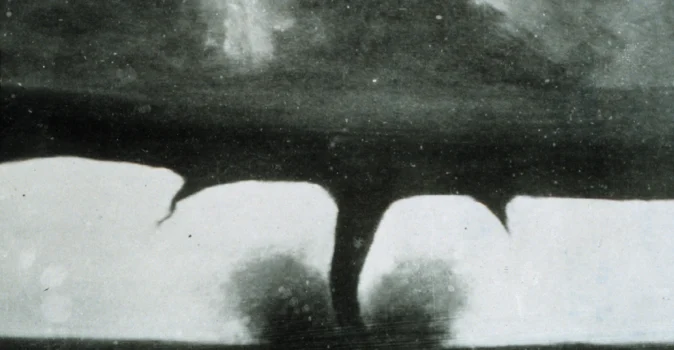

The visual canon of severe weather is dominated by colossal, high-contrast wedges, striated mesocyclones, and ominous multi-vortex funnels bearing down on desolate plains. Yet, the oldest surviving photograph of a tornado—captured on April 26, 1884, near Garnett, Kansas—features none of these cinematic hallmarks. Instead, it portrays a faint, unassuming gray thread hanging limply beneath a flat cloud base, resembling a wisp of smoke more than a meteorological monster.
The image, preserved in the archives of the Kansas Historical Society, was produced by A. A. Adams, a former photography studio owner turned fruit grower in Anderson County. While subsequent decades popularized more dramatic, heavily retouched depictions of nineteenth-century twisters, modern meteorological analysis and historical cross-referencing have firmly established Adams’s modest plate as the earliest authentic photographic record of a tornado. This distinction highlights a fascinating intersection of nineteenth-century photographic limitations, commercial pressures, and the evolution of severe weather documentation.
The Man Behind the Lens: A. A. Adams and the Garnett Tornado
In 1867, A. A. Adams relocated to Anderson County, Kansas, to establish himself as a fruit grower, carrying with him the technical apparatus and expertise from his previous career running a photography studio. On the afternoon of April 26, 1884, those dormant skills were put to an unexpected test. A severe convective storm spawned a tornado approximately 14 miles west of Garnett, near the small hamlet of Westphalia, tracking slowly to the northeast.
According to contemporary eyewitness accounts, the funnel maintained high visibility for nearly thirty minutes—an exceptionally slow progression that afforded Adams a rare window of opportunity. Rather than scrambling away from the disturbance, Adams retrieved his heavy plate camera, transported it to a street corner near the United Presbyterian Church in Garnett, and meticulously prepared his equipment to capture the distant phenomenon.
The resulting photograph depicts a thin, slightly curved rope funnel suspended from a uniform cloud deck, with the silhouette of the town resting across the foreground. Lacking the dramatic flair of later imagery, the photograph is valued by historians precisely for its unvarnished realism. It accurately captures the visual profile of a distant, decaying tornado without the artificial enhancement that would later plague nineteenth-century storm imagery. Recognizing the novelty of his work, Adams printed cabinet cards and stereographs, capitalizing on the prevailing parlor-stereoscope craze of the 1880s. By the time of his death in 1907, local publications rightfully credited him with capturing the first photographic evidence of a tornado.
Chronology of Early Storm Photography
To understand the rarity and technical achievement of Adams’s photograph, one must examine the timeline of severe weather documentation and photographic innovation during the late nineteenth century:
- April 26, 1884: A. A. Adams photographs a slow-moving tornado near Garnett, Kansas, establishing the earliest verifiable visual record of a twister. Signal Corps weather maps from this date confirm atmospheric conditions capable of producing severe convective activity.
- August 28, 1884: Photographer F. N. Robinson captures a violent F4 tornado near Howard in the Dakota Territory. The resulting image features a dramatic black funnel flanked by subsidiary vortices, which later becomes widely misattributed as the first tornado ever photographed.
- 1888: George Eastman introduces the first mass-market Kodak roll-film box camera. This technological leap eliminates the cumbersome tripod and dark-cloth requirements of earlier plate photography, drastically expanding the pool of amateur storm photographers.
- May 12, 1896 – April 27, 1899: An era of pervasive photographic fraud begins, highlighted by forged tornado images—such as the Waynoka, Oklahoma, and Kirksville, Missouri, composites—created by rendering funnels in India ink on glass plates and printing them over genuine landscapes. These fabrications are subsequently exposed by the Monthly Weather Review.
- 1984: A comprehensive study published in the Bulletin of the American Meteorological Society re-evaluates historical storm archives, systematically separating genuine nineteenth-century photographs from doctored composites and reinforcing the historical legitimacy of Adams’s work.
Technical Constraints of Nineteenth-Century Optics
The photographic medium of 1884 imposed severe operational limits on anyone attempting to capture transient atmospheric phenomena. Although the wet collodion process—which required photographers to sensitize and expose glass plates while wet—was gradually being superseded by factory-produced gelatin dry plates, field photography remained an arduous endeavor.
Adams utilized a tripod-mounted plate camera that required manual focusing beneath a dark cloth. The technical parameters of the era precluded instantaneous action shots of fast-moving, close-range severe weather. Standard gelatin emulsions were predominantly sensitive to blue light while remaining blind to red, resulting in bright, overcast skies washing out to a stark, uniform white. Consequently, early storm images universally exhibit a high-contrast, bleached appearance, wherein funnels register as dark or pale strokes against a featureless background.
These optical constraints meant that only distant, slow-moving, and well-illuminated funnels could be successfully captured. The violent, rain-wrapped wedge tornadoes that define modern storm chasing were entirely beyond the technical capabilities of nineteenth-century optics. Before this era of rudimentary photography, scientific inquiry into tornadoes relied exclusively on eyewitness testimony, manual sketches, and post-event damage surveys—methodologies inherently vulnerable to exaggeration and subjective distortion. Adams’s photograph provided an objective baseline of scale and morphology that traditional accounts could not match.
The Dakota Territory Rivalry and Commercial Fabrication
Just four months after Adams’s breakthrough, on August 28, 1884, photographer F. N. Robinson captured an image near Howard, Dakota Territory, that would overshadow Adams’s work for over a century. Robinson’s photograph depicted a massive, menacing black funnel accompanied by two smaller subsidiary vortices. The underlying storm was historically catastrophic, retrospectively rated an F4 on the Fujita scale, resulting in at least six fatalities.
Robinson copyrighted his images through the Library of Congress and marketed them commercially. Surviving prints in the South Dakota State Archives feature archival captions declaring it "The only cyclone ever photographed," a claim that cemented a widespread historical misattribution. For decades, NOAA’s photo library and major journalistic outlets featured Robinson’s image as the definitive first photograph of a tornado.
However, meteorological historians have long treated Robinson’s work with skepticism. Thomas P. Grazulis, author of Significant Tornadoes and the foremost authority on American tornado chronology, concluded that Robinson’s image was likely retouched or composited with an artificially enhanced cloud base. In the competitive nineteenth-century photographic market, dramatic imagery generated revenue, whereas understated records like Adams’s subtle gray thread languished in obscurity. This commercial incentive fueled an industry of photographic doctoring, leading to numerous fabricated storm images at the turn of the century.
Broader Implications and Modern Safety Parallels
The evolution from Adams’s 1884 glass plate to contemporary digital storm photography reflects a broader shift in meteorology and public safety. As photographic equipment advanced and accessibility increased, the scientific community developed more rigorous methods for authenticating visual data. The U.S. Weather Bureau and later researchers—most notably Dr. Tetsuya Fujita, creator of the Fujita intensity scale—utilized verified photographs alongside damage assessments to reconstruct historical climatology.
Nevertheless, modern capabilities have also exacerbated inherent physical risks. While technological barriers such as exposure times and heavy apparatuses have been entirely eradicated by modern weather-sealed digital bodies and high-speed shutters, the fundamental physical danger of tornadoes remains unchanged.
Contemporary meteorology emphasizes that proximity to severe convective storms carries lethal hazards. Tragic milestones, such as the deaths of veteran researcher Tim Samaras, his son Paul, and colleague Carl Young during the May 31, 2013, El Reno tornado, underscore the unpredictable nature of multi-vortex systems and rain-wrapped circulations. Modern consensus aligns with historical safety directives: visual documentation should remain secondary to immediate life safety.
Ultimately, A. A. Adams’s humble contribution from a Garnett street corner endures not because of cinematic spectacle, but because of its unyielding fidelity to truth. By maintaining discipline behind a wooden camera on a spring afternoon in 1884, a Kansas fruit grower produced the first honest portrait of a tornado, establishing an invaluable benchmark for the scientific documentation of extreme weather.