
Many companies today operate under a pervasive, silent assumption: that the general public is clamoring for a total infusion of artificial intelligence into every aspect of their professional and personal lives. Driven by an aggressive push from Silicon Valley leaders, corporations are rapidly rolling out new AI features, products, and workflows, operating on the belief that these innovations will inherently replace outdated practices and streamline broken operational systems. However, a growing body of evidence suggests that the market’s appetite for these tools does not align with the industry’s strategic roadmap. Instead of widespread adoption, many organizations are encountering an "adoption gap," characterized by low retention rates, high delivery costs, and potential long-term damage to brand reputation.
The Current State of AI Adoption and Market Sentiment
Data from the IBM Institute for Business Value and various industry studies indicate that while investment in AI is at an all-time high, the utility provided to the end user often falls short of expectations. In many enterprise settings, AI is deployed as a "bolt-on" feature—a separate, disconnected tool that forces employees to pivot away from their established, efficient workflows. Rather than acting as a force multiplier for productivity, these systems often introduce fragmentation, requiring workers to toggle between multiple, siloed platforms.
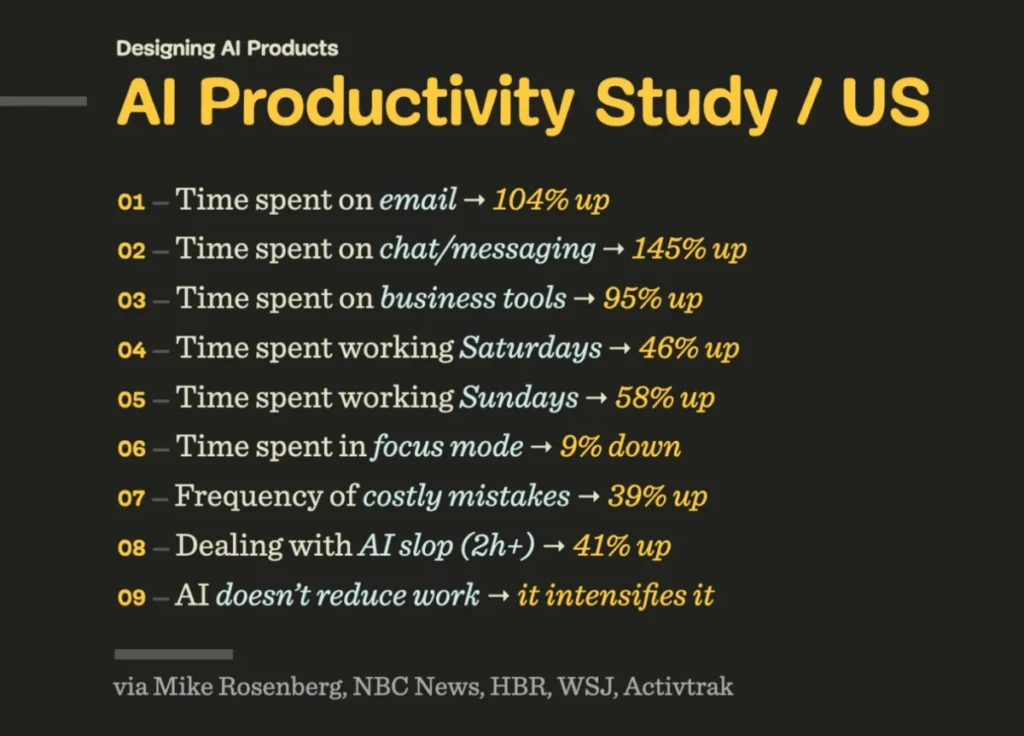
The core of the issue lies in a fundamental misunderstanding of the value proposition. In the lexicon of product design and business strategy, AI is not a value proposition in itself; it is a technology stack or a capability. When companies market "AI-powered" solutions without identifying a specific, high-friction problem for the user, they fail to deliver meaningful value. Furthermore, recent studies from the National Bureau of Economic Research and workplace monitoring platforms show that AI-integrated workflows have, in some instances, led to a decrease in focus time, a spike in time spent managing communications, and an increase in the manual effort required to audit "hallucinations" or errors generated by automated systems.
A Chronology of the AI Push
The current wave of generative AI integration can be traced back to the late 2022 release of public-facing large language models (LLMs). Within months, the technology moved from experimental sandbox environments to the C-suite agenda. By early 2023, Fortune 500 companies were under immense pressure from investors to demonstrate an "AI strategy," leading to a rapid, often uncoordinated, implementation of AI features across software suites.
By 2024, the initial novelty began to wane as organizations faced the reality of implementation. The narrative shifted from "AI will replace your tasks" to "AI will augment your capabilities," yet the design of these tools often failed to reflect that shift. Users reported that the systems felt intrusive rather than supportive. As of 2025, the focus of industry analysts has turned toward the "integration phase," where companies are attempting to move away from standalone chatbots and toward embedded automation—though the success of this transition remains highly variable across sectors.

The "AI-First" Fallacy and Technical Debt
One of the most significant challenges identified by UX researchers is the belief that AI can solve structural issues such as poor data quality, broken organizational culture, or technical debt. Industry experts argue that AI, in many cases, simply amplifies existing organizational shortcomings. If a business process is fundamentally flawed, adding an AI layer often serves to broadcast those flaws to the end user, forcing them to navigate inconsistent data and conflicting logic.
Furthermore, there is a distinct difference between human-centric design and technology-centric design. Users do not compare software performance against the fallibility of a human; they compare it against other, more reliable software features. If a traditional, non-AI feature works with 99% accuracy and an AI-integrated feature operates with 85% accuracy, the user will consistently favor the former. The "cost" of AI—the mental load required to verify, edit, and correct machine output—is a barrier that proponents of the technology frequently overlook.
Official Responses and Industry Perspectives

Major technology firms have begun to respond to these adoption challenges by pivoting their messaging toward "agentic" AI, which aims to complete tasks autonomously rather than just generating text. However, skeptics within the design community, such as those advocating for "AI-second" design principles, argue that the focus should remain on ambient, supportive technology.
In a recent industry forum, design leads emphasized that the most successful implementations are those that remain invisible. When an AI tool works, the user should be aware of the result, not the process. The goal is to offload mundane, repetitive, and cognitively taxing labor, thereby freeing the human operator to focus on tasks requiring intuition, taste, and emotional intelligence. As noted by leaders in the field, the objective should not be to force the human to adapt to the machine’s logic, but to ensure the machine aligns with the user’s existing mental models.
Broader Economic and Societal Implications
The economic impact of this push is profound. While some roles are clearly vulnerable to automation—particularly those involving routine data entry or basic content generation—other positions remain resilient. The Washington Post and other research institutions have categorized job vulnerability based on "exposure" and "adaptability." Roles that require high-level human intuition and complex decision-making are less likely to be replaced, but these workers are currently being forced to deal with the friction of early-stage AI tools.

The societal anxiety surrounding these shifts is not merely about job loss; it is about the erosion of the human element in essential services. Consumers have expressed significant resistance to AI-driven interactions in healthcare, education, and creative fields. There is a clear market preference for human-authored content, human-led therapy, and human-mediated medical advice. This preference highlights a crucial insight: AI is perceived as a tool for efficiency, not a replacement for human connection.
Future Outlook: The Shift to Human-Centric Automation
Moving forward, the industry is likely to undergo a period of "AI rationalization." Companies that prioritize the user experience—by embedding AI in ways that are subtle, calm, and genuinely useful—will likely see higher adoption rates than those that treat AI as a primary selling point. The "AI-second" design philosophy suggests that the most effective tools are those that are built to support the user’s intent, rather than those designed to showcase the power of the model.
In summary, the narrative that everyone is waiting for an AI-centric revolution is being challenged by the reality of user demand. People do not desire more "AI" in their lives in the abstract; they desire tools that work reliably, predict their needs, and reduce the burden of repetitive work. The challenge for developers and product managers is to move past the hype and focus on the quiet, often unglamorous work of improving existing workflows. The ultimate metric of success will not be the volume of AI features launched, but the amount of time and mental energy returned to the user, allowing them to engage more deeply with the human-centric work they find meaningful.

As the industry matures, the distinction between "smart" features and "AI" will likely blur. If the technology is effective, it becomes a standard utility. If it is intrusive or unreliable, it will be discarded, regardless of the sophistication of the underlying model. The winners in the next decade of technology development will be those who recognize that, ultimately, the most valuable commodity is not the intelligence of the machine, but the productivity and well-being of the human.