
As artificial intelligence rapidly transitions from a novelty of single-shot text generation into an indispensable operational engine, the environmental conversation surrounding the technology is undergoing a fundamental recalculation. For years, public discourse on the carbon footprint and electrical demands of generative AI focused predominantly on the discrete query: a user types a prompt into a chatbot, the server processes the input, a response is rendered, and the transaction concludes. Energy analysts, tech companies, and environmental scientists routinely measured electricity consumption in per-prompt increments, typically comparing the energy cost of a single AI query to boiling a kettle of water or powering a lightbulb for a fraction of an hour.
However, this traditional framework has been rendered obsolete by the advent and proliferation of agentic workflows. Instead of merely answering a question, autonomous and semi-autonomous AI agents are now deployed to execute complex, multi-layered tasks. These systems independently write code, execute terminal commands, read sprawling document libraries, query external databases, and iterate through trial-and-error loops until a problem is solved.
This operational shift was recently highlighted by climate scientist Zeke Hausfather in an analysis flagged by Wired journalist Molly Taft. Hausfather’s work sheds light on an uncomfortable reality for the tech industry: when artificial intelligence is permitted to work iteratively through a task, its energy consumption does not scale linearly—it explodes exponentially. As software engineers and enterprises rush to deploy agentic systems to automate white-collar labor, software development, and data analysis, the underlying power demands on global data centers are scaling in ways that current environmental models fail to capture.
The Mechanics of Exponential Compute: From Isolated Prompts to Cumulative Context Windows
To understand why agentic workflows consume significantly more electricity than traditional chatbot interactions, one must examine the computational mechanics of Large Language Models (LLMs). In a standard conversational interface, the context window—the amount of text the model evaluates to generate its next token—is relatively short and bounded. Once the exchange ends, the computational slate is wiped clean.
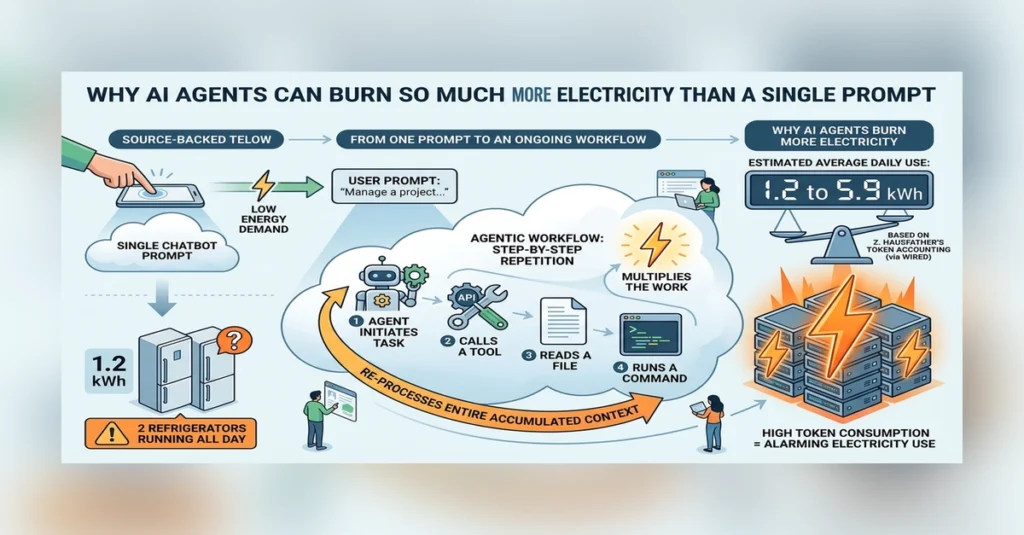
Agentic systems operate on an entirely different paradigm. When an AI agent is tasked with a multi-step assignment, such as debugging a software repository or conducting market research across dozens of web pages, it executes a continuous loop of reasoning and action. Crucially, with every single step the agent takes—whether it is running a diagnostic command, opening a file, or calling an application programming interface (API)—the underlying model must re-process its entire accumulated context.
This means that the model is never merely processing the latest line of input. It is repeatedly sweeping through the complete historical ledger of every action, error, intermediate file, and system output generated since the workflow began. This repeated re-evaluation creates a massive compounding computational load.
According to Hausfather’s metric-based tracking, the text that a user ultimately reads—the final polished output rendered on the screen—accounts for a remarkably minute fraction of the total processing burden, estimated at roughly 0.4 percent of all tokens processed. The remaining 99.6 percent of the computational work is entirely invisible to the end user. It consists of the internal monologue, error correction loops, and persistent context accumulation required to keep the agent oriented toward its goal. By tracking his own daily token consumption as a proxy for energy demand, Hausfather estimated that a typical day of heavy agentic usage results in an energy consumption ranging between 1.2 and 5.9 kilowatt-hours (kWh). To put this into perspective, 5.9 kWh is equivalent to running a standard household refrigerator for nearly an entire day, all generated by a single professional utilizing an AI assistant for complex daily workflows.
Chronology of a Paradigm Shift: How AI Evolved from Static Answers to Autonomous Action
The transition from static chatbots to dynamic agents did not happen overnight; it represents a multi-year maturation of foundational machine learning architectures, inference optimization, and developer tooling.
The journey began in earnest in late 2022 with the public release of consumer-facing generative AI chatbots. During this initial phase, the industry standard was reactive and stateless. Users engaged in prompt-and-response cycles, and the primary technical hurdles for AI developers were latency reduction and output hallucination mitigation. Environmental scrutiny during this period—spanning through 2023—focused on the massive training runs required to build frontier models like GPT-4 or Gemini, as well as the baseline inference costs of serving millions of concurrent users.
By late 2023 and into 2024, however, the AI research community realized that static chatbots were fundamentally limited in their practical utility. Enterprises did not just want an AI that could write a paragraph about a database; they wanted an AI that could connect to the database, write a query, test it, fix syntax errors, and extract the required report independently. This realization catalyzed the development of agentic design patterns, heavily popularized by industry frameworks and research papers that introduced concepts like ReAct (Reasoning and Acting), tool-use orchestration, and autonomous planning loops.
As software developers integrated these capabilities into commercial products throughout 2024 and 2025, the nature of AI workloads shifted decisively. Inference requests transformed from short, discrete spikes into long-running, resource-intensive computational threads. Today, the technology sector finds itself at a crossroads: while the productivity gains of agentic AI are driving unprecedented enterprise adoption, the physical infrastructure supporting these workloads is being pushed to its absolute limits.
Macro-Scale Implications: The Collision Between AI Expansion and Grid Sustainability
When examined in isolation, a daily consumption rate of 1.2 to 5.9 kWh per user may not appear catastrophically high. However, the macroeconomic and environmental picture transforms entirely when projected across a population-scale deployment model.
As millions of knowledge workers, software engineers, financial analysts, and corporate customer service departments adopt agentic assistants to automate routine and semi-complex tasks, the aggregate demand on global electrical grids multiplies exponentially. Major technology companies have already committed to ambitious net-zero carbon targets, yet their recent sustainability reports reveal soaring greenhouse gas emissions driven almost entirely by the explosive expansion of energy-hungry data centers.
This surging demand has triggered a profound supply-chain and infrastructure crisis. Hyperscale cloud providers—including Microsoft, Google, Amazon, and Meta—are scrambling to secure reliable, baseload power sources to feed their expanding server clusters. In recent months, this quest for electricity has led tech giants to invest heavily in renewable energy procurement, explore long-term battery storage solutions, and even pursue controversial agreements to restart decommissioned nuclear power plants, such as the historic deal involving Three Mile Island.
The introduction of agentic workflows pours metaphorical gasoline on an already burning fire. If a traditional chatbot query requires $X$ amount of compute, an agentic workflow that loops twenty times while re-processing a growing context window does not cost $20X$—it can cost substantially more due to quadratic scaling laws associated with attention mechanisms in transformer models. Consequently, the widespread adoption of autonomous AI agents threatens to outpace even the most aggressive projections for renewable energy capacity expansion, raising serious concerns among energy regulators and climate scientists regarding grid reliability, consumer electricity pricing, and carbon emissions.
Strategic Imperatives for Software Builders: Engineering for Efficiency in the Age of Agents
For software developers, product managers, and enterprise architects, these revelations demand an immediate shift in mindset. For the past two years, the prevailing engineering ethos in the AI application layer has been unabashedly maximalist: provide the model with as much context as possible, allow maximum autonomy, encourage extensive reasoning chains, and let downstream hardware handle the computational bill.
That luxury is rapidly evaporating. As organizations face mounting pressure to rein in operational costs and minimize environmental footprints, efficiency in prompt engineering and workflow design is becoming a core competency. Developers can no longer afford to treat compute as an infinite, frictionless resource.
Mitigating the energy footprint of agentic systems requires targeted architectural interventions. Engineers must rethink how context windows are managed, asking critical design questions: Does the agent truly need to retain the entire history of every failed tool call, or can intermediate states be summarized and pruned? Can retrieval-augmented generation (RAG) be optimized to fetch only hyper-targeted information, rather than dumping vast libraries into the model’s active memory? How many iteration loops should an autonomous agent be permitted to execute before requiring human intervention or task re-evaluation?
Furthermore, organizations must implement robust telemetry and monitoring tools specifically designed to track token consumption and computational expenditure at the workflow level. Just as cloud infrastructure teams monitor CPU and memory utilization to optimize server costs, AI application developers must begin treating token economics and energy consumption as primary Key Performance Indicators (KPIs).
Charting the Path Forward: Uncertainty and Responsibility
Despite the growing clarity regarding the mechanics of agentic energy consumption, significant uncertainties remain. The exact global carbon toll of agentic AI is difficult to quantify with absolute precision, as it depends heavily on variables that fluctuate wildly: the energy mix of the local grid where a specific data center is located, the continuous optimization of silicon hardware (such as specialized NPUs and TPUs), the algorithmic efficiency of future model architectures, and the actual frequency and depth of enterprise agent deployment.
Nevertheless, the directional takeaway is unmistakable and definitive. The era of evaluating AI’s environmental and economic impact through the simplistic lens of a single prompt is over. Agentic workflows represent a fundamental departure in how machines process information, characterized by iterative loops, compounding context, and heavy background computation.
As the technology industry continues to build autonomous systems designed to think, plan, and act on our behalf, the ultimate success of this revolution will be measured not only by the intelligence of the outputs it produces, but by its capacity to achieve those results sustainably. For builders, researchers, and policymakers alike, the challenge ahead lies in reconciling the immense productivity of agentic AI with the finite physical boundaries of our global energy infrastructure.