
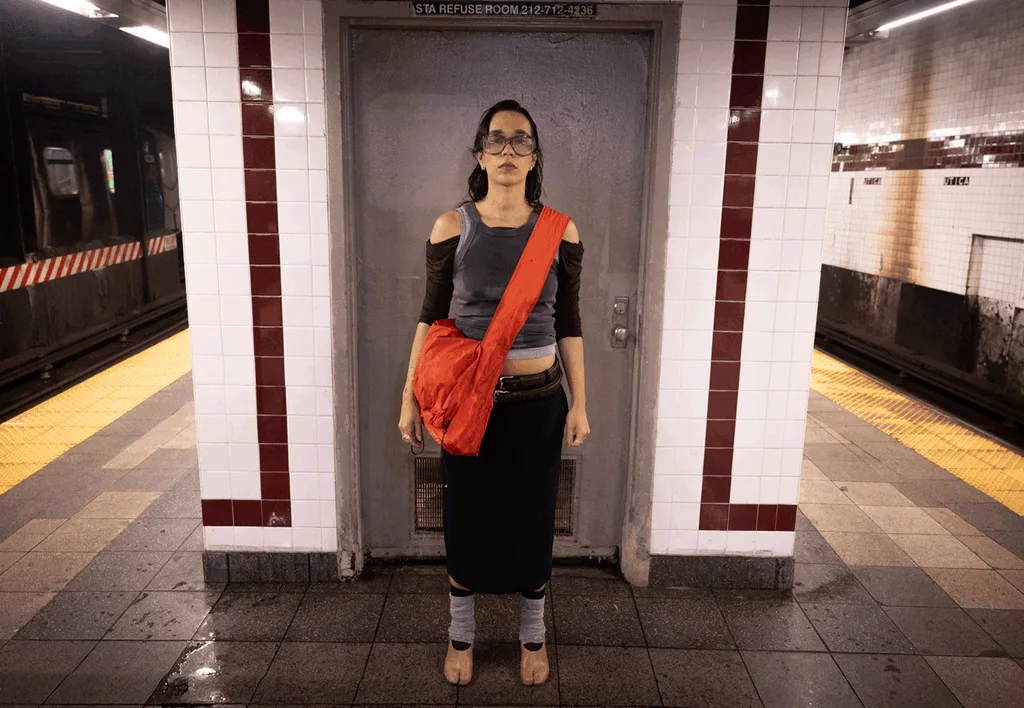

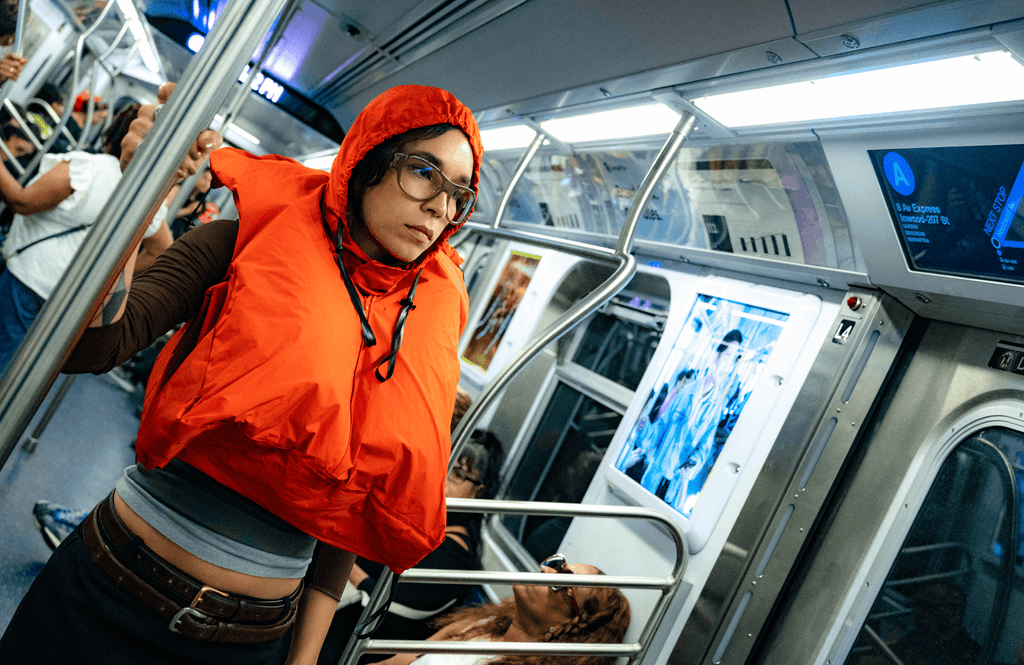
New York City’s bustling streets are no strangers to ubiquitous fashion statements, but a newly unveiled accessory is turning the concept of urban utility on its head. Debuting at the onset of Climate Week, "Lifeline" appears at first glance to be an ordinary, unassuming canvas-style tote bag designed for the daily commute or a quick trip to the local market. However, a closer inspection reveals a sobering reality: hidden within its minimalist seams is a high-performance flotation system directly adapted from marine life-jacket technology. Conceived not as a commercial product, but as a striking piece of cultural commentary and public warning, Lifeline is a collaborative protest against an escalating environmental crisis that is rapidly reshaping modern urban existence.
Developed by a collective of New York-based multidisciplinary artists led by creative director and artist Philip Le Brun alongside artist, designer, and architect Gabriela Mestriner, the bag is deliberately not for sale. Instead, it functions as a visceral physical manifestation of urban vulnerability. By taking arguably the most ubiquitous symbol of contemporary urban mobility—the tote bag—and weaponizing it for survival, the creators have established a poignant dialogue regarding the terrifying new normal of city living on the front lines of climate change.
The Anatomy of a Survival Accessory
The genesis of Lifeline was rooted in grassroots craftsmanship and iterative prototyping. Rejecting mass-manufacturing techniques, the artistic collective constructed the initial iterations by hand, beginning with a single rain jacket and an upcycled life vest. Through a meticulous process of trial and error, the creators heat-welded marine-grade components to allow for instant, reliable inflation when submerged or confronted with sudden deluges.
The finalized softgoods specification is deceptively simple yet rugged: exactly three yards of high-grade nylon, two invisible polyester zippers, four yards of heavy-duty black cord, and four adjustable metallic locks. Every stage of development—from initial sketches to stress-testing and dismantling—was conducted locally and manually. This hands-on approach mirrored the chaotic, improvisational nature of disaster response, contrasting sharply with the polished, frictionless consumerism typically associated with high-end urban accessories.
A Chronology of Crisis: New York’s Drowning Infrastructure
To understand the urgent cultural resonance of Lifeline, one must examine the rapidly deteriorating relationship between New York City’s century-old infrastructure and extreme weather events. The boundary separating ordinary daily life from environmental emergency has blurred dramatically over the past decade, transforming once-in-a-century climate anomalies into routine occurrences.
The timeline of urban flooding in New York City highlights an alarming acceleration in frequency and severity:
- September 2021 (Hurricane Ida): Serving as a devastating watershed moment, the remnants of Hurricane Ida swept through the metropolitan area, dumping a record-shattering three inches of rain in a single hour. The flash floods paralyzed the subway system, trapped motorists on major highways, and tragically claimed the lives of over a dozen residents, many of whom were trapped in illegal basement apartments.
- September 2023: Just two years later, another unprecedented deluge paralyzed the five boroughs, turning major thoroughfares into navigable rivers, flooding public schools, and forcing widespread transit shutdowns that impacted millions of daily commuters.
- Summer 2025: Marking a terrifying leap in frequency, the summer months brought relentless atmospheric instability, culminating in multiple severe weather warnings every single week from June through August.
- The Current Infrastructure Deficit: Historical municipal engineering standards built the city’s drainage and transit systems to withstand severe flooding events on a rare, once-every-five-years basis. Today, these critical thresholds are breached almost annually, leaving nearly 200 Metropolitan Transportation Authority (MTA) subway stations routinely vulnerable to catastrophic inundation during standard heavy rainstorms.
Juxtaposition of Privilege, Consumption, and Survival
The conceptual framework underpinning Lifeline addresses the deep socioeconomic disparities inherent in urban climate vulnerability. During urban disasters, the immediate impacts do not fall evenly across populations, neighborhoods, or geographical zones.
Reflecting on the psychological and physical tensions embodied by the project, Gabriela Mestriner noted that the transition of a mundane consumer object into an emergency lifeline creates a jarring rupture in daily consciousness. The accessory forces wearers to confront uncomfortable dichotomies: convenience versus emergency, mass consumption versus bare survival, and urban privilege versus systemic vulnerability. While affluent residents may possess the resources to evacuate, relocate, or effortlessly recover from property damage, marginalized communities frequently bear the brunt of compromised infrastructure, substandard housing stock, and inadequate municipal flood defenses.
By wearing a tote bag that doubles as a personal flotation device, the user becomes a walking paradox. The object highlights how modern citizens are expected to shoulder personal responsibility for systemic failures, carrying the literal weight of climate adaptation on their shoulders as municipal policies struggle to keep pace with environmental degradation.
Artistic Collective and Collaborative Execution
While spearheaded by Le Brun and Mestriner, the realization of the Lifeline project relied heavily on a synergistic collective of creative professionals who brought distinct technical disciplines to the table. The multidisciplinary team utilized their respective crafts to document, package, and broadcast the project’s stark message to a global audience.
The core production credits include:
- Concept & Creative Direction: Philip Le Brun, driving the overarching narrative of the project as a form of cultural protest.
- Art Direction, Bag Design & Performance: Gabriela Mestriner, whose architectural and design background informed the structural integrity and aesthetic paradox of the survival tote.
- Film & Editing: Jack Inzer, who captured the haunting cinematic footage illustrating the grim reality of the urban environment.
- Photography & Image Production: Emmett Orgass, responsible for producing the striking visual assets that document the bag’s assembly and deployment.
- Visual & Interactive Design: Julia Albuquerque, who translated the physical campaign into digital spaces.
- Stylist: Lucila Hernandes, who curated the integration of the bag into authentic streetwear aesthetics.
Broader Implications and the Future of Urban Adaptation
As global temperatures continue to rise and sea levels threaten coastal metropolises, artistic interventions like Lifeline serve a critical function within civic discourse. They bridge the gap between abstract scientific data and visceral human experience. While traditional municipal campaigns often rely on sterile pamphlets or digital public service announcements, Lifeline utilizes design disruption to pierce the collective apathy surrounding the climate emergency.
The refusal to commercialize the product is perhaps its most powerful statement. By keeping Lifeline out of retail channels, the creators ensure that it remains purely a monument to a reality that policymakers, developers, and citizens must actively work to prevent from becoming standard street fashion. The ultimate goal of Lifeline is not to spark a new trend in survivalist gear, but to render itself entirely obsolete.
As New York City and other major coastal urban centers look toward an uncertain environmental future, projects like Lifeline challenge inhabitants to look past the superficial convenience of modern consumer culture and confront the rising tides before the daily commute requires more than just an umbrella.