
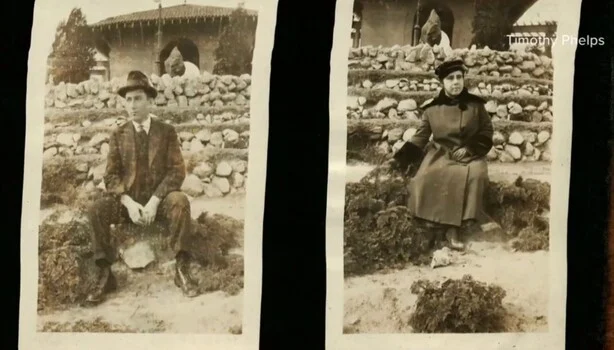

For nearly a century, the cinematic and historical legacy of America’s most notorious Depression-era outlaws, Bonnie Parker and Clyde Barrow, has been inextricably bound to a remarkably well-documented visual archive. From the iconic, theatrical snapshots recovered by law enforcement after a 1933 Joplin, Missouri, shootout to family-preserved albums handed down through generations, the visual record of the Barrow Gang has felt largely settled. However, a dusty photo album recovered from a suburban garage in Texas has reignited a fierce debate among historians, forensic experts, and memorabilia collectors, presenting what could be a trove of entirely unpublished photographs of the infamous duo.
Timothy Phelps, an independent researcher who has spent more than fifteen years meticulously investigating the lives and movements of Bonnie and Clyde, stumbled upon the artifact under unassuming circumstances. While assisting a friend in clearing out the garage belonging to the friend’s late father, Phelps discovered the weathered album tucked away among miscellaneous household items. Unaware of its potential significance at the time, Phelps left the album closed and untouched for approximately a year before finally deciding to examine its contents page by page.
Upon paging through the deteriorating album, Phelps’ attention was immediately arrested by a handwritten inscription identifying the legendary outlaws. Below a faded black-and-white snapshot, the names of Clyde Barrow and Bonnie Parker were carefully scrawled by an unknown hand.
"I knew in my heart it was them," Phelps recalled during a recent interview with Heavan Doyle of KIII 3News in Corpus Christi, Texas. Driven by that conviction, Phelps embarked on a multi-year investigative endeavor. He began systematically holding the newly discovered prints against officially authenticated, historically documented photographs of Parker and Barrow. Furthermore, he sought to track down the geographical settings depicted in the backgrounds of the frames, including one particular image featuring a building clearly marked with the word "hotel." His overarching objective has been to uncover definitive, contextual evidence placing the individuals in the prints squarely within the operational timeline and geography of the Barrow Gang.
The Roadblocks of Academic and Institutional Skepticism
While Phelps remains steadfast in his belief regarding the authenticity of the album, securing validation from institutional authorities and academic historians has proven to be an uphill battle fraught with professional skepticism and personal frustration. Phelps reports that many of the established museums, historical societies, and archiving institutions he approached flatly dismissed the photographs, declaring them impossible to authenticate. Worse still, Phelps claims he encountered considerable resistance, ranging from outright dismissal to condescension and, in some instances, direct threats as he pushed for formal evaluation.
The skepticism of the historical establishment is rooted in rigorous standards of artifact verification. In the historical and archival communities, visual materials without a documented chain of custody face an exceptionally high bar for acceptance. Without knowing who took the photographs, where they were developed, and how they passed from hand to hand over the decades, institutional historians are hesitant to endorse materials that could easily be misattributed or, in worst-case scenarios, elaborately fabricated.
Expert Evaluations: Anatomy Versus Provenance
Faced with institutional pushback, Phelps turned to independent experts specializing in historical forensics and artifact analysis. Their assessments have introduced a fascinating technical divide between historical methodology and forensic science.
Mark Hall-Patton, the retired administrator of the Clark County Museum System near Las Vegas—widely recognized by the public for his frequent appearances as an expert appraiser on the History Channel series Pawn Stars—examined the physical artifact. According to Phelps, Hall-Patton confirmed that the physical album, the photographic prints themselves, and the handwriting found within the pages were entirely consistent with the period of the early 1930s. However, Hall-Patton ultimately could not definitively identify the human subjects captured within the frames, citing the inherent limitations of dating physical media without contextual proof of identity.
Conversely, Houston forensic artist Lois Gibson, a Guinness World Record holder renowned for her exceptional number of successful suspect and victim identifications throughout her career, adopted a more definitive stance based on anatomical comparison. Gibson evaluated the photographs using advanced visual superimposition techniques.
"I put it in different degrees of transparency on top of the known Bonnie Parker photo, and every single feature lines up," Gibson stated, detailing her methodology to local news reporters. Reaching an identical conclusion regarding the male subject in the album, Gibson asserted, "That is the same facial bones in both of those men."
Gibson’s analytical framework rests heavily on human osteology rather than soft-tissue appearance. She explained that while a person’s weight, hairstyle, and age can significantly alter the soft tissues of the face over time, the underlying cranial and facial bone structure remains fundamentally unchanging. By comparing the skeletal geometry visible in the disputed prints with verified portraits of Barrow and Parker, Gibson concluded that the anatomical markers match with a high degree of precision.
The Critical Missing Link: Establishing Provenance
Despite the compelling anatomical alignments presented by forensic analysis, the central challenge facing Phelps’ discovery remains the elusive concept of provenance. In the realm of cultural heritage and historical collecting, provenance refers to the documented, unbroken chain of ownership that legally and historically ties an object directly to its purported subjects or creators.
Phelps acknowledges that the paper trail for the newly found album is virtually nonexistent prior to its presence in a California desert shack—a rumored origin passed along in hearsay—and its eventual resting place in a Texas garage.
"What they want is called provenance, chain of origin," Phelps noted, addressing the persistent demands of historians and appraisers. Without a verifiable history tracing the album from the possession of the outlaws, their associates, or contemporary law enforcement officers directly to the modern day, even the most striking visual similarities struggle to achieve universal acceptance within the historical canon.
A Comparative Look at Documented Paper Trails
To understand why provenance and verifiable paper trails are paramount in the study of Bonnie and Clyde, one must examine how the universally accepted images of the outlaws entered the public consciousness.
In April 1933, the Barrow Gang narrowly escaped a fierce shootout with law enforcement at a rented hideout apartment in Joplin, Missouri. In their hasty retreat, the outlaws left behind a wealth of personal possessions, including an advanced camera and several rolls of undeveloped photographic film. Police officers recovered the film and had it professionally developed at the local newspaper office, the Joplin Globe. Recognizing the immense public interest, the newspaper distributed the images over national news wires. Among them was the now-legendary photograph of Bonnie Parker casually posing with a cigar clenched between her teeth and a revolver gripped in her hand—an image that instantly cemented the romanticized, gun-moll mythology of the duo.
Family archives have similarly provided verifiable documentation supported by clear provenance. In September 1935, and through subsequent estate preservation, family-held artifacts have occasionally surfaced at auction houses with unimpeachable paper trails. For instance, in September 2025, RR Auction facilitated the sale of an extensive archive comprising approximately 600 photographs originating directly from the personal collection of Nell Barrow, the older sister of Clyde Barrow. Fetching $23,750, the collection included between 50 and 60 rare photographs of Bonnie and Clyde, several of which had originally been published in the 1934 biographical account co-authored by Nell Barrow and Emma Parker, Bonnie’s grieving mother. These items carried intrinsic historical value precisely because their custodial lineage was unbroken and fully documented.
Scientific Guidelines for Facial Comparison
In the modern era of digital imaging and forensic science, the methods used to authenticate historical photographs have undergone rigorous standardization. When researchers attempt to match faces across disparate historical photographs, forensic examiners emphasize that visual superimposition is merely one tool among many, rather than a definitive standalone proof.
According to methodological guidelines established by the Facial Identification Scientific Working Group (FISWG)—an organization originally launched by the Federal Bureau of Investigation in 2009—facial superimposition must always be rigorously paired with a comprehensive feature-by-feature comparative analysis. Furthermore, FISWG guidelines dictate that superimposition techniques should only be utilized when both source photographs share identical or highly comparable viewpoints.
Variables such as camera focal length, lens distortion, physical distance, and horizontal or vertical shooting angles can drastically alter how a human face is rendered on photographic film. This technical reality underscores why forensic guidelines insist on strict viewpoint matching before drawing conclusions.
Consequently, researchers analyzing Phelps’ discovered album note that the environmental settings captured in the background of the prints—such as the aforementioned hotel building and other identifiable architectural or streetscape markers—may ultimately carry just as much evidentiary weight as the facial features of the subjects. If historians can successfully identify and date the specific buildings, vehicles, or geographic locations visible in the background frames, they can establish an independent, verifiable timeline that does not rely solely on subjective anatomical interpretation.
Broader Implications for Depression-Era Historical Research
The emergence of Timothy Phelps’ photo album highlights a broader phenomenon within the study of American true crime and Depression-era history: the persistent public fascination with the Barrow Gang and the continuous struggle between amateur enthusiasm and professional historical validation.
Bonnie Parker and Clyde Barrow operated across the American Southwest and Midwest during the height of the Great Depression, from roughly 1932 until their violent deaths in a law enforcement ambush near Sailes, Bienville Parish, Louisiana, on May 23, 1934. During their crime spree, which encompassed bank robberies, small-town store holdups, and numerous murders, the couple actively cultivated their public image, frequently taking snapshots of themselves using automatic cameras and automated photo booths.
Because the outlaws frequently interacted with family members, sympathizers, and local acquaintances while moving through transient hideouts across multiple states, the possibility that additional photographic caches remain hidden in attics, garages, and estate sales is historically plausible. Yet, as the debate over Phelps’ album illustrates, finding such materials is only the first step in a long, arduous process.
As forensic technology continues to advance, providing tools like digital superimposition and enhanced osteological analysis, the gap between subjective historical narrative and empirical science is narrowing. However, the fundamental rules of archival integrity remain steadfast. Until the contextual history of the newly discovered prints can be securely mapped—or the architectural backdrops definitively traced to specific locales frequented by the Barrow Gang—the album will likely remain suspended in a state of historical purgatory: tantalizingly close to the legendary outlaws, yet officially unverified.
Detailed evaluations, side-by-side forensic comparison sheets compiled by Lois Gibson, and an extended look at the pages of Timothy Phelps’ mysterious photo album remain accessible via regional media broadcasts, keeping the ongoing investigation into America’s most infamous outlaws firmly in the public eye.