
The digital advertising landscape has undergone a significant transformation throughout 2026, with Meta’s Facebook platform emerging as a surprisingly cost-efficient engine for marketers. Comprehensive new research, which analyzed nearly 1,800 distinct Facebook advertising campaigns across a diverse range of industry verticals, reveals a tightening of performance metrics that suggests a maturation in Meta’s algorithmic delivery. By tracking key performance indicators—including click-through rate (CTR), cost per click (CPC), conversion rate (CVR), and cost per lead (CPL)—the study provides a definitive look at how the platform has balanced the competing needs of reach and acquisition in the current economic climate.
A Year of Efficiency: The 2026 Performance Landscape
The overarching narrative of the 2026 data is one of heightened efficiency. While many digital channels have seen fluctuating prices due to global inflation and increased competition for digital real estate, Facebook’s ecosystem has bucked the trend by lowering the barrier to entry for traffic-focused campaigns.
Traffic campaigns, specifically designed to drive users to external websites or landing pages, have seen a marked improvement in performance. Advertisers observed a 14% decrease in average CPC, while simultaneously benefiting from a 13% increase in CTR. This dual-positive trend suggests that the creative quality being served to audiences, combined with Meta’s improved machine-learning-driven delivery, is resonating more effectively with the platform’s user base.
The chronology of these shifts indicates a steady optimization period throughout the first three quarters of 2026. As Meta continued to refine its Advantage+ suite and automated bidding strategies, the platform moved away from manual bidding limitations, allowing for a more fluid auction environment that favored advertisers who leaned into the platform’s algorithmic recommendations.
Divergent Industry Trends in Traffic Generation
While the aggregate data paints a picture of lower costs, the experience varies significantly when segmented by industry. The study highlights a clear bifurcation between sectors that have successfully capitalized on these algorithmic changes and those that have faced headwinds.
The Real Estate sector emerged as the clear leader in efficiency, recording a substantial 39.56% decline in CPC. This is a critical development for a sector that historically struggles with high acquisition costs. Similarly, the Restaurants and Food industry saw a 37.50% drop in CPC, and the Industrial and Commercial sector experienced a 37.21% decrease. These sectors likely benefited from the platform’s ability to better identify high-intent local audiences, a direct result of improved location-based targeting capabilities.
Conversely, some industries faced rising costs. The Shopping, Collectibles, and Gifts sector saw a sharp 73.53% increase in CPC, likely driven by heightened competition and seasonal volatility. Sports and Recreation also saw a notable uptick of 43.90%. These outliers underscore that while the broader platform is trending toward efficiency, industry-specific demand and seasonality remain dominant variables in the auction process.

Lead Generation: Sustaining Value Amidst Change
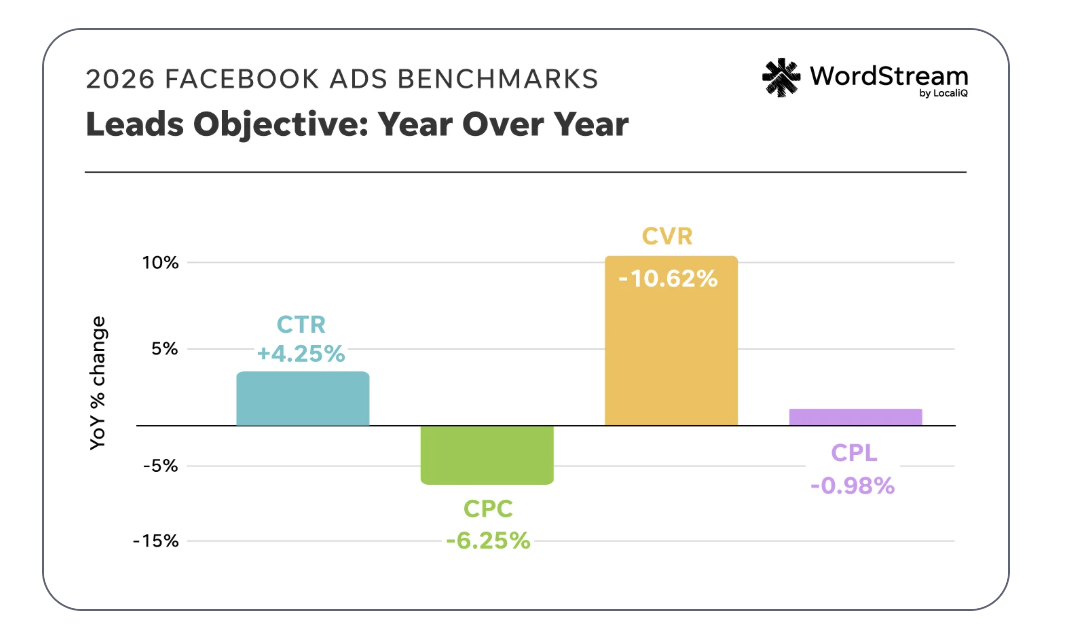
For advertisers focused on lead generation—where the goal is not merely a click but a contact submission—the data provides a reassuring outlook. Despite the dynamic nature of digital privacy regulations and user behavior shifts, the average cost per lead (CPL) remained largely flat throughout 2026.
This stability is significant. Maintaining a steady CPL while the platform undergoes backend changes suggests that the quality of leads may be improving even if the raw price per lead is not significantly dropping. Furthermore, the cost to secure a click within these lead campaigns also declined for the majority of industries. For instance, the Automotive (For Sale) sector saw a 44.17% drop in CPC, while the Dentistry and Health and Fitness sectors saw declines of 41.72% and 30.30%, respectively.
Only a small minority of industries saw an increase in lead campaign CPCs, with Education and Instruction (+4.24%) and Sports and Recreation (+0.93%) being the only notable exceptions. This consistency across the board suggests that Meta’s lead-generation infrastructure—specifically Instant Forms and native conversion tools—has reached a state of high optimization.
Strategic Implications for Paid Media Budgets
The 2026 benchmark data arrives at a pivotal moment for marketing directors tasked with balancing multi-channel budgets. A primary point of tension for many organizations is the allocation between Google Ads and Meta Ads.

According to the analysis, Google Ads CPC currently sits at more than double the average CPC found on the Meta platform. However, the data warrants a nuanced interpretation. Google Search, by its nature, captures users who are often further along the purchase journey, characterized by high intent. In contrast, Facebook operates on a discovery-based model. The fact that Facebook has made its traffic cheaper and more engaging suggests that the platform is successfully bridging the gap between "passive" social browsing and "active" consumer behavior.
For budget-conscious teams, this data implies that Facebook can now serve as a high-volume, lower-cost funnel to feed the more expensive, high-intent channels. By leveraging the 13% improvement in CTR and the lower CPCs, advertisers can effectively build broader audiences at a fraction of the cost, reserving higher-spend search campaigns for the final stage of conversion.
The Role of Algorithmic Optimization
The underlying cause of this performance boost appears to be the evolution of Meta’s internal bidding and campaign management tools. Industry analysts point to the aggressive implementation of AI-driven bidding as the primary catalyst. By automating the targeting process and removing manual constraints, the platform can scan millions of potential impressions in real-time, matching the right ad to the right user at the optimal price point.
This "black box" approach, while sometimes frustrating for advertisers seeking granular control, is clearly yielding results in terms of aggregate efficiency. The 2026 findings suggest that the platform is no longer just selling impressions; it is effectively optimizing for the desired business outcome, whether that is a website visit or a lead submission.
Future Outlook and Strategic Recommendations
As we look toward the remainder of the year and into 2027, the primary takeaway for marketers is clear: the era of manual micromanagement on Facebook is rapidly giving way to a period of algorithmic partnership. Advertisers who have embraced automated bidding and creative testing have largely seen their costs decrease and their engagement metrics rise.
However, the volatility observed in the Shopping and Sports sectors serves as a warning. Macroeconomic factors and seasonal competition will always have the power to override platform-wide trends. Therefore, the strategy for the coming months should involve a hybrid approach: using the platform’s automated tools to capture broad efficiencies, while maintaining strict, industry-specific monitoring to guard against sudden spikes in CPC.
In conclusion, the 2026 data paints a picture of a more robust, efficient, and cost-effective Facebook advertising ecosystem. For the average advertiser, the choice between scale and performance is becoming a false dilemma. By leaning into the current efficiency trends and utilizing the platform’s native lead-generation tools, organizations have a rare opportunity to stretch their paid social budgets further than they have in previous years, providing a more stable foundation for long-term growth. As the digital advertising landscape continues to consolidate around major players, Meta’s ability to maintain these benchmarks will be critical in sustaining its position as a cornerstone of the modern marketing mix.