
The digital marketing landscape is undergoing its most profound structural shift since the advent of search engine optimization (SEO), driven by the rapid evolution of generative artificial intelligence. As consumers increasingly turn to conversational AI platforms such as OpenAI’s ChatGPT, Perplexity, Google Gemini, and Microsoft Copilot to answer complex queries, traditional search engine results pages (SERPs) are being bypassed. Instead of presenting a curated list of clickable blue links, modern answer engines synthesize information from multiple web sources into a single, comprehensive response. This shift has given rise to a critical blind spot for brands: zero-click visibility. When an AI provides a definitive answer to a user’s question, it may mention a brand or cite a source without requiring the user to visit the underlying website. Consequently, traditional traffic metrics and rank trackers are no longer sufficient to measure digital presence. To address this challenge, businesses are increasingly adopting Answer Engine Optimization (AEO) checkers—specialized diagnostic tools designed to audit, monitor, and improve how generative AI platforms perceive, cite, and recommend brands.
![AEO checker tools that measure answer engine visibility [2026]](https://no-cache.hubspot.com/cta/default/53/9dd5e54b-fbef-4dd0-bc44-1689feb1ea18.png)
The transition from keyword-driven search to conversational query resolution represents a fundamental reengineering of how human beings discover information online. For decades, the digital economy operated on a transactional model: a user typed keywords into a search engine, the engine returned a ranked list of URLs, and the user clicked through to a website to find information, evaluate products, or make a purchase. SEO strategies were built around securing top rankings for high-volume keywords, optimizing meta tags, and building authoritative backlink profiles to signal trustworthiness to search algorithms. However, the launch of Google’s AI Overviews in May 2024, alongside the explosive mainstream adoption of autonomous conversational models, accelerated a paradigm shift toward synthesized answers. In this new ecosystem, the search engine itself consumes the content, processes the data, and delivers the final conclusion directly to the user. For brands, this means that visibility is no longer guaranteed by ranking second or third on a page of links. If an AI engine’s underlying retrieval-augmented generation (RAG) system fails to recognize a brand as an authoritative entity, the company effectively ceases to exist within that conversational context. Industry analysts note that this zero-click reality has fundamentally altered consumer journeys, shortening the path to decision-making while obscuring the provenance of the information driving those decisions. This growing friction has forced marketing departments to pivot their analytics focus from traffic acquisition to brand citation and entity recognition.
![AEO checker tools that measure answer engine visibility [2026]](https://53.fs1.hubspotusercontent-na1.net/hubfs/53/aeo-checker-2-20260903-852936.webp)
To navigate this opaque environment, software developers and marketing technology firms have introduced AEO checkers—diagnostic platforms engineered to monitor brand performance across generative search environments. Unlike traditional SEO tools that evaluate keyword positions and backlink counts, an AEO checker performs several distinct functions tailored to conversational AI. First, it continuously tracks brand visibility by running automated prompt arrays across multiple engines, including ChatGPT, Perplexity, Gemini, and AI Overviews. Second, it distinguishes between brand citations—where an AI model links directly back to a company’s domain as a source—and brand mentions, where a company is referenced in the text without an accompanying hyperlink. Third, these tools evaluate sentiment analysis, determining whether the AI frames the brand positively, neutrally, or negatively in comparison to market competitors. Furthermore, advanced AEO checkers audit underlying technical elements such as structured data (schema markup), entity graphs, and crawler accessibility, ensuring that AI bots can easily parse, index, and trust a website’s content. By aggregating these data points into a unified dashboard, AEO checkers provide marketing teams with actionable recommendations, highlighting content gaps where competitors are being favored and suggesting structural updates to improve citation rates.
![AEO checker tools that measure answer engine visibility [2026]](https://53.fs1.hubspotusercontent-na1.net/hubfs/53/aeo-checker-3-20260903-8904553.webp)
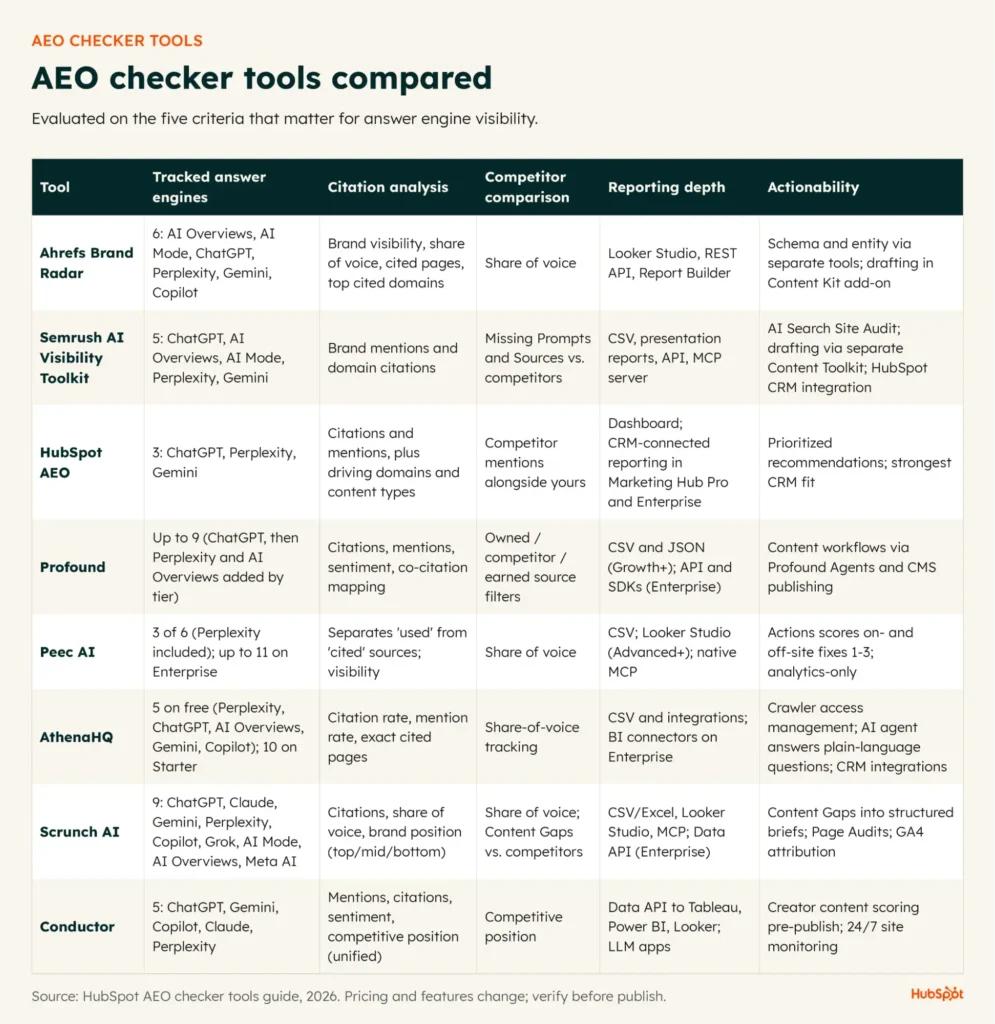
Evaluating and implementing an effective AEO strategy requires understanding the nuanced ways different generative platforms surface information. For instance, Perplexity attaches inline citations to nearly every assertion it makes, populating a dedicated sidebar with source links that users can inspect. ChatGPT integrates web search dynamically when a query demands current data, displaying citation indicators that link back to original publishers. Google AI Overviews, meanwhile, trigger selectively based on whether Google’s algorithms determine that an AI-generated summary adds genuine value to a classic search query. Because these outputs are dynamic and prone to fluctuation based on session context, geographic location, and prompt phrasing, manual spot-checking quickly becomes inefficient at scale. Consequently, automated enterprise and mid-market AEO platforms—ranging from specialized pure-play tools like Peec AI and Profound to established suite extensions from HubSpot, Ahrefs, and Semrush—have emerged as essential infrastructure for modern digital visibility management. These tools automate the tedious process of prompt iteration, logging historical performance trends and enabling organizations to quantify their share of voice within AI-generated ecosystems.
![AEO checker tools that measure answer engine visibility [2026]](https://53.fs1.hubspotusercontent-na1.net/hubfs/53/aeo-checker-4-20260903-6212698.webp)
The financial and operational implications of this technological shift are substantial. Traditional marketing attribution models rely heavily on click-through traffic and session data captured by web analytics platforms. However, because generative AI frequently resolves user queries without a click, a vast amount of brand influence occurs entirely off-site. Forward-thinking organizations are adapting by establishing new key performance indicators (KPIs), such as AI Visibility Scores, Citation Share of Voice, and Uncited-Prompt Ratios. By tracking these metrics over time, companies can gauge their conceptual authority within specific market niches. Moreover, integrated ecosystems—such as HubSpot’s AEO tooling embedded within Marketing Hub—are beginning to bridge the gap between AI diagnosis and content execution. By connecting AEO diagnostics directly to a Customer Relationship Management (CRM) database and generative content agents, these platforms allow marketing teams to transform an AI citation gap into a research-backed, brand-aligned content draft with minimal manual friction. While traditional SEO tools remain indispensable for maintaining technical crawlability and baseline authority, the parallel adoption of AEO checkers marks a permanent maturation in digital strategy, ensuring that brands remain visible, accurate, and influential in the rapidly expanding universe of artificial intelligence.