

The digital landscape is undergoing a profound structural evolution, marked by significant regulatory adjustments in Europe, the quiet return of critical analytics for small businesses, and the rapidly shifting mechanics of artificial intelligence-driven product discovery. For digital marketers, search engine optimization (SEO) professionals, and enterprise strategists, recent weeks have brought a wave of updates that fundamentally alter how commercial visibility is measured, earned, and maintained.
From the European Economic Area (EEA) to global Google Business Profiles and the burgeoning ecosystem of AI shopping assistants like ChatGPT, the rules of digital engagement are shifting. These developments suggest that traditional keyword optimization and traditional link-building strategies are no longer sufficient on their own. Instead, success increasingly relies on structured data feeds, technical platform compliance, historical trust, and structural alignment with algorithmic shifts.
Google Redesigned Commercial Search Results Across The European Economic Area
Google has officially introduced a radical new layout for search results targeting commercial queries within the European Economic Area (EEA). This regulatory-driven redesign features specialized, dedicated units specifically engineered for price-comparison sites and direct suppliers. Formally documented by Google Search Central on September 8, the rollout represents a direct response to regional digital market regulations, which mandate fairer visibility for aggregator platforms and independent providers.
Under the newly implemented framework, comparison sites (often referred to as aggregators) receive a specialized unit where the top-ranked provider is expanded by default. However, securing placement within this unit is not automatic; aggregators must perform substantial technical work, including establishing and maintaining specific data feeds or application programming interfaces (APIs) to integrate with Google’s infrastructure. Conversely, direct suppliers receive their own dedicated unit requiring no extra data submission work. There is, however, a critical structural caveat: the direct supplier unit only appears alongside an aggregator unit, establishing a symbiotic visibility model.
Alongside these changes, Google also introduced a centralized regional hub outlining seven distinct regional features deployed across the EEA, Türkiye, and South Africa.
The implications for analytics and performance measurement are immediate. Enterprise rank-tracking tools and Search Console data originating from these European nations may diverge significantly from what the exact same queries return in other global regions. Consequently, marketing teams observing a sudden regional performance decline must perform granular audits; the drop may simply be a byproduct of the new results layout rather than a genuine loss in organic search performance or consumer interest.
The Return of View Counts on Google Business Profiles
After an absence of more than three and a half years, Google has officially begun rolling out view counts globally for Google Business Profile posts. The long-awaited metric provides local businesses and multi-location enterprises with a renewed window into consumer interaction across Google Search and Google Maps.
The announcement was quietly delivered via the September Small Business Bulletin, published in the Business Profile Help Community by Google employee Lisa Landsman. According to the rollout specifications, the updated view counts appear directly on each individual post card within the merchant dashboard. The system covers posts from the past eighteen months on a rolling basis, aggregating views seamlessly from both Search and Maps surfaces. However, Google has confirmed that this data is not yet accessible via the Business Profile API, limiting automated reporting capabilities for enterprise-level local SEO management platforms.
The historical context of this feature is notable. Google abruptly discontinued previous post metrics on February 20, 2023, leaving local business owners in a metrics vacuum without any official replacement for nearly 44 months. During this prolonged blackout, post performance across updates, promotional offers, and corporate events remained a persistent blind spot for local search optimization strategies.
Industry analysts emphasize an important distinction regarding the restored metric: the count tracks impressions and views rather than user clicks, which Google previously retired. Therefore, the numerical data indicates whether a post was seen by a potential customer, but it does not measure direct transactional impact or subsequent conversion behavior. Local businesses must adjust their interpretation metrics accordingly, using view counts as a gauge of top-of-funnel brand awareness rather than bottom-line lead generation.
ChatGPT Shopping Relies Heavily on Feed-Integrated Sources
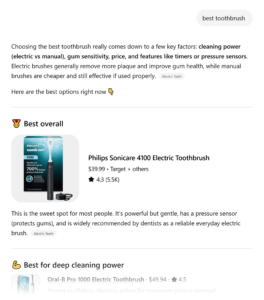
The mechanics of AI-driven product discovery are coming into sharper focus, thanks to recent empirical data highlighting how conversational models source recommendations. According to findings from data analytics firm Profound, ChatGPT Shopping relies overwhelmingly on product choices drawn from feed-integrated sources rather than purely organic, web-crawled search indexes.
Profound’s analytical tracking revealed a dramatic shift in recommendation sourcing: feed-integrated product recommendations surged from a meager 8.26% to an overwhelming 61.54% on July 10, remaining dominant across 1,757,723 tracked prompt runs throughout the month of July. Profound operates by processing daily prompts and categorizing the products surfaced in the raw system logs. While this proprietary dataset reflects one vendor’s specific prompt tracking rather than universal consumer shopping sessions, the trend is unmistakable.
The business impact of this architectural preference was swift and severe for unprepared retailers. Between the periods of July 7–9 and July 10–12, approximately 450 out of 687 Profound client brands experienced at least a one-third decrease in their ChatGPT Shopping visibility. Conversely, 67 brands gained an equivalent or greater surge in visibility over the same timeframe.
This data underscores a vital strategic shift for e-commerce brands. Securing a presence in AI-driven shopping recommendations increasingly requires establishing a direct, feed-based pipeline into emerging AI recommendation engines. Traditional organic ranking methods—while still foundational for traditional search engines—may leave brands invisible within conversational commerce environments if they lack structured product feeds.
The Lasting Impact of Old Low-Value Pages on Site Recovery
As search engine algorithms grow more sophisticated in assessing overall site quality, technical leadership at Google continues to warn webmasters about the lingering dangers of historical low-value content. Google Search Advocate John Mueller recently addressed a common misconception among site operators: the belief that deleting or updating problematic programmatic pages instantly restores a site’s algorithmic standing.
Mueller’s comments were made in response to a site operator whose web infrastructure had automatically generated thousands of low-value pages by combining domain names, technologies, and superficial attributes. Mueller suggested that such automated, programmatic bloat may cause Google’s core quality systems to "possibly lost faith in your site providing good value to users."
The core distinction highlighted by Google’s engineering team is that cleaning up technical errors and actively demonstrating sustained value to users are two entirely separate operational challenges. Even after a site owner performs extensive technical pruning, redirects, or structural updates to remove low-quality pages, regaining the trust of Google’s evaluation systems requires patience and consistent evidence of high utility. Algorithmic recovery from severe quality penalties or programmatic over-generation is rarely instantaneous; it requires a prolonged period of demonstrated editorial and structural integrity.
Severe Visibility Loss Following UK Domain Migrations
Migrating an established news publication from a country-code top-level domain to a generic top-level domain carries immense technical and algorithmic risk. A striking case study shared by NewzDash founder John Shehata illustrates the catastrophic potential of such moves: a UK-based news website experienced a staggering 98% collapse in its visibility on trending Google News searches within just two weeks of switching its domain extension from .co.uk to .com.
According to data presented by Shehata, the unnamed UK publisher had maintained a stable Search Visibility percentage of 1% to 2% for heavily monitored news queries over the 14-month period preceding the domain migration. However, following the structural change, visibility plummeted to a nominal 0.02% within fourteen days. Four months post-migration, the site had failed to recover any meaningful share of its prior news visibility.
Industry analysts note that domain migrations are exceptionally difficult to reverse once algorithmic authority has been fractured. While Shehata noted that the publisher was simultaneously navigating broader core algorithm updates and concurrent technical challenges—implying that the domain shift may not have been the sole catalyst—the timeline serves as a cautionary tale. Website migrations must never be treated as quick operational tasks. Strategic planning for domain transitions requires budgeting for a prolonged recovery window measured in months, not the standard weeks associated with routine ranking fluctuations.
Strategic Implications: The Rise of "Inclusion Before Ranking"
Synthesizing these disparate developments reveals a unified overarching theme defining the current era of digital marketing: the critical importance of inclusion preceding traditional ranking.
Across multiple search ecosystems, the primary barrier to entry is no longer merely outranking a competitor for a specific keyword; it is gaining structural admission into the system itself. In the European Economic Area, Google’s redesigned commercial search layout dictates that a brand must submit a structured data feed simply to be considered within aggregator units. Similarly, within ChatGPT’s shopping ecosystem, the vast majority of product recommendations flow directly from connected merchant feeds rather than traditional organic link graphs. Furthermore, structural domain shifts and historical low-value pages demonstrate that foundational trust and technical compliance must be established before any content can successfully compete for visibility.
For digital strategists, this evolution requires a fundamental realignment of departmental priorities. Feeds, structured data compliance, and technical domain architecture historically resided outside the direct purview of traditional SEO ranking teams. Today, these technical foundations serve as the absolute gatekeepers of digital visibility. Whether navigating regional regulatory frameworks in Europe, adapting to the return of local Business Profile metrics, or optimizing for conversational AI discovery, organizations must prioritize data pipeline integration and technical hygiene to secure their place in the modern search economy.