
For decades, the digital landscape has been defined by a rigid contract: users must navigate complex menus, forms, and labyrinthine sales funnels to achieve their goals. Since the introduction of the Xerox Star and the Apple Macintosh, the Graphical User Interface (GUI) has been the primary mediator between human intent and machine execution. However, this long-standing paradigm is currently undergoing a structural transformation. Driven by the rapid maturation of Large Language Models (LLMs) and autonomous agent frameworks, the web is shifting away from the "point-and-click" model toward a new era of intent-driven design. In this model, the user defines a goal, and the software silently manages the mechanical execution required to fulfill it, effectively rendering traditional interface elements obsolete.
A Chronology of Interface Evolution

The trajectory of human-computer interaction (HCI) has been marked by a continuous effort to reduce friction. In the early 1980s, the shift from Command Line Interfaces (CLI) to GUIs was hailed as a revolution in accessibility, allowing users to interact with files and applications via visual metaphors like folders and icons. By the early 2000s, the rise of the web browser solidified the "form-fill" era, where e-commerce and SaaS platforms standardized the multi-step checkout and dashboard workflows.
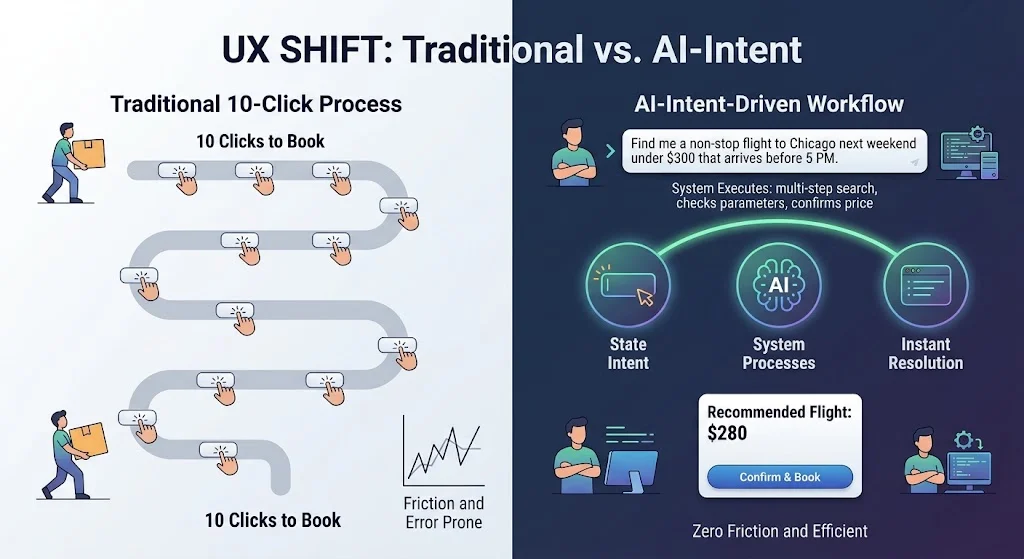
However, research from the Nielsen Norman Group suggests that this model has reached a point of diminishing returns. As applications have become more feature-rich, the cognitive load on users has skyrocketed. A typical flight booking process, for instance, requires a user to engage with at least ten distinct interaction points: selecting dates, toggling filters for non-stop flights, inputting passenger details, and navigating payment gateways. This is a passive-mechanical process where the software provides the container, and the human provides the labor. The current shift toward intent-driven design represents the next logical step in HCI: moving from manual orchestration to autonomous goal fulfillment.
The Mechanism of Intent-Driven Systems
Intent-driven design relies on three core pillars that fundamentally alter how software is built and consumed. The first pillar is high-level goal processing. Instead of a series of sequential inputs, the system uses natural language processing to extract the user’s ultimate objective—such as "Find a flight to Chicago under $300 arriving before 5 PM." The system, acting as an agent, processes these constraints against real-time data to present a single, actionable resolution.
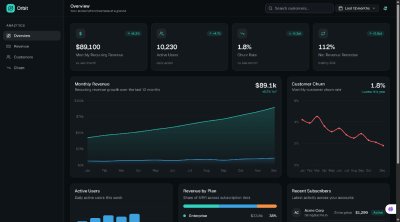
The second pillar is Generative User Interface (GUI 2.0). Unlike traditional static layouts, where every user sees the same navigation bar and sidebars, generative systems render the interface in real-time. If a user needs to analyze financial data, the system generates a custom calculator widget on the fly. Once the task is finished, the widget disappears. This reduces interface clutter and minimizes the search time traditionally spent navigating through irrelevant dashboard modules.
The third pillar is autonomous execution. By delegating the retrieval, comparison, and verification of data to AI agents, the software reduces the user’s role from "operator" to "supervisor." This shift necessitates a new approach to error handling. As noted in the Google PAIR (People + AI Research) Guidebook, the traditional "prevention-first" model of warning modals must be replaced by a "recovery-first" model. When an AI acts on behalf of a user, the design must prioritize clear, transparent audit logs and frictionless "undo" capabilities, ensuring that users maintain a sense of agency despite the automation.

Data and Industry Impact
The economic implications of this transition are significant. Industry data indicates that user abandonment rates in complex forms often exceed 60% due to "form fatigue." By replacing these processes with intent-based systems, companies are observing higher conversion rates and lower support ticket volumes. For example, platforms like Perplexity AI have demonstrated that users prefer synthesized, direct answers over the traditional "ten blue links" model of search. By bypassing the need to open multiple tabs, these platforms have redefined the search experience, effectively capturing user intent at the source.
Furthermore, the rise of tools like Vercel’s v0 illustrates how design itself is being automated. By converting natural language prompts into functional React components, these platforms allow for rapid prototyping that bypasses the manual labor of drawing rectangles or manually coding CSS. This does not necessarily eliminate the need for designers; rather, it shifts their focus. The professional designer’s role is evolving from the "pixel-pusher" to the "architect of intent." Designers must now define the constraints of the AI, the tone of the system, and the ethical boundaries of the autonomous agents.
Ethical Considerations and the Black Box Problem
While the removal of interface friction is a primary goal, the move toward invisible software introduces complex ethical challenges. The "Black Box" problem remains a significant hurdle: when a system provides an answer, how can the user verify its reasoning? Transparency in feedback loops is critical. If a system suggests a financial transaction or a travel itinerary, it must clearly display the criteria it used to arrive at that decision.
The Stanford Human-Computer Interaction (HCI) Group has emphasized that automation must not cross the line into manipulation. There is a growing concern regarding "dark patterns" in AI, where systems might subtly guide users toward outcomes that benefit the platform rather than the user. To mitigate this, developers are being urged to adopt the principles of the Center for Humane Technology, which advocates for "time well-spent" metrics. The success of a digital product should no longer be measured by "time-on-site" or "clicks-per-session," but by the efficiency with which a user’s problem is resolved.
Future Implications for the Web
As we move toward the latter half of the decade, the concept of the "website" as a collection of pages is likely to fade. We are transitioning toward a "component-based, intent-responsive" web. This future is not necessarily "no interface"—a term coined by Golden Krishna—but rather an "adaptive interface." The goal is for the UI to be as temporary and fluid as the human thought process itself.
In professional environments, this shift will likely force a re-evaluation of software procurement. Enterprise systems that rely on legacy, high-friction interfaces will face increasing pressure to adopt API-first architectures that allow AI agents to interact with their databases directly. This will create a more interconnected web, where disparate services communicate via intent-fulfillment agents rather than requiring users to manually copy and paste data between applications.
Conclusion
The evolution from the point-and-click paradigm to intent-driven design is not merely a technological trend; it is a fundamental shift in how humans interact with the digital world. By prioritizing the user’s intent over the mechanism of interaction, developers and designers can create systems that are more intuitive, efficient, and human-centered. The ultimate measure of progress in this new era will be the invisibility of the software. When a user can achieve a complex goal with a single, clear command, the interface has fulfilled its primary purpose: to disappear, leaving the user with the result they desired, not the labor they were forced to endure. As we refine these systems, the industry must remain vigilant in its commitment to transparency, ethical design, and user autonomy, ensuring that as interfaces die, human agency remains the core of the digital experience.