
The architecture of digital discovery is undergoing a seismic transformation. For decades, the digital economy operated on a predictable paradigm: users submitted queries to search engines, reviewed a ranked list of blue links, clicked through to a destination website, and engaged with content on the publisher’s domain. Today, that linear user journey is rapidly dissolving. When modern consumers turn to conversational artificial intelligence platforms such as OpenAI’s ChatGPT, Perplexity, Google Gemini, or Google AI Overviews, they increasingly receive synthesized, comprehensive answers directly on the results page. Often, the user acts on this synthesized response without ever visiting the underlying source websites.
This shift has introduced a profound visibility crisis for brands, publishers, and digital marketers. Traditional search engine optimization (SEO) metrics—historically anchored in keyword rankings, click-through rates, and page-one positions—no longer paint an accurate picture of market visibility. If an AI engine answers a high-intent buyer question by recommending a competitor while omitting your brand entirely, your traditional rankings matter very little. You are effectively invisible in the spaces where modern consumer decisions are finalized.
To combat this erosion of visibility, digital strategists have increasingly turned to Answer Engine Optimization (AEO). Operating at the intersection of technical SEO, entity modeling, and natural language processing, AEO is the deliberate practice of optimizing content so that brands are accurately cited, mentioned, and recommended within AI-generated responses. Because manual tracking of conversational engines quickly becomes unmanageable at scale, a new category of specialized software known as AEO checkers has emerged. These tools measure brand visibility across generative platforms, diagnose content gaps, and prescribe actionable structural fixes.
Understanding Answer Engine Optimization and the Mechanics of Generative Search

To comprehend the necessity of AEO checkers, one must first understand the underlying mechanics of generative search engines. Unlike legacy search engines that primarily index pages based on keyword density, backlink profiles, and technical crawlability, answer engines ingest massive corpuses of information, synthesize the data, and formulate contextual responses. When Google launched AI Overviews in May 2024, it permanently altered its flagship search engine results pages (SERPs) to prioritize summaries over static link lists. Similarly, platforms like Perplexity and ChatGPT rely on real-time web retrieval to fetch authoritative, highly structured content to answer complex user queries.
SEO and AEO are not competing disciplines; rather, they address two distinct halves of the same digital marketing challenge. SEO focuses on securing a position within a list of links, while AEO focuses on earning citations, brand mentions, and direct recommendations inside the synthesized text block. However, the two remain deeply symbiotic. Robust foundational SEO—characterized by clean technical architecture, crawlability, and verifiable authority signals—supplies the bedrock trust that answer engines rely on when selecting which sources to parse and cite. When an AI model generates a response, it seeks content that is structured logically, answers explicit user intent directly, and derives authority from verifiable primary sources.
The Anatomy and Workflow of an AEO Checker
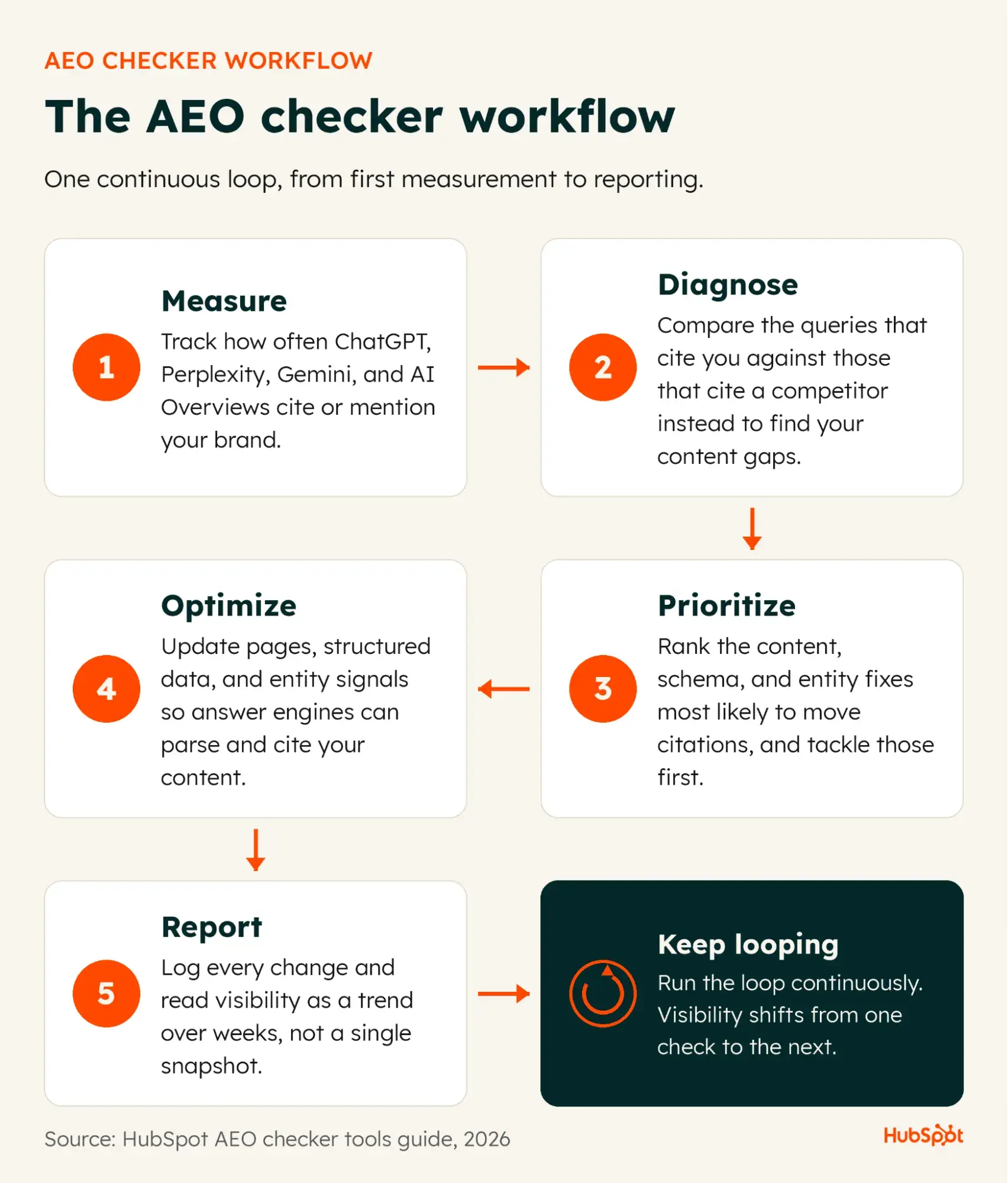
Because AI-generated answers are dynamic, personalized, and frequently ephemeral, monitoring brand presence manually is an uphill battle. A professional-grade AEO checker automates this surveillance, providing a continuous diagnostic loop that measures visibility, isolates content gaps, and prioritizes remediation efforts.
An effective AEO checker evaluates several critical dimensions of digital presence:

- Citation Frequency: Measuring how often an engine links directly to your domain as an authoritative source within a generated response.
- Brand Mention Analysis: Tracking instances where your brand name, product, or service is referenced in the body of the answer, even if a direct hyperlink is absent.
- Competitor Benchmarking: Identifying which rival brands capture citations for your priority target queries and analyzing the source material powering their success.
- Semantic Accuracy: Detecting whether AI engines present accurate information regarding your pricing, features, and use cases, or if they perpetuate factual inaccuracies or hallucinations.
- Technical Readability: Assessing whether server-side rendering, schema markup, and site architecture permit AI crawlers to efficiently parse your web properties.
Once these parameters are ingested, the software ranks remediation tasks, flagging schema corrections, entity adjustments, and content expansions that offer the highest probability of improving citation rates.
Manual Versus Automated Verification Protocols
While automated software represents the gold standard for enterprise scalability, understanding manual verification remains essential for baseline audits and smaller datasets.
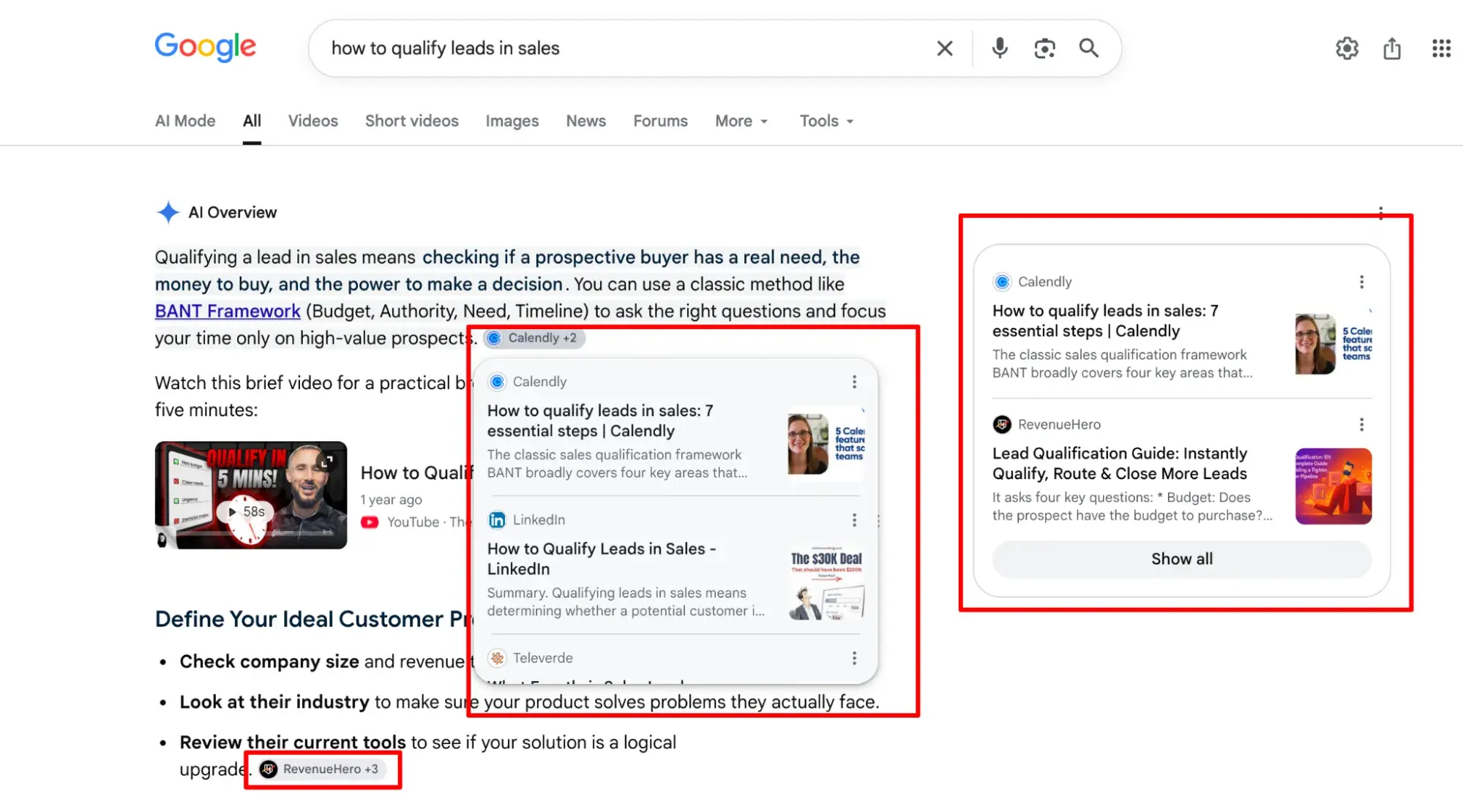
Conducting a manual audit across Google AI Overviews requires systematic execution. First, strategists must define a curated list of priority queries encompassing brand names, branded product terms, and high-intent informational questions that prospective buyers typically ask. These searches must be executed in signed-out or incognito browsing sessions to prevent algorithmic personalization from skewing results. Because Google AI Overviews do not trigger for every query—deploying only when systems determine a summary genuinely enhances the standard search experience—sampling across multiple sessions is mandatory. When an AI Overview does appear, auditors must record whether their domain appears among the inline source links and document the exact claims made by the model.
Checking citations on conversational platforms like ChatGPT and Perplexity follows a similar methodology. Perplexity routinely attaches inline citations to every response, accompanied by a dedicated sidebar panel listing all referenced sources. ChatGPT displays inline citations when web search protocols are activated, alongside a corresponding sources panel beneath the dialogue box. Because these platforms retrieve live web data dynamically, prompts must be carefully phrased to mirror real-world user intent—such as requesting comparisons of specific software categories for defined business use cases—thereby forcing the engine to fetch current, inspectable sources.
Evaluating AEO Software: Core Buyer Criteria
As the market for AEO software matures, selecting the right platform requires careful evaluation against specific operational requirements. Organizations must look beyond basic keyword tracking and prioritize tools that offer:
- Multi-Engine Coverage: The capability to monitor visibility across all major generative ecosystems, including ChatGPT, Perplexity, Gemini, and Google AI Overviews.
- Citation Versus Mention Differentiation: The analytical precision to distinguish between a hyperlinked citation and an unlinked brand mention, providing a granular view of true authority transfer.
- Historical Trend Analysis: Longitudinal tracking capabilities that visualize visibility scores over weeks and months, filtering out the inherent volatility of dynamic AI responses.
- Actionable Remediation: Features that translate diagnostic failures into concrete, prioritized content and technical recommendations rather than merely dumping raw data logs.
- CRM and Analytics Integration: Advanced enterprise platforms that bridge the gap between AI visibility and downstream pipeline metrics, connecting zero-click impressions to actual business revenue.
Landscape of Leading AEO Checking Tools
The current marketplace features a diverse array of specialized tools designed to help organizations audit and improve their generative search footprint.
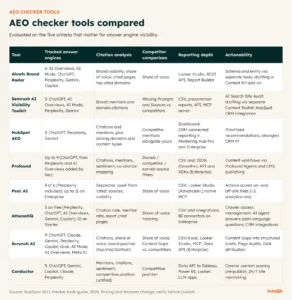
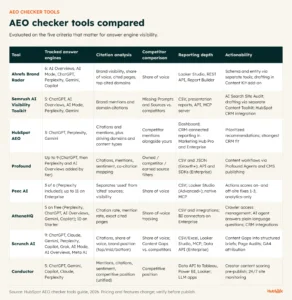
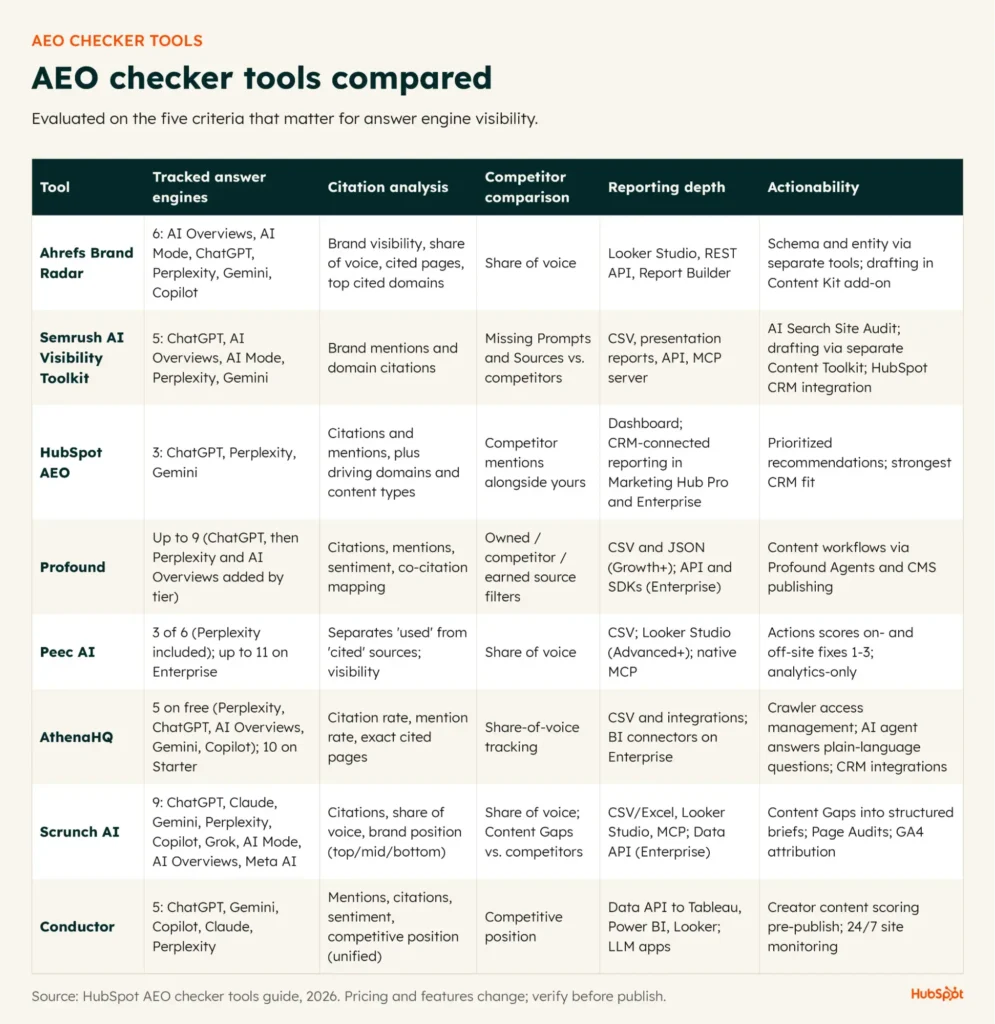
Among tools specializing in Google AI Overviews tracking, platforms like Ahrefs Brand Radar and Semrush AI Visibility Toolkit leverage massive organic search indices to flag which ranking keywords already trigger AI summaries, allowing brands to optimize near-inclusion pages.
For dedicated ChatGPT citation detection, tools like HubSpot AEO track both citations and mentions, alongside the specific competitor domains driving visibility. Platforms such as Profound offer deeper contextual analysis, including sentiment scoring, uncited-prompt flagging, and source-type breakdowns (owned, earned, and competitor).
When monitoring Perplexity specifically, solutions like Peec AI and AthenaHQ provide streamlined analytics and conversational assistants well-suited for tracking real-time retrieval patterns. Meanwhile, tools focusing on technical readiness, such as Scrunch AI and Conductor, ensure that site architecture, schema markup, and entity definitions remain fully optimized for AI crawler consumption.
Key Metrics That Matter in Answer Engine Optimization
Transitioning from traditional SEO analytics to AEO measurement requires tracking a refined set of performance indicators. Chief among these is the Aggregate Visibility Score, which quantifies your overall presence across multiple generative engines over time. Share of Voice (SOV) within AI answers measures your brand’s footprint relative to key competitors for a defined prompt universe. Citation Coverage tracks the percentage of relevant queries where your domain is explicitly referenced as an authoritative source.
Crucially, digital marketers must reconcile the reality of zero-click influence. Because answer engines frequently resolve user intent without generating a traditional outbound click, traditional web analytics will not capture the entirety of AEO’s impact. Consequently, marketing teams must monitor proxy metrics, including branded search lift, direct traffic spikes, and AI-referred session data, reading these metrics as longitudinal trends rather than relying on isolated snapshots.

From Measurement to Action: Enterprise Integration
Historically, specialized SEO and AEO auditing tools have suffered from a fundamental operational limitation: they end at diagnosis. They identify visibility gaps, flag missing schema, and surface content opportunities, but leave the execution phase entirely to the user, requiring disparate teams to export data, brief writers, and manually rebuild fixes across separate content management systems.
Forward-thinking enterprise platforms are actively bridging this gap by unifying diagnosis and execution within a single workflow. For example, HubSpot AEO translates visibility data into prioritized, context-aware recommendations, specifying precisely what content to create, update, or restructure. Advanced enterprise integrations leverage CRM data to power AI content agents that generate research-backed first drafts aligned with a brand’s distinct voice. These drafts integrate directly into native content editors, allowing marketing teams to refine and publish optimized material seamlessly. Furthermore, by anchoring these workflows to a smart CRM, organizations can attribute traffic originating from AI tools as a distinct channel, tying zero-click visibility and referral sessions directly to downstream contacts and pipeline revenue.
Future Outlook and Strategic Imperatives
As artificial intelligence continues to redefine how humanity accesses information, optimizing for answer engines is no longer an experimental marketing tactic—it is a core operational necessity. The digital landscape will continue to penalize static, legacy optimization strategies while rewarding brands that embrace structured data, authoritative entity positioning, and rigorous visibility monitoring. By deploying robust AEO checking tools, establishing systematic auditing protocols, and aligning diagnostic insights with agile content creation, organizations can secure their foothold in the generative search era, ensuring their brand remains visible, trusted, and recommended when it matters most.