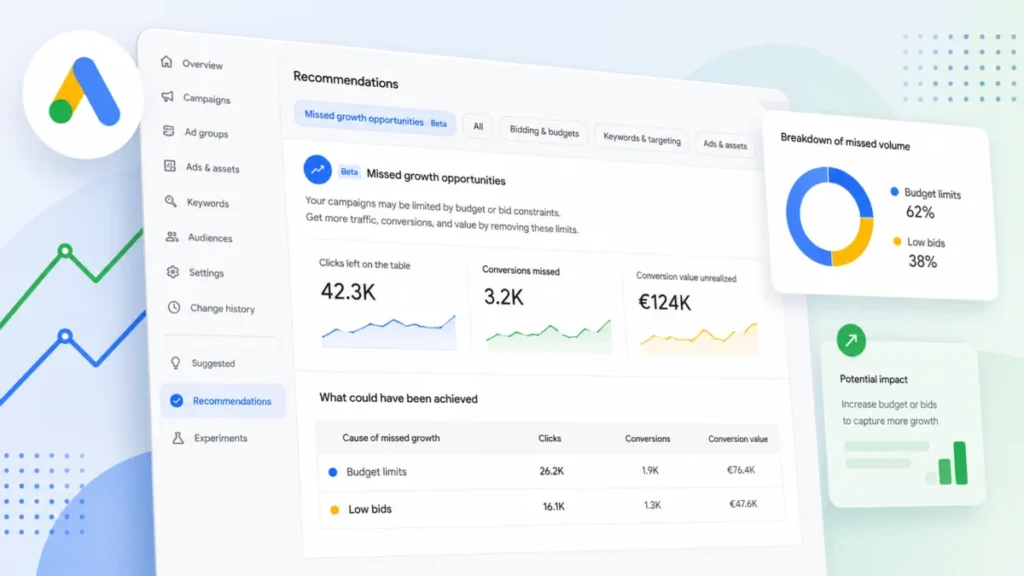

Google Ads is officially moving its "Missed Growth Opportunity" insights from its experimental Labs environment into the main Recommendations tab as a new beta feature. This strategic integration aims to provide advertisers with a significantly clearer and more accessible view of the potential traffic, conversions, and revenue they might be forfeiting due to current budget constraints or suboptimal bid strategies. The move represents a notable step in Google’s ongoing efforts to enhance the transparency and actionable intelligence available to its advertising partners, directly surfacing critical performance estimates alongside its suite of existing optimization recommendations.
The Genesis of a Critical Insight
For years, advertisers on Google Ads have grappled with the complex challenge of optimizing their campaigns to maximize return on investment (ROI). A perennial dilemma has been determining the ideal budget allocation and bid levels to capture maximum market share without overspending. Google’s platform, with its vast array of keywords, targeting options, and competitive landscapes, often makes this an intricate balancing act.
In response to this persistent need, Google Ads introduced the "Missed Growth Opportunity" tool within its Google Ads Labs. Labs serves as an incubator for experimental features, allowing Google to test new functionalities with a subset of advertisers before a wider rollout. While valuable, its placement in Labs meant that these crucial insights were not readily available or prominent for all eligible advertisers, often requiring a deliberate search to access. The insights provided a detailed breakdown of unrealized performance, attributing lost opportunities specifically to either insufficient budgets (leading to campaigns pausing prematurely or missing peak hours) or low bids (resulting in lower ad rankings and lost impression share).
What the New Beta Entails
The core functionality of the "Missed Growth Opportunity" remains consistent, but its integration into the main Recommendations tab fundamentally alters its visibility and impact. Advertisers will now encounter these estimates as part of their regular workflow when reviewing Google’s optimization suggestions. The new beta recommendation is designed to estimate the tangible impact of increasing budgets or raising bids, providing data-driven projections that highlight:
- Estimated additional conversions: The number of extra conversions that could be achieved by adjusting budgets or bids.
- Projected incremental revenue: The financial gain associated with these additional conversions, offering a direct measure of potential ROI.
- Increased impression share: The percentage of ad impressions currently being missed due to budget or bid limitations.
- Enhanced traffic volume: The potential increase in clicks and website visitors.
- Attribution of missed performance: A clear distinction between opportunities lost due to budget caps versus those lost due to competitive bidding (ad rank).
This granular breakdown empowers advertisers to make more informed decisions, prioritizing where additional investment could yield the most significant returns. Instead of abstract suggestions, the platform now aims to present quantified opportunities, tying potential spending directly to measurable outcomes.
From Labs to Mainstream: A Chronology of Optimization
The evolution of Google Ads recommendations reflects a broader industry trend towards automation and AI-driven insights. Historically, campaign optimization was largely a manual process, relying on an advertiser’s expertise, meticulous data analysis, and often, a degree of trial and error.
- Early 2000s: Google AdWords (now Google Ads) primarily offered basic reporting and manual controls. Optimization was heavily dependent on advertiser skill.
- Mid-2000s to Early 2010s: Introduction of automated bidding strategies (e.g., Target CPA, Enhanced CPC) and initial versions of optimization suggestions within the platform. These were often broad and less personalized.
- Mid-2010s: Growth of "Optimization Score" and more granular recommendations. Google began emphasizing the potential for AI and machine learning to guide advertisers. The concept of "recommendations" became a central part of the platform’s user experience.
- Late 2010s – Early 2020s: Google Ads Labs emerged as a testing ground for advanced features. Tools like "Missed Growth Opportunity" were developed here, allowing a select group of advertisers to experiment with more sophisticated insights. These early versions provided a glimpse into the future of data-driven optimization, albeit in a somewhat hidden corner of the platform.
- Current Beta Rollout: The present integration of "Missed Growth Opportunity" into the main Recommendations tab marks a significant shift. It signifies Google’s confidence in the tool’s utility and its commitment to making such advanced insights universally accessible, moving them from an experimental phase to a core platform feature for eligible users. This move is consistent with Google’s broader strategy to simplify complex ad management and empower advertisers with actionable intelligence, effectively bringing enterprise-level insights to a wider audience.
The Strategic Rationale Behind Google’s Move

Google’s decision to promote "Missed Growth Opportunity" from Labs to the main Recommendations tab is underpinned by several strategic objectives:
- Democratizing Advanced Insights: By making these insights more prominent, Google aims to democratize sophisticated optimization strategies. Smaller businesses or advertisers with less technical expertise can now benefit from data previously requiring extensive manual analysis or specialized tools.
- Driving Efficient Ad Spend: Google’s business model thrives on ad spend. By helping advertisers identify and capitalize on missed opportunities, the platform encourages more efficient allocation of budgets. When advertisers see a clear path to increased ROI, they are more likely to increase their investment, leading to higher overall ad revenue for Google. This is not merely about increasing spend, but optimizing it to deliver better results, fostering advertiser loyalty and platform stickiness.
- Enhancing Advertiser Satisfaction and Retention: A more transparent and insightful platform leads to better campaign performance, which in turn boosts advertiser satisfaction. Satisfied advertisers are more likely to continue using Google Ads, reducing churn and strengthening Google’s dominant position in the digital advertising market.
- Strengthening the Optimization Score Ecosystem: The "Optimization Score" is a key metric within Google Ads, indicating how well a campaign is set up to perform. Recommendations contribute directly to improving this score. By adding such a impactful recommendation, Google further enriches the value of its Optimization Score, providing a clearer roadmap for advertisers to enhance their campaigns.
- Responding to Competitive Pressures: The digital advertising landscape is increasingly competitive, with platforms like Meta, Amazon, and TikTok constantly innovating. By continually refining its platform with intelligent, actionable insights, Google maintains its competitive edge and ensures its offerings remain indispensable to advertisers.
Industry Context: The Evolving Landscape of Digital Advertising
The digital advertising industry has undergone a rapid transformation, characterized by increasing data volumes, algorithmic complexity, and the pervasive influence of artificial intelligence. Advertisers are no longer just managing bids and keywords; they are navigating sophisticated ecosystems where machine learning plays a crucial role in everything from audience targeting to ad delivery.
A key challenge for advertisers has always been the concept of "impression share lost." This metric, which indicates the percentage of impressions your ads are not showing for due to budget or ad rank, is a direct indicator of missed opportunities. Prior to robust tools, understanding the monetary impact of this lost impression share was often an educated guess. For instance, a campaign losing 30% impression share due to budget might seem significant, but without a projected uplift in conversions and revenue, the argument for increasing spend remains abstract.
Google’s new integration addresses this by attempting to quantify the impact. Imagine a scenario where an advertiser is spending $1,000 daily and sees a recommendation: "By increasing your daily budget to $1,200, you could gain an estimated 150 additional conversions and $1,500 in revenue per month." Such a concrete projection transforms a theoretical optimization into a clear business case, making it easier for advertisers to justify budget adjustments internally or to clients. This level of insight is becoming increasingly vital as businesses seek maximum efficiency from every marketing dollar in a challenging economic climate.
According to a 2023 report by eMarketer, global digital ad spending is projected to continue its upward trajectory, reaching over $800 billion by 2026. Within this growth, search advertising remains a cornerstone. Tools that help advertisers extract maximum value from their search ad investments are therefore critical for both Google and its partners. The ability to visualize "missed growth" directly ties into this larger economic context, ensuring that ad spend is not just allocated, but optimally invested.
Expert Perspectives and Initial Reactions
The announcement of this beta feature has garnered attention from paid media experts and the wider advertising community. PPC expert Thomas Eccel was among the first to spot the update, noting its re-emergence from Google Ads Labs. His observation underscores the continuity of the feature, highlighting Google’s commitment to refining and promoting proven tools.
Initial reactions from the advertising community are cautiously optimistic. Many view the feature as a welcome addition, providing another valuable data point for strategic planning.
"Having these insights directly within the Recommendations tab is a game-changer for visibility," stated Sarah Chen, a senior PPC manager at a digital agency. "Previously, we’d have to actively seek out these reports in Labs, but now they’re front and center. It makes the conversation with clients about budget increases much more data-driven, showing them the tangible opportunities they might be missing."
However, industry experts also emphasize a crucial caveat: these are modeled estimates, not guaranteed outcomes. "While Google’s machine learning models are incredibly sophisticated, every business is unique," advised Mark Johnson, a veteran digital marketing consultant. "Advertisers should treat these recommendations as directional insights. It’s essential to cross-reference them with their own historical performance data, business objectives, and market intelligence before making significant budget or bid adjustments. A/B testing and careful monitoring post-implementation will still be vital."

This sentiment reflects a broader understanding within the industry that while automation and AI are powerful, human oversight and strategic validation remain indispensable. The tool provides a powerful hypothesis, but the advertiser must still conduct the experiment.
The Nuances of Modeled Data: A Critical Look
The effectiveness and reliability of the "Missed Growth Opportunity" insights hinge entirely on the accuracy of Google’s underlying models. These models analyze vast datasets, including historical campaign performance, competitor bidding behavior, search query trends, and auction dynamics, to project potential outcomes. Factors influencing these projections include:
- Seasonality and Trends: The model must accurately account for seasonal fluctuations and emerging trends that impact demand and competition.
- Competitor Behavior: Dynamic changes in competitor bidding strategies can alter the landscape, potentially impacting the accuracy of long-term projections.
- Landing Page Experience and Ad Relevance: While the tool focuses on budget and bids, the ultimate conversion rate is also heavily influenced by the quality of the ad creative and the user experience on the landing page, which the model may not fully encapsulate in its "missed opportunity" calculation.
- External Factors: Unforeseen market shifts, economic downturns, or even changes in consumer behavior outside the direct purview of Google Ads can influence actual results, diverging from modeled estimates.
Therefore, while the feature offers compelling data, advertisers must maintain a degree of healthy skepticism and integrate these recommendations into a broader, holistic optimization strategy. It is a powerful assistant, not an infallible oracle. The emphasis on "beta" status also implies that Google will continue to refine these models based on real-world performance feedback, underscoring the iterative nature of such advanced features.
Broader Implications for Advertisers and the Ecosystem
The integration of "Missed Growth Opportunity" carries significant implications across the digital advertising ecosystem:
- For Individual Advertisers: This feature offers a clearer, more persuasive case for budget increases and bid adjustments, potentially leading to higher ROI for those who act prudently. It can help identify underperforming campaigns that simply need more fuel rather than a complete overhaul.
- For Digital Agencies: Agencies can leverage these insights to provide more data-backed recommendations to their clients, strengthening their value proposition. It can streamline the process of identifying and communicating growth opportunities, potentially leading to more productive client relationships and larger managed budgets.
- For Google’s Platform: The continuous enhancement of its recommendation engine reinforces Google’s position as the leading platform for search advertising. It demonstrates Google’s commitment to empowering advertisers and maintaining its competitive edge. This could also encourage advertisers to consolidate more of their ad spend on Google’s platform, given the advanced optimization tools available.
- Industry Standard-Setting: As Google introduces more sophisticated, quantified recommendations, it sets a higher bar for other ad platforms. Competitors may feel pressure to develop similar tools to help advertisers visualize and act upon missed growth opportunities, driving innovation across the industry.
- The Future of Optimization: This move further solidifies the trend towards intelligent automation in advertising. As AI models become more sophisticated, the role of the advertiser may shift increasingly from manual execution to strategic oversight, interpretation of data, and validation of AI-generated recommendations.
Conclusion: Balancing Opportunity with Prudence
The integration of "Missed Growth Opportunity" insights into the main Google Ads Recommendations tab marks a significant advancement in the platform’s ability to guide advertisers towards optimal performance. By making these critical estimates more visible and accessible, Google aims to empower businesses with the data needed to unlock untapped potential in traffic, conversions, and revenue.
For advertisers, this beta feature presents a powerful planning tool, offering a quantified view of how budget and bid constraints might be hindering growth. However, the underlying principle of due diligence remains paramount. While the allure of "missed growth" is strong, successful advertisers will approach these recommendations with a blend of enthusiasm and critical analysis, validating the modeled estimates against their unique business context and performance data. Ultimately, this new feature has the potential to become an invaluable asset for strategic decision-making, provided it is wielded with both insight and prudence.