
The rapid evolution of search engine optimization (SEO) toward Answer Engine Optimization (AEO) and generative artificial intelligence has fundamentally altered how digital marketers audit website performance. For decades, SEO professionals relied on standardized, straightforward methods to verify whether a web page resided within a search engine’s index. The most popular among these was the "site:" search operator in engines like Google and Bing, which allowed users to quickly check domain inclusion without logging into Google Search Console (GSC) or Bing Webmaster Tools (BWT).
Similarly, verifying whether specific page content had been successfully indexed—or identifying instances of duplicate content—was historically achieved by isolating a substantial snippet of meaningful text, enclosing it in quotation marks, and running a standard web search. However, as users increasingly pivot from traditional search engine result pages (SERPs) to conversational AI interfaces and large language models (LLMs) equipped with real-time web browsing capabilities, these legacy diagnostic methods are becoming obsolete.
Without direct access to robust webmaster platforms, developers and marketers face a distinct diagnostic hurdle in the AI-search era. A novel workaround, popularized by digital strategists, involves leveraging custom prompt engineering within AI chatbots to determine if a specific webpage is being actively retrieved and referenced by generative search models.
The Evolution of Search Indexing and the Rise of AI Retrieval
To understand the necessity of modern search workarounds, one must examine the shifting architectural landscape of information retrieval. Traditional search engines operate on a crawl, index, and rank paradigm. Web crawlers systematically discover pages via links, process the hypertext markup language (HTML), store the data in massive proprietary indices, and rank the pages based on hundreds of algorithmic signals.
In contrast, modern AI-driven search environments—including ChatGPT with browsing, Perplexity, and Microsoft Copilot—rely heavily on Retrieval-Augmented Generation (RAG). When a user poses a query, the AI system queries underlying indices, retrieves relevant documents or snippets, and synthesizes a novel textual response. Consequently, a page might be indexed by an underlying search index but completely ignored by an LLM due to contextual irrelevance, strict safety filters, robot exclusion directives specifically targeted at AI agents, or rendering limitations.
Industry experts note that traditional metrics are increasingly insufficient. When webmasters lack access to centralized server log files, Google Search Console, or Bing Webmaster Tools, verifying retrieval status requires a shift from passive observation to active querying.
A Step-by-Step Methodology for AI Retrieval Testing
Because major LLMs utilize real-time search APIs to fetch current web data, marketers can simulate an index verification check directly inside a chatbot interface. This process relies on exact-match string prompts designed to force the AI to search its underlying retrieval database rather than relying solely on its static parametric memory.
The auditing procedure involves the following structured steps:

- Select a Unique Content Snippet: Choose a distinct, meaningful sentence or phrase from the target web page. Avoid generic statements; select text that is unique enough to distinguish the page from similar content across the web.
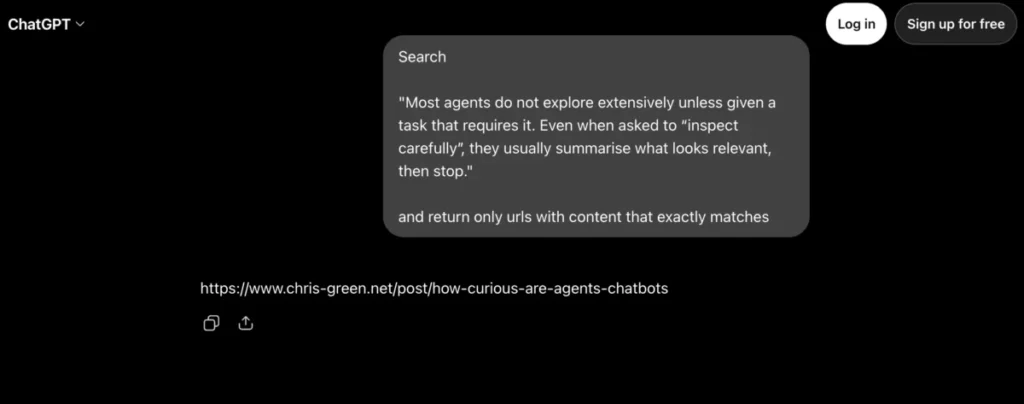
- Formulate the Exact-Match Prompt: Instruct the chatbot explicitly to look for the exact string. A reliable prompt structure reads: "Search for ‘[paste your snippet here]’ and return any results which contain that exact text only."
- Execute and Cross-Verify: Submit the prompt to a generative AI tool—such as a signed-out instance of ChatGPT—and evaluate whether the resulting output references your specific target URL.
- Account for Variability: Because modern AI models frequently route queries through diverse data sources and retrieval APIs, results can fluctuate. Analysts recommend testing the same snippet four to five times, or varying the selected text block, to ensure consistency and eliminate false negatives.
If an AI chatbot successfully retrieves and cites the URL, search professionals can reliably infer that the page has been successfully discovered, crawled, indexed, and integrated into the AI search ecosystem’s active retrieval index.
Troubleshooting Indexing Failures in Generative Search
When a web page fails to appear in AI retrieval tests, digital marketers and site administrators must initiate a comprehensive technical audit. A negative result does not automatically indicate a permanent penalty or a critical failure; rather, it highlights specific bottlenecks in the content lifecycle.
Key technical and operational elements to troubleshoot include:
- Discovery Delays: The page may be newly published, and search crawlers or AI agents simply have not yet encountered or prioritized the URL. Patience is often required as automated systems balance crawl budgets.
- Rendering and JavaScript Hurdles: If the core content is dynamically loaded via complex client-side JavaScript, AI retrieval agents may fail to execute the script properly, leaving the page functionally empty during the crawling phase.
- Directives and Blocking: Review
robots.txtfiles and meta robots tags. Many websites inadvertently block AI crawlers (such as GPTBot, ClaudeBot, or PerplexityBot) while allowing traditional search engine spiders to index the site. - Information Density and Uniqueness: If the text snippet used for testing is too generic, the AI may return alternative sources or fail to recognize the target page as a primary authority. Content that lacks distinctiveness often struggles to achieve visibility in retrieval-augmented generation models.
Workflow Automation and Browser Extensions
While manual copy-pasting of text snippets into chatbot interfaces is effective for ad-hoc audits, it can become cumbersome during large-scale enterprise SEO campaigns. To streamline this diagnostic process, developers have begun creating specialized browser tools.
For instance, open-source community developers have introduced developer-mode browser utilities—such as the GitHub-hosted "Exactly Matchy" extension—designed to accelerate exact-match retrieval testing. These tools typically automate the extraction of selected page text and format the precise prompt required for AI chatbot interaction.
However, security experts and industry veterans issue standard cautions regarding the adoption of third-party browser extensions. Because unauthorized or unverified extensions pose potential security risks akin to unvetted software downloads, digital professionals are strongly advised to inspect source code repositories thoroughly before installing developer-mode tools onto production workstations.
Broader Implications for Digital Marketing and AEO
It is crucial to distinguish between retrieval inclusion and search visibility. Confirming that an AI search engine can retrieve a specific URL is merely the first hurdle in modern Answer Engine Optimization.
If a page successfully passes AI retrieval tests but fails to drive meaningful organic traffic or secure prominent citations within AI-generated answers, the underlying issue shifts from technical indexing to content authority and comparative relevance. In the AEO landscape, simply being indexed is no longer sufficient; content must demonstrate exceptional depth, factual accuracy, clear structure, and recognized domain authority to outcompete rival sources during the LLM synthesis phase.
Ultimately, while AI-based retrieval workarounds do not completely replace comprehensive server log analysis or official webmaster dashboards, they provide a vital supplementary toolkit for modern digital strategists navigating the complex intersection of search engines and generative artificial intelligence.