

The digital landscape has long been scrutinized for its psychological toll, characterized by relentless doom-scrolling, the overwhelming intensity of global crises, and the subtle pressures of curated highlight reels. As online environments increasingly grow more harrowing, public sentiment has decisively shifted toward intervention. According to Sprout Social’s Q1 2026 Pulse Survey, an overwhelming 68% of consumers support enacting strict social media bans to protect children, with parents of young children forming the vanguard of this advocacy. In response to mounting public pressure, landmark judicial settlements, and a cascade of global legislative proposals, lawmakers and tech giants alike are fundamentally reshaping how minors access the internet. For global brands and social media marketers, this transition marks the end of the "Wild West" era of digital advertising, ushering in a highly regulated landscape that demands sophisticated compliance, age-aware content strategies, and a strategic pivot toward hybrid real-world and digital ecosystems.
The Evolution of Global Digital Regulation: A Chronological Overview
The movement to restrict youth access to social media has evolved rapidly from regional legislative debates into a coordinated international phenomenon. For years, lawmakers expressed growing concern over the addictive design features of major platforms, yet enforcement mechanisms remained largely theoretical. That paradigm shifted dramatically between 2024 and 2026, transforming how governments approach digital child safety.
The timeline of major regulatory milestones highlights this accelerated shift:
- Late 2024 to 2025: Various U.S. state legislatures began passing sweeping age-verification and parental consent laws, many of which immediately faced fierce legal challenges regarding freedom of expression and data privacy. Meanwhile, European regulatory bodies intensified investigations into algorithmic amplification for minors.
- April 2026: Turkey passed comprehensive legislation banning personal social media accounts for children under the age of 15, while introducing mandatory, strict parental controls for teens aged 15 to 17.
- June 2026: The United Arab Emirates (UAE) officially established a minimum age requirement of 15 for personal social media use, placing the strict duty of enforcement directly onto platform operators and disabling certain features for users aged 15 and 16.
- August 2026: France’s highest constitutional court struck down a previous iteration of a national youth social media ban on the grounds that it curtailed freedom of expression, though legal experts widely anticipate a revised framework. Simultaneously, countries like Australia enforced robust nationwide bans prohibiting children under 16 from maintaining personal social media profiles, setting a precedent that galvanized international policymakers.
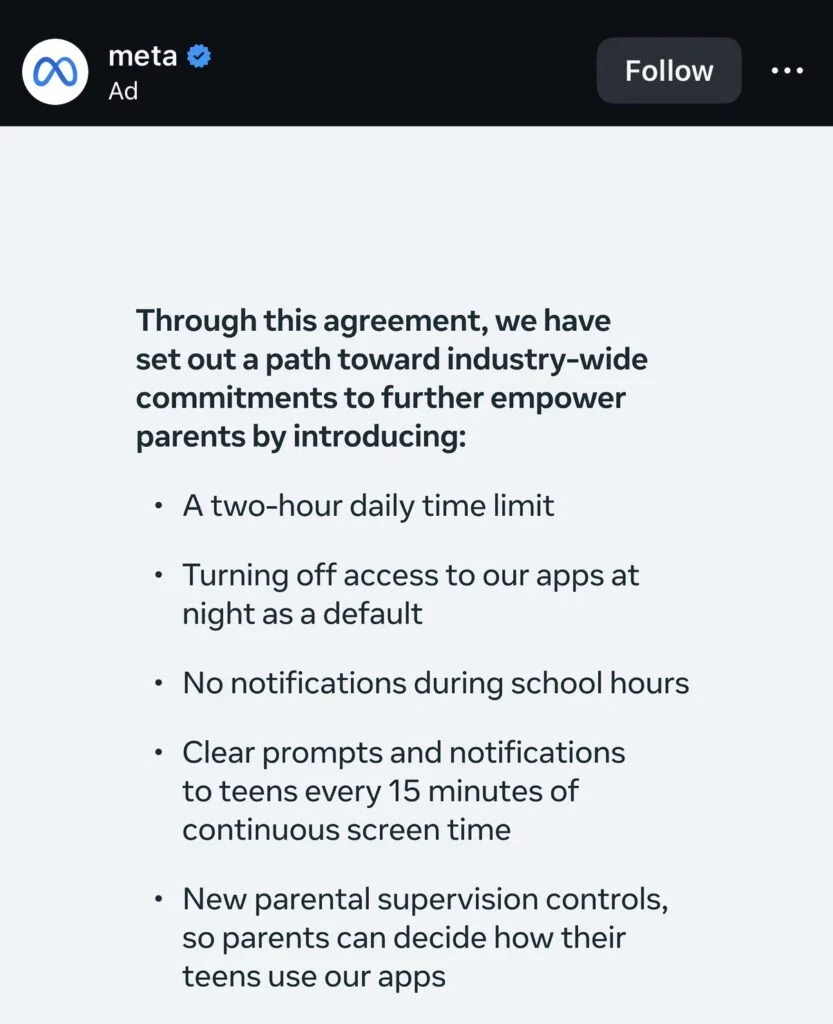
- Late 2026: Landmark judicial actions, most notably the Meta youth safety settlement, fast-tracked a series of mandatory platform safeguards across Instagram and Facebook. This settlement established that sweeping structural changes could be implemented via judicial enforcement faster than through traditional legislative channels.
Platform Self-Regulation and the Impact of the Meta Settlement
Rather than waiting for uniform federal mandates, major social networking companies have proactively updated their platform functionality to preempt total bans. Data from the Q1 2026 Sprout Pulse Survey reveals that consumers express a preference for platforms implementing practical parental consent mechanisms and robust age-verification technology over outright jurisdictional bans. Consequently, tech giants—including Meta, Snap Inc., WhatsApp, and Alphabet’s YouTube—have rolled out expanded parental controls, restricted sensitive content delivery, enforced strict daily time limits, and integrated family-friendly app ecosystems.
The legal watershed moment arrived with the Meta youth safety settlement. Under the terms of this sweeping agreement, Meta committed to enforcing severe structural restrictions across Instagram and Facebook to shield minor users. Significantly, the financial and structural terms of the settlement are tied to whether competing networks—such as TikTok, YouTube, and Snapchat—adopt parallel protective standards. This interconnected accountability has effectively established a universal industry baseline, fundamentally altering how brands can reach younger demographics regardless of the specific platform they utilize.
Regional Policy Breakdown: EMEA, APAC, and the United States
As regulatory frameworks diverge across continents, global brands must navigate a fragmented patchwork of compliance requirements.

Europe, Middle East, and Africa (EMEA)
- United Arab Emirates: Active legislation sets the minimum age at 15 for personal accounts, with restricted feature access for users aged 15–16. Enforcement is the sole responsibility of the platforms.
- Turkey: Passed legislation banning under-15 accounts and mandating strict parental controls for ages 15–17, pending full operational rollout.
- United Kingdom: Proposed regulations under the Online Safety Act target the removal of algorithmic network access for children under 16, while introducing overnight curfews and gaming platform precautions for 16- and 17-year-olds.
- Greece: Proposed legislation establishes a 15-year age floor for personal social media accounts.
- Denmark: Actively negotiating terms for a projected under-15 personal account ban, drawing inspiration from Australian models.
- France: An initial legislative ban for children under 15 was struck down by the top court for infringing on freedom of expression; however, revised bills are currently being drafted.
- European Union: The European Commission has floated a bloc-wide recommendation for all member states to implement a unified restriction for youth aged 16 and under.
Asia-Pacific (APAC)
- Australia: Fully active legislation prohibits individuals under 16 from holding personal social media accounts, placing the legal and technical burden of age verification squarely on networks.
- Indonesia: Implements a tiered structure where children under 13 may only access designated child-friendly products, users aged 13–16 require verified parental consent, and high-risk networks are restricted to those 16 and older.
- Malaysia: Actively enforces a strict registration ban preventing children under 16 from creating new social media profiles.
- New Zealand: Advanced proposals seek to bar minors under 16 from accessing platforms classified as high-risk.
United States Regulatory Models
While nearly half of U.S. states have introduced diverse age-assurance and social media restriction bills—many of which remain tied up in federal court battles—legislation generally falls into four distinct regulatory models:
- Age Restrictions and Parental Consent: Establishes hard age floors while permitting conditional access for older teens via verified parental approval.
- Feed and Design Restrictions: Eliminates algorithmic feeds and personalized recommendations for minor accounts, curbing automated engagement loops.
- Usage and Time Limits: Imposes mandatory daily caps on minor app usage across networks.
- App-Store Verification: Shifts the regulatory burden away from individual social networks and onto major gatekeepers like Apple and Google to verify ages and secure parental consent at the point of download.
Strategic Adaptation for Brands and Social Media Marketers
For marketing professionals, these legislative shifts introduce profound brand safety considerations and operational challenges. Sam Morgan-Smith, Head of Social at the UK-based public relations agency The Romans, notes that the era of blanket posting—or "throwing confetti" and blindly trusting the algorithm—has officially concluded. Brands are now forced to operate with heightened precision.
"Compliance cannot be a bolt-on; it needs to be built into the workflow," Morgan-Smith explains. This requires comprehensive governance playbooks detailing permissible content by age, region, and platform, alongside strict data protocols for user consent and age segmentation.
Similarly, Tiffany Sayers, co-founder of Australian agency Loft Social, emphasizes the necessity of rigorous operational adjustments. "If underage users are legislatively restricted or platforms are penalized for blurred lines, we’ll need more rigor in how brands brief talent, capture first-party data, and define success," says Sayers. She advocates for moving beyond platform default policies to establish robust internal frameworks, including stricter influencer vetting, comprehensive content archiving, and legal reviews for giveaways, comments, and calls-to-action.
Pivoting Toward Hybrid and Real-World Ecosystems
As organic digital reach among younger audiences contracts due to regulatory tightening, industry leaders recommend diversifying marketing investments. This includes a creative resurgence in real-world (IRL) activations—such as micro-events, experiential retail theater, peer-to-peer word-of-mouth campaigns, and university activations. Simultaneously, digital strategies are shifting toward youth-safe environments, secure instant messaging channels, and gaming platform integrations that bridge digital influence with tangible, offline brand trust.
Analytical Implications: The Maturation of Digital Media
The transition from unchecked digital expansion to strict regulatory compliance signals a profound maturation of the social media ecosystem. Observers note that this evolution mirrors the historical regulation of traditional broadcast television and advertising decades prior. While initial adjustments may reduce vanity metrics and complicate top-of-funnel audience acquisition, industry experts argue that the shift ultimately reinforces digital legitimacy.
By pivoting toward ethical governance, transparent data protocols, and age-aware content creation, brands can insulate themselves against legal noncompliance while deepening genuine consumer trust. As Tiffany Sayers concludes, social media continues to deliver robust return on investment across the marketing funnel; it simply demands smarter systems and a fundamental pivot in executive measurement—moving away from superficial metrics of popularity toward enduring brand affinity and audience resonance.