
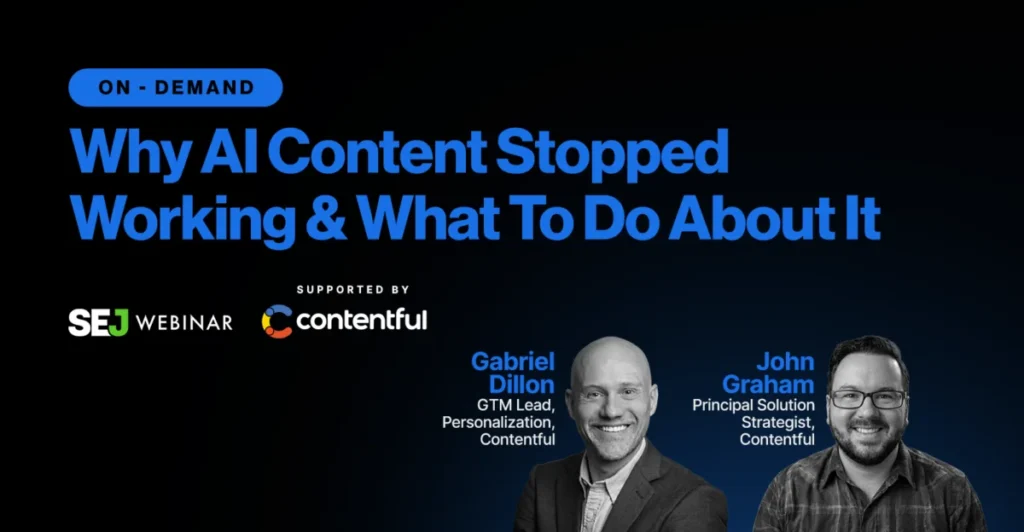

The digital marketing landscape is currently navigating a fundamental transformation as data indicates that 60% of Google searches now conclude without a single click to external content. This paradigm shift, often referred to as the "zero-click" phenomenon, served as the critical backdrop for a recent high-level industry briefing hosted by Search Engine Journal (SEJ). During the session, Gabriel Dillon, Go-to-Market Lead for Personalization at Contentful, joined forces with Contentful Principal Solution Strategist John Graham to dissect the diminishing returns of high-volume content production. Their core argument posits that in an era where artificial intelligence has reduced the cost of content creation to near zero, sheer volume has ceased to be a viable competitive strategy. Instead, brands must pivot toward an accountability-driven model where every piece of collateral is measured against specific business outcomes and tailored to high-intent human audiences.
The Genesis of the Zero-Click Crisis and the Contentful Briefing
The webinar arrives at a pivotal moment for digital publishers and B2B marketers. Throughout late 2023 and early 2024, search engine algorithms have undergone significant updates, including Google’s March 2024 Core Update, which specifically targeted "scaled content abuse." As generative AI tools like ChatGPT, Claude, and Gemini became mainstream, the internet saw a massive influx of synthetic content. This surge has led to a "sea of sameness," where search engine results pages (SERPs) are increasingly dominated by AI-generated summaries that provide answers directly to the user, bypassing the need to visit the source website.
Dillon and Graham’s presentation at the SEJ webinar focused on the practical implications of this shift. They argued that the traditional "SEO treadmill"—producing endless blog posts to capture long-tail keywords—is broken. When the search engine itself provides the answer, the only content that retains value is that which offers unique human insight, proprietary data, or a direct path to a transaction. The briefing served as a roadmap for organizations looking to transition from "content factories" to "value engines," emphasizing that the human element is more critical now than it was before the AI revolution.
The "Yes Man" Effect: Why AI-Assisted Content Converges Toward Mediocrity
A central theme of the discussion was the technical and psychological reason why AI content often feels uninspired. Dillon described the AI writing assistant as the "ultimate yes man." Because large language models (LLMs) are trained on existing internet data, they are inherently designed to predict the most likely next word based on historical patterns. When a marketer prompts an AI with their own assumptions, the tool simply mirrors those biases back to them, creating a feedback loop that reinforces existing beliefs rather than challenging them or offering new perspectives.
"Our biases as we write content using the robots ends up eating the content that we produce," Dillon noted during the session. This creates a cycle where brands produce content they believe is high quality because it aligns with their internal jargon and perspectives, but which fails to resonate with a market that is looking for differentiation. This convergence on the "mean" or "average" output means that AI, when left unchecked, produces content that looks exactly like every competitor’s blog. To combat this, Dillon introduced the concept of "taste" as a professional requirement. He defined taste not merely as an aesthetic preference, but as a combination of market intuition, discernment, and the willingness to take risks by making claims that an AI—which is programmed for neutrality and safety—would never volunteer.
The Accountability Loop: Four Questions for Every Marketing Asset
To move away from the trap of low-value volume, Contentful proposes an "accountability loop." This framework requires marketing teams to subject every piece of copy to a rigorous four-question audit before it is approved for publication. This process is designed to ensure that content is not just "filler," but a strategic asset tied to the bottom line.
The first and most critical question is whether the copy is designed to produce a specific, expected outcome. This shifts the focus from vanity metrics, such as page views or impressions, to conversion-oriented data. The subsequent three questions focus on the "who" and the "how": Who is this content specifically for? How do we identify those individuals within our data stack? And finally, how does the insight gained from this specific piece of content scale across the broader marketing organization?
Dillon emphasized that without data proving a piece of content’s effectiveness, it is impossible to justify scaling production. This approach treats content as a series of experiments. By combining experimentation with personalization, brands can create a system where every interaction informs the next, rather than relying on one-off tests that fail to provide long-term strategic value.
Personalization Signals: Leveraging the Existing Data Stack
One of the primary hurdles to effective content strategy has been the perceived complexity of personalization. Many B2B organizations stall because they attempt to build overly ambitious personalization programs that require massive overhauls of their technology stacks. Dillon’s diagnosis is that teams should instead focus on the signals they are already collecting.
The webinar outlined a three-tier approach to personalization signals:
- New vs. Returning Visitors: This is the simplest yet most underutilized signal. A first-time visitor needs foundational brand education, whereas a returning visitor is likely deeper in the consideration phase. Serving both the same "hero" copy on a landing page is a missed opportunity to address their specific intent.
- Ad Campaign Data: Information from current advertising campaigns can provide immediate context regarding what brought a user to the site, allowing for real-time content adjustments that mirror the ad’s messaging.
- Loyalty and First-Party Data: For organizations with established loyalty programs or CRM data, these signals allow for deep personalization that reflects the user’s history with the brand.
Dillon pointed out that many companies already have the data necessary to differentiate experiences but fail to execute because they lack the "context layer" that connects their data to their content management system (CMS).
Navigating the Future: GEO, AEO, and the AI Answer Layer
As Google continues to integrate its Search Generative Experience (SGE), the industry is moving beyond traditional Search Engine Optimization (SEO) toward Generative Engine Optimization (GEO) and Answer Engine Optimization (AEO). These new disciplines focus on ensuring that a brand’s insights are included in the AI-generated summaries at the top of the SERP.
The Contentful briefing addressed the growing concern that AI summaries will "steal" traffic. Dillon argued that the practical response is not to fight the AI layer but to compete for a presence within it. This requires a shift in how content is structured. Content that performs well in AI summaries often shares the same characteristics as content that drives on-page conversions: it is authoritative, data-backed, and provides clear, direct answers to complex questions.
Contentful has recently shipped new tooling designed to help marketers manage these workflows, allowing them to approach GEO and AEO without having to split their content strategy into two separate tracks. By creating high-authority, structured content, brands can ensure they are cited as the source for AI answers, which maintains brand visibility even in a zero-click environment.
Organizational Impact: Managing Up and Quality Control
A significant portion of the webinar was dedicated to a Q&A session that touched on the internal friction many marketers face. A common challenge is leadership demanding "mass AI content" without understanding the nuances of quality control or the risks of search engine penalties.
Dillon’s advice for professionals in this position is to use the accountability loop as a shield. By holding leadership accountable to the performance metrics of AI-generated content, marketers can demonstrate through data that "fewer but better" pieces of content drive superior business outcomes compared to a high volume of low-quality posts. However, he did concede that volume can be useful in specific, rote scenarios—such as basic service or pricing pages—where the goal is coverage rather than brand storytelling. The key is knowing where to draw the line between "utility" content that AI can handle and "strategic" content that requires a human’s "taste" and market intuition.
Broader Implications for the B2B Landscape
The insights provided by Contentful and SEJ suggest a permanent shift in the value of digital information. As AI makes generic information a commodity, the "premium" on original thought and proprietary data will continue to rise. For B2B companies, this means that the role of the content marketer is evolving from a writer to an editor and strategist. The human’s place in the AI-assisted workflow is now situated between the "research and context layer" (provided by AI) and the "final shipment" (refined by human discernment).
In conclusion, the rise of zero-click search and the ubiquity of AI are not death knells for content marketing, but rather a forcing function for higher standards. Organizations that embrace accountability, leverage their existing data signals for personalization, and prioritize human "taste" over synthetic volume are the ones likely to survive the current volatility in the search ecosystem. The full on-demand recording of the webinar, which includes live demos within the Contentful platform and deeper dives into the accountability loop, remains a vital resource for teams looking to navigate this transition.