
The digital marketing landscape is undergoing its most profound transformation since the dawn of search engine optimization. As consumers increasingly turn to artificial intelligence interfaces—such as ChatGPT, Google Gemini, and Perplexity—to answer their questions, businesses are scrambling to ensure their brands are cited within these conversational platforms. This emerging discipline, known as Answer Engine Optimization (AEO), commands a vast spectrum of financial commitments. For modern organizations navigating this shift, the fundamental question remains: How much does AEO actually cost?
The short answer reveals a staggering financial range. Basic self-service monitoring tools can cost as little as $30 a month, while comprehensive, full-service agency programs designed to manage every facet of a brand’s AI presence can exceed $15,000 monthly. Understanding what drives this wide pricing disparity is critical for marketing leaders tasked with allocating budgets efficiently in an evolving media ecosystem.
Main Facts and the Cost Spectrum
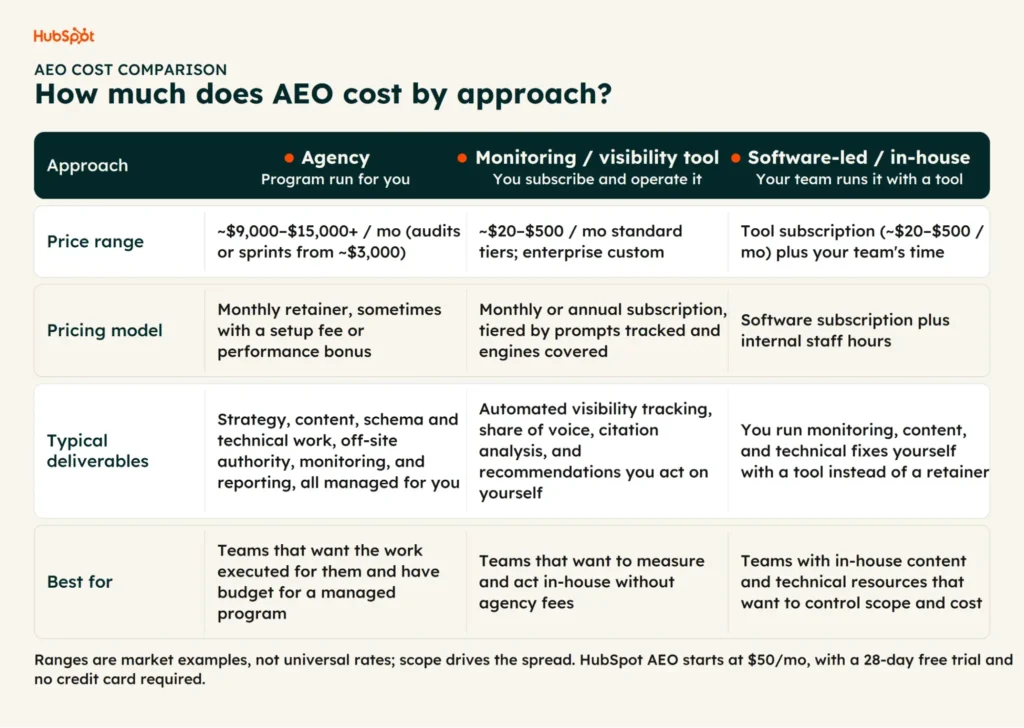
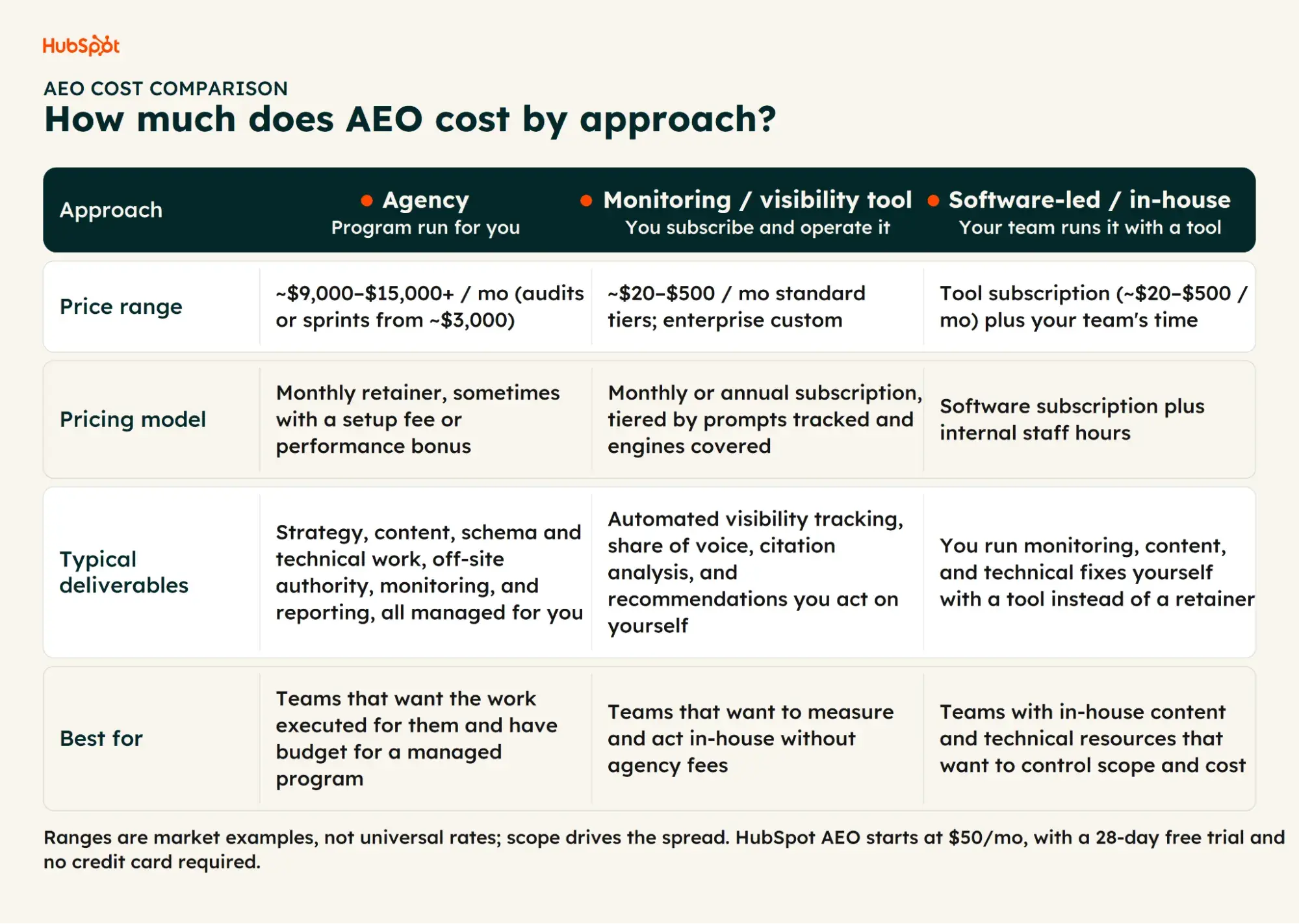
To size an AEO budget effectively, organizations must understand that pricing is directly tied to scope. The market currently divides into three distinct tiers based on the level of service and execution required:
-
Monitoring and Visibility Software: Ranging from roughly $29 to $489 per month for standard tiers, these tools track how often and in what context a brand appears in AI-generated answers. Platforms like HubSpot AEO—priced at $50 per month—and multi-engine trackers like Peec AI and Profound provide automated tracking, share-of-voice calculations, and citation analyses. These platforms are designed for teams that prefer an in-house, data-driven approach without paying agency retainers.
-
Software-Led and In-House Operations: This approach combines the cost of a monitoring subscription with the allocation of internal staff hours. Rather than hiring external consultants, internal content creators, technical webmasters, and SEO specialists execute the necessary schema updates, content restructuring, and authority-building campaigns.

-
Full-Service Agency Programs: Ranging from $3,000 for a one-time audit or short-term sprint to upwards of $15,000 a month for enterprise-level retainers, agencies take total ownership of a brand’s AI visibility. Services typically encompass advanced strategy formulation, large-scale content production, technical schema implementation, off-site authority building, and continuous performance reporting.
Background Context and the Rise of AI Search
The urgency behind AEO spending stems from a fundamental shift in user behavior. Over the past several years, search engines have evolved from lists of blue links into direct answer engines that synthesize information from across the web. While traditional SEO focuses on ranking web pages to drive click-through traffic, AEO focuses on entity recognition, brand mentions, and being cited as the authoritative source within a machine-generated response.
Industry data highlights the growing importance of this channel. According to recent studies tracking large language model (LLM) traffic growth, referral traffic originating from AI platforms roughly tripled between January and December 2025. Although AI-driven referrals still represent a modest fraction of overall web traffic—typically remaining under 2% of total referral datasets—their conversion value and influence on high-intent buyers are disproportionately high.
This behavioral shift has forced enterprises to look beyond standard keyword rankings. However, industry analysts caution against treating AEO as a replacement for SEO. Instead, the two disciplines are deeply interconnected.
Chronology and Evolution of AEO Pricing Models
As recently as 2023, optimization for AI engines was an experimental subset of technical SEO, often billed under general retainer agreements without dedicated line items. By 2024 and 2025, as conversational AI adoption exploded, specialized software tools emerged to track prompt visibility across disparate LLMs.
By 2026, the market matured into defined pricing models. Software vendors introduced metered pricing based on the volume of prompts tracked and the number of search engines covered. Simultaneously, specialized digital marketing agencies began offering standalone AEO retainers and hybrid models that couple fixed monthly fees with performance-based milestones.

During this evolution, pricing models generally fell into four distinct billing structures:
- Monthly Retainers: Common among agencies, providing predictable ongoing execution of content and technical fixes.
- Project-Based Sprints: One-time fees ranging from $3,000 to $7,000 for initial audits, foundational schema fixes, and baseline visibility reports.
- Software Subscriptions: Tiered SaaS models billed monthly or annually, based on usage metrics such as prompt volume and engine coverage.
- Hybrid Models: Retainer fees supplemented by performance metrics, tying a portion of agency compensation to measurable increases in AI brand share of voice.
Supporting Data and Budget Tiers
The financial spread in AEO is driven by five core variables: the size of an organization’s existing content library, the technical complexity of its website infrastructure, the competitive density of its industry, the volume of prompts tracked, and the degree of human labor required for content production.
When mapping these variables to budget tiers, organizations generally fall into three spending categories:
- Lean Tier (Under $100/month): Ideal for small businesses and lean marketing teams. This tier relies on standalone monitoring software—such as HubSpot AEO’s $50/month plan or similar self-service tools—to track brand mentions and competitor citations without external labor costs.
- Mid-Market Tier ($1,000 to $5,000/month): Suited for growing companies investing in light agency support or dedicating internal personnel to execute content and schema adjustments based on software recommendations.
- Enterprise Tier ($9,000 to $15,000+/month): Designed for large brands operating in highly competitive verticals, utilizing full-service agencies to handle comprehensive technical optimization, continuous content generation, and multi-engine tracking.
Official Responses and Industry Perspectives
Marketing technologists and agency executives emphasize that AEO investment must be strategically integrated with existing marketing budgets rather than treated as an isolated experiment.
Industry experts frequently warn against common pricing pitfalls in the current market. Because AEO is a relatively new category, some agencies repackage traditional SEO services as "AI optimization" while charging inflated retainers without offering genuine LLM tracking or entity-optimization strategies. Marketing leaders are advised to review statements of work carefully, ensuring deliverables specify exact metrics—such as prompt tracking volume, schema implementation, and citation analysis—rather than vague promises of "guaranteed top AI rankings."
Furthermore, search engine optimization professionals stress that cutting an established SEO budget to fund AEO can be counterproductive. Because AI answer engines frequently source their citations from pages that hold strong traditional search rankings, weakening a brand’s foundational SEO can inadvertently degrade its visibility in AI-generated responses.
Broader Impact and Implications for Marketers
The financial commitment to AEO marks a permanent expansion of corporate digital marketing budgets. As conversational interfaces become the primary gateway for consumer discovery, organizations that fail to optimize for machine comprehension risk losing visibility in critical purchase decisions.
For small and mid-sized teams, the availability of accessible monitoring tools and software integrations—such as HubSpot AEO’s inclusion within Marketing Hub Professional and Enterprise tiers, or its standalone availability with free trial options—democratizes access to AI visibility data. This allows leaner organizations to conduct low-risk, 60-to-90-day pilots for minimal out-of-pocket costs before committing to heavier operational expenditures.
Ultimately, budgeting for AEO requires a balanced approach. By establishing clear baselines, tracking core metrics like share of voice and citation frequency, and aligning AI visibility efforts with traditional search strategies, organizations can future-proof their digital presence without overspending on unproven promises.