
A groundbreaking study conducted by Growth Memo in collaboration with Semrush reveals that topical authority is not merely a conventional SEO tactic but a crucial, durable strategy for achieving visibility and dominance in the rapidly evolving landscape of AI-powered search. While some established giants like Forbes can seemingly cast a wide net across diverse topics, the vast majority of brands will find sustained success in AI search by meticulously cultivating deep expertise within their core subject areas. This insight challenges the notion that large language models (LLMs) might favor a more generalized approach, instead underscoring the enduring value of focused content strategies.
The Shifting Sands of Search: From Blue Links to AI Answers

For years, the digital marketing world has championed "topical authority" as a cornerstone of effective search engine optimization (SEO). In the era of traditional "blue link" search results, Google’s algorithms increasingly favored websites that demonstrated comprehensive expertise and trustworthiness within specific niches. This emphasis intensified with updates focusing on E-A-T (Expertise, Authoritativeness, Trustworthiness), later expanded to E-E-A-T (Experience, Expertise, Authoritativeness, Trustworthiness), pushing brands to move beyond keyword stuffing and towards becoming definitive resources for their target audiences. Companies like HubSpot and ClickUp have historically faced algorithmic demotions when their content strategies veered too far from their foundational expertise, demonstrating the significant weight search engines place on a coherent topical focus.
However, the advent of generative AI in search, spearheaded by platforms like ChatGPT, Google’s Bard/Gemini, and Microsoft’s Copilot (integrating into Google’s Search Generative Experience, SGE), introduced a new paradigm. These AI models often provide direct answers and comprehensive summaries, frequently diminishing the user’s need to click through to external websites. This shift sparked debate among SEO professionals: would AI’s ability to synthesize information from vast datasets render traditional topical authority less relevant, or would it, paradoxically, make it even more critical? The Semrush study offers a definitive answer: topical authority is more vital than ever, particularly for achieving a coveted "brand mention" in AI-generated responses.
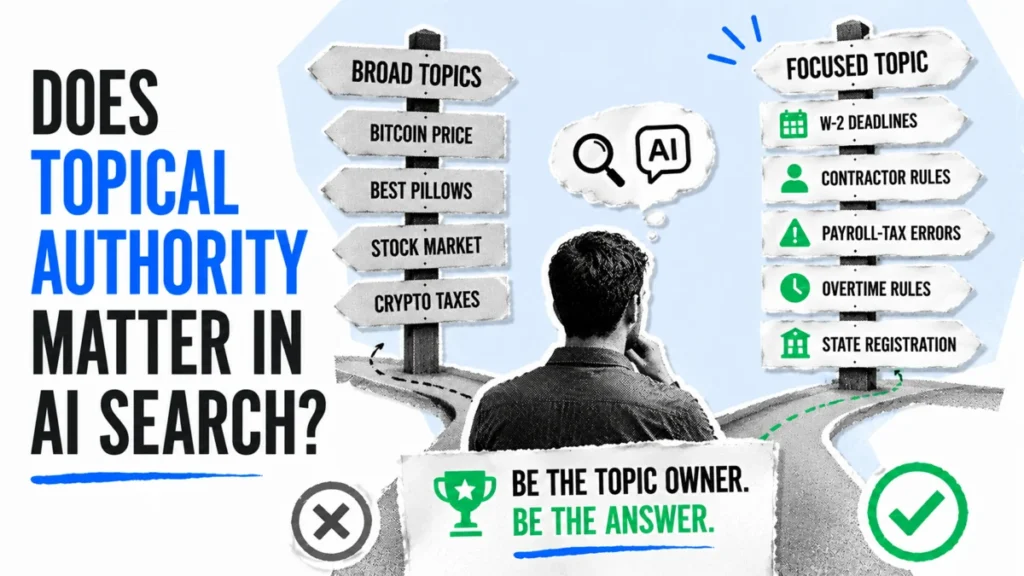
Consider a payroll software company. In the traditional search world, they might chase high-volume, broad finance terms. In the AI search environment, the strategic imperative shifts. Instead of attempting to cover every facet of finance, the topical authority approach dictates a deep dive into specific payroll-related queries: W-2 deadlines, contractor classification, common payroll-tax errors, overtime regulations, and state registration requirements. While ChatGPT might provide a direct answer to some of these, the overarching goal isn’t just immediate traffic from every glossary page. It’s about establishing the brand as the consistent, trusted source for all payroll-related questions, ultimately positioning it as the go-to answer for the crucial query: "Which payroll software should I use?" This long-term play, centered on durable authority, is the bedrock of AI search success.

Semrush Study Unveils AI Search Dynamics
To rigorously investigate the role of topical authority in AI search, the Semrush team granted Growth Memo access to an extensive dataset derived from their proprietary AI Visibility Toolkit. This comprehensive study analyzed over 1,000 categories and thousands of AI responses to prompts, offering an unprecedented look into how brand mentions and citations are distributed and retained.
The methodology involved classifying categories based on their ownership status. A "category owner" was defined as a brand that commanded an impressive 80% or more Share of Voice (SoV) in AI answers within a specific topic, maintaining at least a 5 percentage point lead over its closest competitor. Conversely, "unsettled categories" were those where no single brand met this stringent definition, indicating an open competitive field.

An important observation from the data concerned the nature of cited sources. While nearly half of the cited pages in the study proved challenging to classify due to cryptic URLs (e.g., "examplesite.gov/0982349"), the most frequently cited content types were product or service landing pages, closely followed by classic editorial content such as blog posts or articles. Intriguingly, corporate homepages were cited in only 4% of instances, suggesting that AI models prioritize specific, topic-relevant content over general brand portals. This finding reinforces the need for granular, specialized content within a broader topical strategy.
The Landscape of AI Category Ownership: An Open Field
The study’s findings paint a compelling picture of the current state of AI search, revealing a vast landscape ripe for strategic conquest. As of June 2026, a mere 15.2% of the analyzed categories exhibited a clear "owner." In stark contrast, a significant 53.7% were classified as "open fields," meaning multiple contenders vied for the top spot without any single brand achieving dominant ownership. This represents a substantial opportunity, particularly when compared to the highly saturated and competitive environment of classic Google Search, where established brands often hold entrenched positions.

Even more striking is the inverse relationship between category volume and ownership. The study defined "AI search volume" as an estimation of how many users might prompt in a given topic, acknowledging that while not perfect, it serves as a valuable proxy for demand. When analyzing categories by this metric, the researchers found that the biggest categories by volume were the least likely to have a clear owner.
To illustrate this, the 1,094 categories were split into two groups based on AI-search volume. The top group, comprising 547 categories, accounted for a staggering 98% of all volume-based AI-search demand within the sample. Yet, this high-demand group exhibited the lowest owner rate, at just 11.3%. The bottom group, with significantly less volume, had a higher owner rate of 19.0%. This critical disparity leads to a powerful conclusion: an overwhelming 89.3% of the estimated AI-search demand currently resides in categories with no clear owner. This indicates that while demand for AI-generated information is concentrated, the ownership of those answer spaces is not, presenting a significant "land grab" opportunity for agile brands.
Brand Mentions Trump Citations in AI’s Court

One of the study’s most profound revelations concerns the hierarchy of influence in AI responses. While citations are undoubtedly essential for an AI model to source its information, user behavior studies consistently show that consumers pay significantly more attention to direct brand mentions within the AI’s answer than to the often-subtle citations. In essence, a direct recommendation or mention of a brand by the AI is "AEO (Answer Engine Optimization) gold."
Previous research by Growth Memo into how consumers navigate high-stakes purchases in "AI Mode" corroborated this. In traditional search, users frequently build their own shortlists by consulting multiple sources. However, in AI Mode, this behavior dramatically shifts. Out of 147 codeable tasks, only eight resulted in genuinely self-built shortlists. A striking 64% of AI Mode participants clicked on nothing at all, instead relying solely on the AI’s synthesized text and any inline product snippets to declare their finalists. The preference for the top result was also profound: 74% of participants chose the item ranked first in the AI’s response as their top pick, with the mean rank of the final choice being a mere 1.35. Only a negligible 10% opted for something ranked third or lower. This data unequivocally demonstrates the outsized influence of a prominent brand mention in an AI response.
The study further highlighted a slightly negative correlation (-0.229) between citations and brand mentions. This means that the most-cited domain was rarely the most-mentioned (only 20.8% of the time). Conversely, a brand that was most mentioned was often cited at least once (69.9% of the time). This suggests that while citations are a prerequisite for inclusion, they do not guarantee prominent brand mentions. AI models likely evaluate a confluence of factors to determine which brands to feature directly in their answers.

Analyzing ownership across industries revealed interesting patterns. While most sectors showed clear owners, the legal industry stood out with virtually no established category owners. In contrast, the retail sector exhibited the highest owner rate, with 61.6% of its 99 analyzed categories having a clear leader. This disparity might reflect differing content landscapes, brand maturity, or the inherent complexity and trustworthiness required in various fields.
Hallmarks of an AI Category Leader
The study identified several consistent characteristics among brands that achieved category ownership in AI search. While the data allowed for correlation rather than direct causation, these traits offer valuable clues for aspiring leaders:

- More Brand Mentions: Unsurprisingly, category owners had a significantly higher share of brand mentions in AI answers compared to their runner-up competitors. This is the ultimate objective.
- More Citations: Owners also tended to have more explicit citations from the AI model, indicating a strong foundation of high-quality, relevant source material.
- More Traffic: Higher overall website traffic correlated with category ownership, suggesting that a strong existing web presence contributes to AI visibility.
- Higher Branded Search Volume: In 55.7% of owner-runner-up pairs, the category owner exhibited higher branded search volume. This indicates a pre-existing level of brand recognition and trust among users, which AI models may implicitly or explicitly factor into their responses.
These characteristics collectively form a robust working hypothesis: sustained topical authority, underpinned by a strong brand identity, consistently high-quality content, and a high-authority domain, collectively contribute to a brand earning an outsized share of mentions in AI-generated answers. It’s a holistic approach where deep expertise meets brand strength and comprehensive content coverage.
Navigating the Competitive Terrain: Opportunity for Challengers
The study also delved into the durability of category ownership and the potential for challengers to disrupt established leaders. For categories with a clear owner, retention rates were remarkably high, with first place being retained in 90.4% of month-over-month (MoM) comparisons. This indicates that once a brand establishes itself as a category owner, displacing it becomes exceedingly difficult. The investment in achieving ownership yields durable returns.

However, the picture changes significantly for categories with emerging or unsettled leaders. In these more fluid environments, leadership positions shifted much more frequently. Out of 5,470 MoM comparisons, leaders switched in 1,950 instances. Crucially, these changes were concentrated in categories where the initial lead was narrow. Leaders that were eventually dethroned typically had a median 1.3-point lead, whereas those who retained their position held a more substantial 2.9-point lead. This suggests that a lead of at least 5 percentage points creates a much more defensible position.
The study provided illustrative examples of leader changes, demonstrating how a brand might be trending upwards but still reverse course, remain flat and be overtaken, or even grow but be surpassed by a faster-growing competitor. These scenarios highlight that a brand’s internal trajectory (e.g., increasing mentions) does not guarantee safety; the competitive landscape and the margin over rivals are paramount.
While the dataset alone could not definitively explain the precise reasons for these switches (e.g., changes in AI source selection, prompt interpretation nuances, or genuine shifts in underlying brand relevance), the overarching condition for disruption is clear: categories with narrow leads are highly contestable, offering a window of opportunity for challengers. Conversely, wide, sustained ownership is significantly harder to dislodge.

Strategic Imperatives for AI Category Dominance
The findings of this Semrush and Growth Memo study offer clear, actionable imperatives for brands navigating the AI search landscape. The era of broad, superficial content creation is over; the future belongs to focused, authoritative content strategies.
- Strategic Focus over Broad Coverage: Brands must leverage the principle of topical ownership to guide their content strategy. Instead of aiming for general coverage across loosely related topics, the focus should be on building comprehensive, in-depth content within a select set of core topics where the brand genuinely seeks to be the definitive answer. This "content constraint" is not a limitation but a strategic advantage, as ownership compounds over time.
- Identify and Invest in Open Categories: With 89.3% of AI-search demand currently residing in categories without a clear owner, there is an unprecedented opportunity for brands to establish early dominance. The cost of selecting the wrong categories today is significantly lower than it will be in 12 months as the landscape matures and ownership solidifies. Brands should use tools like the AI SEO Budget Reallocation Planner to identify high-potential, unowned categories and allocate resources strategically.
- Defend Existing Leads, Challenge Weak Ones: For categories where a brand already holds a leadership position, the strategy must shift to aggressive defense to maintain that crucial 5-percentage-point margin. Simultaneously, brands should identify categories where competitors have narrow leads and launch targeted content initiatives to challenge those positions.
- Prioritize Brand Mentions: Understanding that users value brand mentions over raw citations, content strategies must be geared towards earning that direct recommendation from AI models. This means creating content that is not only highly accurate and comprehensive but also demonstrably authoritative and trustworthy, aligning with the principles of E-E-A-T.
- Long-Term Vision for Brand Equity: The study underscores that topical authority in AI search builds long-term brand equity. Becoming the consistent answer to a specific set of questions fosters trust and recognition, which can translate into significant business value beyond immediate clicks. Broad coverage may still have a role in broader marketing efforts, but it will not be the driver for establishing AI answer dominance.
In conclusion, the emergence of AI search represents a fundamental paradigm shift, but one where foundational principles of expertise and authority remain paramount. The window of opportunity to establish category ownership is currently wide open, particularly in high-demand, unowned areas. Brands that strategically choose their battles, deeply invest in core topical expertise, and prioritize earning direct AI mentions will be best positioned to thrive in this new era, cementing their status as the authoritative voice in their respective fields for years to come.