

The landscape of online discovery has undergone a profound structural transformation, altering how consumers and business professionals alike seek and secure information. For decades, the digital discovery paradigm relied on a predictable sequence: a user entered a query into a traditional search engine, reviewed a list of blue links, and navigated across multiple web properties to investigate options and compile answers. Today, that multi-step journey is increasingly bypassed in favor of direct synthesis. Millions of users now turn to conversational artificial intelligence platforms such as OpenAI’s ChatGPT, Perplexity, Google’s AI-powered search features, and Anthropic’s Claude to receive immediate, single-source answers.
This behavioral pivot represents a fundamental disruption for the global marketing and search engine optimization (SEO) industries. For years, digital marketing strategies were anchored by a singular preoccupation: securing top-tier rankings on traditional search engine results pages to drive organic inbound web traffic. In the wake of generative AI integration, that framework is obsolete. The central strategic question for modern enterprises is no longer simply whether their domain ranks on a search page, but whether artificial intelligence search tools actively recognize, cite, and recommend their brand within synthesized responses.

Understanding the Mechanics of AI Search and Market Categorization
To navigate this new era effectively, organizations must distinguish between the various software applications collectively labeled as artificial intelligence search tools. Industry analysts broadly segment these technologies into three distinct functional categories: answer engines, artificial intelligence site search tools, and answer engine optimization (AEO) platforms. Each category serves a fundamentally different user base and objective, preventing a one-size-fits-all approach to enterprise adoption.
Answer engines—exemplified by tools like ChatGPT, Google Gemini, and Perplexity—utilize natural language processing and vast training datasets or real-time web crawlers to generate comprehensive responses to open-ended human queries. Rather than offering a directory of external links, these systems interpret complex inputs and formulate a single narrative reply. While some platforms explicitly display inline citations and hyperlinks to original sources, others rely purely on internalized parametric memory.

Concurrently, artificial intelligence site search tools operate inward, deployed directly onto corporate websites, e-commerce portals, and enterprise knowledge bases. Platforms such as Algolia, Coveo, and Elasticsearch empower visitors and internal employees to query extensive product catalogs or documentation libraries using natural language conversational prompts, drastically improving internal information retrieval.
The third and fastest-growing category comprises AEO tools. Built specifically for marketing and communications teams, AEO software tracks brand visibility across external answer engines, benchmarks performance against industry competitors, and provides tactical recommendations designed to increase the frequency and favorability of brand citations in AI-generated summaries.
The Shifting Behavior of B2B and Consumer Buyers
The migration toward generative AI search is not a speculative future trend; it is the dominant mode of research for contemporary buyers. Recent empirical studies underscore the scale of this behavioral shift. Research published by Forrester indicates that an overwhelming 94 percent of business-to-business (B2B) buyers incorporated artificial intelligence into their most recent purchasing cycles. Within that cohort, 55 percent utilized AI tools specifically to compare competing vendors, 54 percent researched product specifications, and 47 percent relied on AI output to construct internal business cases—all before initiating direct contact with a vendor’s sales organization.
Consequently, AI answer engines have ascended to become the primary primary source for vendor research, frequently outpacing traditional vendor websites, direct sales outreach, and industry analyst reports. A parallel transformation is occurring in consumer markets. Data from McKinsey & Company reveals that approximately 50 percent of consumers across all demographic cohorts, including baby boomers, utilize AI-powered search when making significant purchasing decisions. Furthermore, Adobe Digital Insights reported that 56 percent of United States consumers leveraged generative artificial intelligence during recent holiday shopping seasons, representing a dramatic 45 percent year-over-year increase.
This behavioral reality introduces a phenomenon often described as the "zero-click" purchase journey. According to analytics from Bain & Company, roughly 60 percent of traditional and AI-assisted searches now conclude without the user ever clicking through to an external web property. Because buyers complete the vast majority of their evaluation phase within the confines of an AI dialogue box, brands that fail to appear in the initial generative summary are effectively invisible during the critical consideration window.

An Analysis of Leading AI Search and Analytics Platforms
As organizations adapt to this environment, the software market has expanded to offer specialized tools tailored to specific functional requirements.
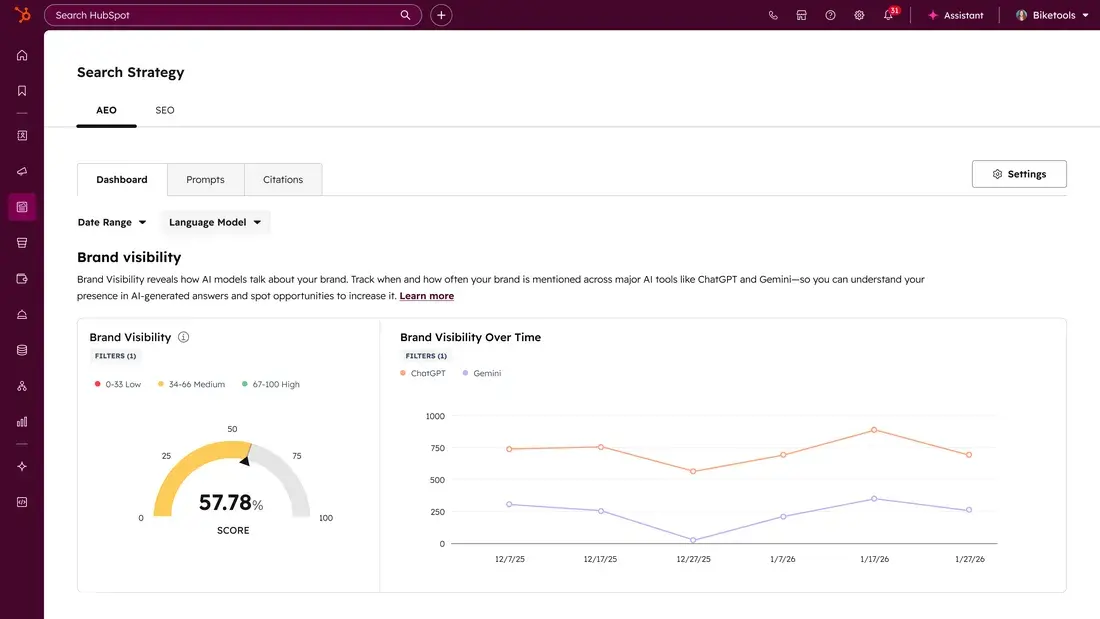
For marketing analytics and visibility tracking, platforms designed specifically for answer engine optimization have emerged as vital assets. Tools such as HubSpot AEO monitor brand representation across major ecosystems including ChatGPT, Perplexity, and Gemini. By integrating customer relationship management (CRM) data with generative search tracking, advanced AEO platforms can accurately predict the exact prompts high-intent buyers are likely to enter, grounding optimization efforts in actual customer behavior rather than generic keyword assumptions. Early adopters of specialized AEO frameworks have reported measurable gains in AI-driven referral traffic, partially offsetting broader industry declines in traditional organic search click-through rates.

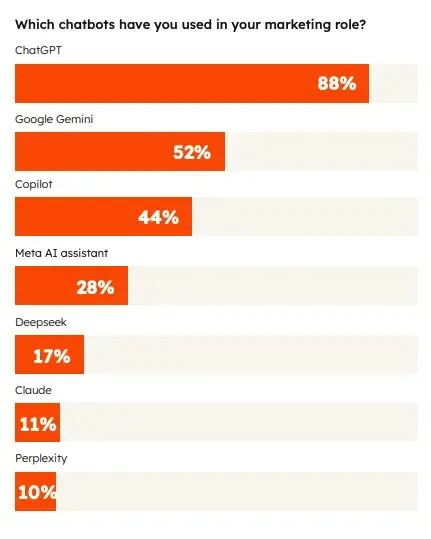
For everyday operational research, content brainstorming, and data synthesis, ChatGPT remains the most widely adopted platform among professionals. Industry surveys indicate that up to 88 percent of marketing practitioners utilize ChatGPT in their daily workflows, drawn by its versatility in handling multi-step analysis, creative drafting, and market research tasks that process billions of prompts daily.
Where verifiable sourcing and factual accuracy are paramount, Perplexity has established a strong market presence among B2B evaluators. Unlike standard conversational models, Perplexity was engineered from its inception to prioritize real-time web retrieval coupled with mandatory inline citations. Independent media and academic evaluations have consistently noted Perplexity’s lower error rates regarding source attribution, making it a preferred utility for rigorous fact-checking and competitive intelligence gathering.
Strategic Implications and the Path Forward for Enterprises
The maturation of artificial intelligence search represents a permanent structural evolution in digital commerce. For marketing executives, content strategists, and enterprise leadership, the strategic imperatives are clear. While foundational principles of digital authority—such as publishing credible, well-sourced, and expert-vetted content—remain vital, passive reliance on traditional SEO is no longer sufficient.
Organizations must implement rigorous measurement protocols to audit their brand presence across generative search platforms. Utilizing diagnostic snapshots, such as specialized AI search audits, allows companies to establish a baseline visibility score. Following this diagnostic phase, integrating dedicated AEO tracking tools enables marketing teams to systematically close visibility gaps, optimize for conversational queries, and secure authoritative citations in AI-generated responses.
Ultimately, the transition from directory-based search to synthesized answer engines rewards brands that prioritize transparency, authoritative thought leadership, and deep customer alignment. Enterprises that proactively adapt their measurement and optimization strategies to this new paradigm will secure a decisive competitive advantage, ensuring their products and services remain visible at the exact moment modern buyers seek definitive answers.